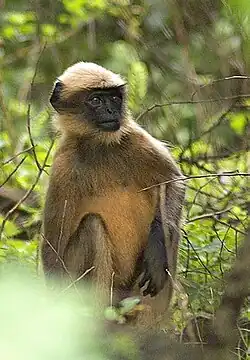
Black-footed gray langur
| Black-footed gray langur[1] | |
|---|---|
 | |
Scientific classification  | |
| Kingdom: | Animalia |
| Phylum: | Chordata |
| Class: | Mammalia |
| Infraclass: | Placentalia |
| Order: | Primates |
| Family: | Cercopithecidae |
| Genus: | Semnopithecus |
| Species: | S. hypoleucos |
| Binomial name | |
| Semnopithecus hypoleucos Blyth, 1841 | |
 | |
| Black-footed gray langur range | |
| Synonyms | |
|
Semnopithecus dussumieri | |

The black-footed gray langur (Semnopithecus hypoleucos) is an Old World monkey, one of the species of langurs. Found in southern India, this, like other gray langurs, is a leaf-eating monkey.
Taxonomy
The black-footed gray langur was previously considered to be a subspecies of Semnopithecus entellus. Research in 2003 may indicate that it is a subspecies of Semnopithecus dussumieri. Some experts believe that the species may be a naturally occurring hybrid of Semnopithecus johnii and Semnopithecus dussumieri.
Distribution
The black-footed gray langur is distributed throughout south-western India (Goa, Karnataka and Kerala), but is centred on the Western Ghats.[2] Its total range is around 35,000 km2 (14,000 sq mi), with the species living inside and outside of protected areas.
References

- ↑ Groves, C. P. (2005). Wilson, D. E.; Reeder, D. M. (eds.). Mammal Species of the World: A Taxonomic and Geographic Reference (3rd ed.). Baltimore: Johns Hopkins University Press. p. 174. ISBN 0-801-88221-4. OCLC 62265494.
- 1 2 Singh, M.; Kumara, H.N.; Kumar, A.; Nag, C. (2020). "Semnopithecus hypoleucos". IUCN Red List of Threatened Species. 2020 e.T167543916A17942313. doi:10.2305/IUCN.UK.2020-2.RLTS.T167543916A17942313.en. Retrieved 19 November 2021.
- ↑ "Appendices | CITES". cites.org. Retrieved 14 January 2022.