Canaanite and Aramaic inscriptions
| Part of a series on |
| Canaanite and Aramaic inscriptions |
|---|
 |
The Canaanite and Aramaic inscriptions, also known as Northwest Semitic inscriptions,[1] are the primary extra-Biblical sources for understanding of the societies and histories of Phoenicia, the Israelites, and the Arameans, which includes groups within the Northwest Semitic languages. Northwest Semitic contains the Aramaic and Canaanite languages; the latter groups includes Phoenician—Punic, the Ammonite language, and Hebrew.
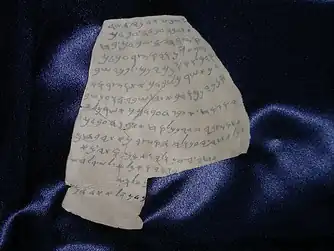
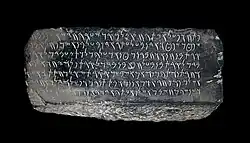
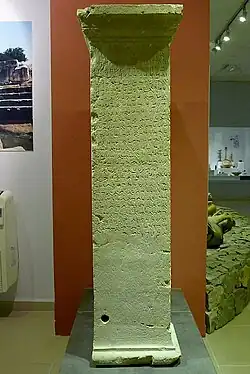
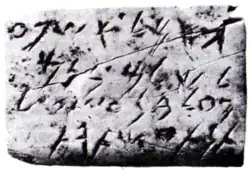
Semitic inscriptions may occur on stone slabs, ostraca, and ornaments and range from simple names to full texts.[2][3][4][5]
The oldest inscriptions form a dialect continuum that includes Canaanite languages and Aramaic, exemplified by writings which scholars have struggled to fit into either category, such as the Stele of Zakkur and the Deir Alla inscription.[6][7][8][9]
Languages


The Old Aramaic period (850–612 BC) saw increased production and dispersal of inscriptions — not because the Arameans formed a dominant empire, but because their language was increasingly adopted as a regional lingua franca. Their language was adopted as an international language of diplomacy, particularly in the late Neo-Assyrian Empire when it spread throughout the Near East—including Egypt (in administration) and Mesopotamia (where it became natively spoken).[10] The first known Aramaic inscription was the Carpentras Stele, found in southern France in 1704; it was considered to be Phoenician text at the time.[11][12]
Only 10,000 inscriptions in Phoenician-Punic, a Canaanite language, are known,[5][13] such that "Phoenician probably remains the worst transmitted and least known of all Semitic languages."[14] The only other substantial source for Phoenician-Punic are the excerpts in Poenulus, a play written by the Roman writer Plautus (see Punic language § Example for an analysis).[5] Within the corpus of inscriptions only 668 words have been attested, including 321 hapax legomena (words only attested a single time), per Wolfgang Röllig's analysis in 1983.[15] This compares to the Bible's 7,000–8,000 words and 1,500 hapax legomena, in Biblical Hebrew.[15][16] The first published Phoenician-Punic inscription was from the Cippi of Melqart, found in 1694 in Malta;[17] the first published such inscription from the Phoenician "homeland" was the Sarcophagus of Eshmunazar II published in 1855.[18][19]
Fewer than 2,000 inscriptions in Ancient Hebrew, another Canaanite language, are known, of which the vast majority comprise just a single letter or word.[20][21] The first detailed Ancient Hebrew inscription published was the Royal Steward inscription, found in 1870.[22][23]
List of notable inscriptions

Corpora
The inscriptions written in ancient Northwest Semitic script (Canaanite and Aramaic) have been catalogued into multiple corpora (i.e., lists) over the last two centuries. The primary corpora to have been produced are as follows:
| Abbreviation | Authors | Date | Title | Description |
|---|---|---|---|---|
| Ham. | Hendrik Arent Hamaker | 1828 | Miscellanea Phoenicia. | Assessed 13 inscriptions[24] |
| Ges. | Wilhelm Gesenius | 1837 | Scripturae Linguaeque Phoeniciae | Only c.80 inscriptions and 60 coins were known in the entire Phoenicio-Punic corpus[24][25] |
| Schr. | Paul Schröder | 1869 | Die phönizische Sprache. Entwurf einer Grammatik, nebst Sprach- und Schriftproben. | The first study of Phoenician grammar; listed 332 texts known at the time[24][26] |
| CIS | — | 1881–1962 | Corpus Inscriptionum Semiticarum | The first section focuses on Phoenician-Punic inscriptions (176 "Phoenician" inscriptions and 5982 "Punic" inscriptions)[2] |
| NE | Mark Lidzbarski | 1898 | Handbuch der Nordsemitischen Epigraphik | —[27] |
| KI | Mark Lidzbarski | 1907 | Kanaanäische Inschriften (moabitisch, althebräisch, phönizisch, punisch). | — |
| NSI | George Albert Cooke | 1903 | Text-book of North-Semitic Inscriptions: Moabite, Hebrew, Phoenician, Aramaic, Nabataean, Palmyrene, Jewish | —[27] |
| KAI | Herbert Donner, Wolfgang Röllig | 1960–2002 | Kanaanäische und Aramäische Inschriften | Considered the "gold standard" for the last fifty years[28] |
| TSSI | John Clark Love Gibson | 1971–1982 | Textbook of Syrian Semitic Inscriptions. | — |
| TAD | Bezalel Porten, Ada Yardeni | 1986–2000 | Textbook of Aramaic Documents from Ancient Egypt | — |
| HAE | Johannes Renz, Wolfgang Röllig | 1995 | Handbuch der althebräischen Epigraphik. | — |
| HNPI | Karel Jongeling | 2008 | Handbook of Neo-Punic Inscriptions. | — |
| WSAI | Benjamin Sass, Israel Finkelstein | 2013 | "The West Semitic Alphabetic Inscriptions, Late Bronze II to Iron IIA: Archeological Context, Distribution and Chronology". Hebrew Bible and Ancient Israel. 2 (2): 149. 2013. doi:10.1628/219222713X13757034787838. | — |
Inscriptions
The inscriptions listed below include those which are mentioned in multiple editions of the corpora above (the numbers in the concordance column cross-refer to the works above), as well as newer inscriptions which have been published since the corpora above were published (references provided individually). They are ordered chronologically by date of their modern discovery, illustrating the development of the study of ancient Semitic epigraphy.




















Bibliography
- Röllig, Wolfgang [in German] (1983). "The Phoenician Language: Remarks on the Present State of Research". Atti del I Congresso Internazionale di Studi Fenici e Punici. Vol. 2. Rome. pp. 375–385. doi:10.11588/propylaeumdok.00001074.
{{cite book}}: CS1 maint: location missing publisher (link)
See also
References
- ↑ Kanaanäische und Aramäische Inschriften. 1961.
Seit dem Erscheinen von Mark Lidzbarskis "Handbuch der Nordsemitischen Epigraphik" (1898) und G. A. Cooke's "Text-Book of North-Semitic Inscriptions" (1903) ist es bis zum gegenwärtigen Zeitpunkt nicht wieder unternommen worden, das nordwestsemitische In schriftenmaterial gesammelt und kommentiert herauszugeben, um es Forschern und Stu denten zugänglich zu machen.... Um diesem Desideratum mit Rücksicht auf die Bedürfnisse von Forschung und Lehre abzu helfen, legen wir hiermit unter dem Titel "Kanaanäische und aramäische Inschriften" (KAI) eine Auswahl aus dem gesamten Bestände der einschlägigen Texte vor
[Since the publication of Mark Lidzbarski's "Handbuch der Nordsemitischen Epigraphik" (1898) and G. A. Cooke's "Text-Book of North-Semitic Inscriptions" (1903), no attempt has been made to publish collected and annotated Northwest Semitic inscription material to make it accessible to researchers and students. To remedy this desideratum with regard to the needs of research and teaching, we hereby present a selection from the entire collection of relevant texts under the title "Canaanite and Aramaic Inscriptions" (KAI).] - 1 2 Mark Woolmer (ed.). "Phoenician: A Companion to Ancient Phoenicia". A Companion to Ancient Phoenicia, ed. Mark Woolmer: 4.
Altogether, the known Phoenician texts number nearly seven thousand. The majority of these were collected in three volumes constituting the first part of the Corpus Inscriptionum Semiticarum (CIS), begun in 1867 under the editorial direction of the famous French scholar Ernest Renan (1823–1892), continued by J.-B. Chabot and concluded in 1962 by James G. Février. The CIS corpus includes 176 "Phoenician" inscriptions and 5982 "Punic" inscriptions (see below on these labels).
- ↑ Parker, Heather Dana Davis; Rollston, Christopher A. (2019). "Teaching Epigraphy in the Digital Age". In Hamidović, David; Clivaz, Claire; Savant, Sarah Bowen (eds.). Ancient Manuscripts in Digital Culture. pp. 189–216. doi:10.1163/9789004399297_011. ISBN 978-90-04-39929-7. JSTOR 10.1163/j.ctvrxk44t.14. S2CID 182624532. p. 190:
Of course, Donner and Röllig's three-volume handbook entitled KAI has been the gold standard for five decades now
- ↑ Suder, Robert W. (1984). Hebrew Inscriptions: A Classified Bibliography. Susquehanna University Press. p. 13. ISBN 978-0-941664-01-1.
- 1 2 3 Doak, Brian R. (2019-08-26). The Oxford Handbook of the Phoenician and Punic Mediterranean. Oxford University Press. p. 223. ISBN 978-0-19-049934-1.
Most estimates place it at around ten thousand texts. Texts that are either formulaic or extremely short constitute the vast majority of the evidence.
- ↑ Kaufman, Stephen A. (1986). "The Pitfalls of Typology: On the Early History of the Alphabet". Hebrew Union College Annual. 57: 1–14. JSTOR 23507690.
- ↑ McCarter Jr., P. Kyle (1 January 1991). "The Dialect of the Deir Alla Texts". In Jacob Hoftijzer and Gerrit Van der Kooij (ed.). The Balaam Text from Deir ʻAlla Re-evaluated: Proceedings of the International Symposium Held at Leiden, 21–24 August 1989. BRILL. pp. 87–. ISBN 90-04-09317-6.
It may be appropriate to observe at this point that students of the Northwest Semitic languages seem to be becoming increasingly dissatisfied with the usefulness of the Canaanite-Aramaic distinction for categorizing features found in texts from the Persian Period and earlier. A careful reevaluation of the binary organization of the Northwest Semitic family seems now to be underway. The study of the Deir 'Alla texts is one of the principal things prompting this reevaluation, and this may be counted as one of the very positive results of our work on these texts… the evidence of the Zakkur inscription is crucial, because it shows that the breakdown is not along Aramaic-Canaanite lines. Instead, the Deir 'Alla dialect sides with Hebrew, Moabite, and the language spoken by Zakkur (the dialect of Hamath or neighboring Lu'ath) against Phoenician and the majority of Old Aramaic dialects.
- ↑ Kaufman, Stephen A. (1985). "המיון של הדיאלקטים השמיים הצפוניים-מערביים מתקופת המקרא" [The Classification of the North West Semitic Dialects of the Biblical Period and some Implications thereof]. Proceedings of the World Congress of Jewish Studies. ט: 41–57. JSTOR 23529398.
The very term "Canaanite" is meaningful only vis-a-vis something else – i.e. Aramaic, and, as we shall see, each new epigraphic discovery of the early first millennium seems to contribute further evidence that the division between Canaanite and Aramaic cannot be traced back any distance into the second millennium and that the term "Canaanite," in a linguistic as opposed to an ethnic sense, is irrelevant for the Late Bronze Age. Ugaritic is a rather peripheral member of the Late Bronze Age proto-Canaanite-Aramaic dialect continuum, a dead-end branch of NW Semitic, without known descendants. Our inability to reach a universally acceptable decision on the classification of Ugaritic is by no means due only to our less than total knowledge of the language. As witnessed by the case of the Ethiopian dialects studied by Hetzron, even when we do have access to relatively complete information, classification is by no means a certain thing. How much more so, then, in the case of dialects attached in a few short, broken inscriptions! The dialect of ancient Samal has been the parade example of such a case within the NW Semitic realm. Friedrich argued long and hard for its independent status; of late, however, a consensus seems to have developed that Samalian is Aramaic, albeit of an unusual variety. The achievement of such a consensus is due in no small part to the ongoing recognition of the dialectal diversity within Aramaic at periods much earlier than previously considered, a recognition largely due to the work of our main speaker, Prof. J.C. Greenfield. When we tum to the dialect of the language of the plaster texts from Deir 'Alla, however, scholarly agreement is much less easy to perceive. The texts were published as Aramaic, or at least Aramaic with a question mark, a classification to which other scholars have lent their support. The savants of Jerusalem, on the other hand, seem to be agreed that the language of Deir 'Alla is Canaanite – perhaps even Ammonite. Now frankly I have never been much interested in classification. My own approach has always been rather open-ended. If a new language appears in Gilead in the 8th century or so, looks somewhat like Aramaic to its North, Ammonite and Moabite to its South, and Hebrew to its West (that is to say: it looks exactly like any rational person would expect it to look like) and is clearly neither ancestor nor immediate descendant of any other known NW Semitic language that we know, why not simply say it is Gileadite and be done with it? Anyone can look at a map and see that Deir 'Alla is closer to Rabbat Ammon than it is to Damascus, Samaria or Jerusalem, but that doesn't a priori make it Ammonite. Why must we try to squeeze new evidence into cubbyholes designed on the basis of old evidence?
- ↑ Garr, W. Randall (2004). "The Dialectal Continuum of Syria-Palestine". Dialect Geography of Syria-Palestine, 1000-586 B.C.E. Eisenbrauns. pp. 205–. ISBN 978-1-57506-091-0.
- ↑ Huehnergard, John; Pat-El, Na’ama (2005). The Semitic Languages. Oxon: Routledge. p. 114. ISBN 0415057671.
- ↑ Gibson, J. C. L. (30 October 1975). Textbook of Syrian Semitic Inscriptions: II. Aramaic Inscriptions: Including Inscriptions in the Dialect of Zenjirli. OUP Oxford. p. 120. ISBN 978-0-19-813186-1.
The Carpentras stele: The famous funerary stele (CIS ii 141) was the first Syrian Semitic inscr. to become known in Europe, being discovered in the early 18 cent.; it measures 0.35 m high by 0.33m broad and is housed in a museum at Carpentras in southern France.
- ↑ Daniels, Peter T. (31 March 2020). "The Decipherment of Ancient Near Eastern Languages". In Rebecca Hasselbach-Andee (ed.). A Companion to Ancient Near Eastern Languages. John Wiley & Sons. pp. 7–8. ISBN 978-1-119-19329-6.
Barthélemy was not done. On 13 November 1761, he interpreted the inscription on the Carpentras stela (KAI 269), again going letter by letter, but the only indication he gives of how he arrived at their values is that they were similar to the other Phoenician letters that were by now well known… He includes a list of roots as realized in various languages – and also shows that Coptic, which he conjectured was the continuation of the earlier language of the hieroglyphs, shares a variety of grammatical features with the languages listed above. The name "Semitic" for those languages lay two decades in the future, and the group "Aramaic," which from the list includes Syriac, Chaldaean [Jewish Aramaic], and Palmyrene, as well as the Carpentras stela, seems to have been named only about 1810 though it was recognized somewhat earlier (Daniels 1991)
- ↑ Lehmann, Reinhard G. (2013). "Wilhelm Gesenius and the Rise of Phoenician Philology". Biblische Exegese und hebräische Lexikographie. pp. 209–266. doi:10.1515/9783110267044.209. ISBN 978-3-11-026612-2. Quote: "Nearly two hundred years later the repertory of Phoenician-Punic epigraphy counts about 10.000 inscriptions from throughout the Mediterranean and its environs."
- ↑ Röllig 1983.
- 1 2 Röllig 1983: "The Phoenician-Punic vocabulary attested to date amounts to some 668 words, some of which occur frequently. Among these are 321 hapax legomena and about 15 foreign or loan words. In comparison with Hebrew with around 7000–8000 words and 1500 hapax legomena (8), the number is remarkable."
- ↑ Ullendorff, Edward (1971). "Is Biblical Hebrew a Language?". Bulletin of the School of Oriental and African Studies, University of London. 34 (2): 241–255. doi:10.1017/S0041977X00129520. JSTOR 612690. S2CID 162745779.
- ↑ Lehmann, Reinhard G. (2013). "Wilhelm Gesenius and the Rise of Phoenician Philology" (PDF). Beihefte zur Zeitschrift für die alttestamentliche Wissenschaft. 427. Berlin/Boston: Walter de Gruyter GmbH: 210 and 257. ISBN 978-3-11-026612-2. Archived from the original (PDF) on 2016-03-04. Retrieved 2014-02-21.
Soon thereafter, at the end of the 17th century, the abovementioned Ignazio di Costanzo was the first to report a Phoenician inscription and to consciously recognize Phoenician characters proper... And just as the Melitensis prima inscription played a prominent part as the first-ever published Phoenician inscription... and remained the number-one-inscription in the Monumenta (fig. 8), it now became the specimen of authentic Phoenician script par excellence... The Melitensis prima inscription of Marsa Scirocco (Marsaxlokk) had its lasting prominence as the palaeographic benchmark for the assumed, or rather deduced "classical" Phoenician ("echtphönikische") script.
{{cite journal}}: CS1 maint: periodical has ISBN (link) - 1 2 Lehmann, Reinhard G. [in German] (2013). "Wilhelm Gesenius and the Rise of Phoenician Philology" (PDF). Beihefte zur Zeitschrift für die alttestamentliche Wissenschaft. 427. Berlin / Boston: De Gruyter: 209–266. Archived from the original (PDF) on 2016-03-04. Retrieved 2015-04-08.
Alas, all these were either late or Punic, and came from Cyprus, from the ruins of Kition, from Malta, Sardinia, Athens, and Carthage, but not yet from the Phoenician homeland. The first Phoenician text as such was found as late as 1855, the Eshmunazor sarcophagus inscription from Sidon.
- 1 2 Turner, William Wadden (1855-07-03). The Sidon Inscription. p. 259.
Its interest is greater both on this account and as being the first inscription properly so-called that has yet been found in Phoenicia proper, which had previously furnished only some coins and an inscribed gem. It is also the longest inscription hitherto discovered, that of Marseilles—which approaches it the nearest in the form of its characters, the purity of its language, and its extent — consisting of but 21 lines and fragments of lines.
- ↑ Millard, Alan (1993). "Review of Ancient Hebrew Inscriptions. Corpus and Concordance". The Journal of Theological Studies. 44 (1): 216–219. doi:10.1093/jts/44.1.216. JSTOR 23967100.
…every identifiable Hebrew inscription dated before 200 BC… First ostraca, graffiti, and marks are grouped by provenance. This section contains more than five hundred items, over half of them ink-written ostraca, individual letters, receipts, memoranda, and writing exercises. The other inscriptions are names scratched on pots, scribbles of various sorts, which include couplets on the walls of tombs near Hebron, and letters serving as fitters' marks on ivories from Samaria.... The seals and seal impressions are set in the numerical sequence of Diringer and Vattioni (100.001–100.438). The pace of discovery since F. Vattioni issued his last valuable list (Ί sigilli ebraici III', AnnaliAnnali dell'Istituto Universitario Orientate di Napoli 38 (1978), 227—54) means the last seal entered by Davies is 100.900. The actual number of Hebrew seals and impressions is less than 900 because of the omission of those identified as non-Hebrew which previous lists counted. A further reduction follows when duplicate seal impressions from different sites are combined, as cross references in the entries suggest... The Corpus ends with 'Royal Stamps' (105.001-025, the Imlk stamps), '"Judah" and "Jerusalem" Stamps and Coins' (106.001-052), 'Other Official Stamps' (107.001), 'Inscribed Weights' (108.001-056) and 'Inscribed Measures' (109.001,002).... most seals have no known provenance (they probably come from burials)... Even if the 900 seals are reduced by as much as one third, 600 seals is still a very high total for the small states of Israel and Judah, and most come from Judah. It is about double the number of seals known inscribed in Aramaic, a language written over a far wider area by officials of great empires as well as by private persons.
- ↑ Graham I. Davies; J. K. Aitken (2004). Ancient Hebrew Inscriptions: Corpus and Concordance. Cambridge University Press. p. xi. ISBN 978-0-521-82999-1.
This sequel to my Ancient Hebrew Inscriptions includes mainly inscriptions (about 750 of them) which have been published in the past ten years. The aim has been to cover all publications to the end of 2000. A relatively small number of the texts included here were published earlier but were missed in the preparation of AHI. The large number of new texts is not due, for the most part, to fresh discoveries (or, regrettably, to the publication of a number of inscriptions that were found in excavations before 1990), but to the publication of items held in private collections and museums.
- ↑ AVIGAD, N. (1953). "The Epitaph of a Royal Steward from Siloam Village". Israel Exploration Journal. 3 (3): 137–152. JSTOR 27924525.
The inscription discussed here is, in the words of its discoverer, the first 'authentic specimen of Hebrew monumental epigraphy of the period of the Kings of Judah', for it was discovered ten years before the Siloam tunnel inscription. Now, after its decipherment, we may add that it is (after the Moabite Stone and the Siloam tunnel inscription) the third longest monumental inscription in Hebrew and the first known text of a Hebrew sepulchral inscription from the pre-Exilic period.
- ↑ Clermont-Ganneau, 1899, Archaeological Researches In Palestine 1873–1874, Vol 1, p.305: "I may observe, by the way, that the discovery of these two texts was made long before that of the inscription in the tunnel, and therefore, though people in general do not seem to recognise this fact, it was the first which enabled us to behold an authentic specimen of Hebrew monumental epigraphy of the period of the Kings of Judah."
- 1 2 3 Lehmann, Reinhard G. [in German] (2013). "Wilhelm Gesenius and the Rise of Phoenician Philology" (PDF). Beihefte zur Zeitschrift für die alttestamentliche Wissenschaft. 427. Berlin / Boston: De Gruyter: 240. Archived from the original (PDF) on 2016-03-04. Retrieved 2015-04-08.
Basically, its core consists of the comprehensive edition, or re-edition of 70 Phoenician and some more non-Phoenician inscriptions... However, just to note the advances made in the nineteenth century, it is noteworthy that Gesenius' precursor Hamaker, in his Miscellanea Phoenicia of 1828, had only 13 inscriptions at his disposal. On the other hand only 30 years later the amount of Phoenician inscribed monuments had grown so enormously that Schröder in his compendium Die phönizische Sprache. Entwurf einer Grammatik nebst Sprach- und Schriftproben of 1869 could state that Gesenius knew only a quarter of the material Schröder had at hand himself.
- ↑ "Review of Wilhelm Gesenius's publications". The Foreign Quarterly Review. L. Scott. 1838. p. 245.
What is left consists of a few inscriptions and coins, found principally not where we should a priori anticipate, namely, at the chief cities themselves, but at their distant colonies... even now there are not altogether more than about eighty inscriptions and sixty coins, and those moreover scattered through the different museums of Europe.
- ↑ Röllig 1983: "This increase of textual material can be easily appreciated when one looks at the first independent grammar of Phoenician, P.SCHRODER'S Die phonizische Sprache Entuurf einer Grammatik, Halle 1869, which appeared just over 110 years ago. There on pp. 47–72 all the texts known at the time are listed — 332 of them. Today, if we look at CIS Pars I, the incompleteness of which we scarcely need mention, we find 6068 texts."
- 1 2 Bevan, A. A. (1904). "North-Semitic Inscriptions". The Journal of Theological Studies. 5 (18): 281–284. doi:10.1093/jts/os-V.18.281. JSTOR 23949814.
- ↑ Parker, Heather Dana Davis; Rollston, Christopher A. (2019). "Teaching Epigraphy in the Digital Age". In Hamidović, D.; Clivaz, C.; Savant, S. (eds.). Ancient Manuscripts in Digital Culture: Visualisation, Data Mining, Communication. Vol. 3. Alessandra Marguerat. Brill. pp. 189–216. ISBN 978-90-04-34673-4. JSTOR 10.1163/j.ctvrxk44t.14.
Of course, Donner and Röllig's three-volume handbook entitled KAI has been the gold standard for five decades now
- 1 2 3 4 5 6 7 8 9 10 11 12 13 14 15 16 17 ICO: Amadasi Guzzo, Maria Giulia (1967). Le iscrizioni fenicie e puniche delle colonie in Occidente. Studi semitici (in Italian). Istituto di studi del Vicino Oriente, Università. Retrieved 2022-10-13.
- ↑ AO 4831
- ↑ Sauter, Megan (2014-04-09). "The Tomb of Queen Helena of Adiabene". Biblical Archaeology Society. Archived from the original on 2026-02-11. Retrieved 2026-03-08.
- 1 2 Moriggi, Marco (2011). "Phoenician and Punic Inscriptions in the Museo di Antichità di Torino (Turin, Italy)". Egitto e Vicino Oriente. 34: 81–94. JSTOR 24233436.
- ↑ See Commons:Category:Euting Nabataean inscriptions from Hegra, Al-Ula
- ↑ Clermont-Ganneau, Charles Simon (1897). "Une inscription phénicienne de Tyr". Comptes rendus des séances de l'Académie des Inscriptions et Belles-Lettres. 41 (4): 347–349. doi:10.3406/crai.1897.71008.
- ↑ Twelve Arebsun steles
- Smirnow, Y.J., 1895, Arbeiten der Abteilung für klassische, byzantinische und westeuropäische Altertumskunde, Erstes Buch, 1895 = Journal de la société russe d’archéologie / Zapisky Imperatorskoe Russkoe archeologicheskoe Obshchestvo, Nlle série 8/3-4 (Petersburg), 1896, 444-446.
- Halevy, (with image)
- Clermont-Ganneau, Ch., 1898, Inscription araméenne de Cappadoce, Comptes rendus de l’Académie des inscriptions et belles-lettres : 630-640, 808-810.André Lemaire, textes araméens d’Anatolie d’époque perse, 3 octobre 2000
- Clermont-Ganneau, Ch., 1900, https://archive.org/details/RecueilDarchologieOrientaletome3/page/n71/mode/2up?view=theater Inscription araméenne de Cappadoce], Recueil d’archéologie orientale III, Paris : 59-70, spéc. 69-70.
- Lemaire, André, à paraître, Les pierres et inscriptions araméennes d’Arebsun (Cappadoce). Nouvel examen, dans S. Shaked-A. Netzer éd., Irano-Judaica IV, Jérusalem.
- Lidzbarski, M., 1900-1902, Aramäische Inschriften aus Kappadocien, Ephemeris für semitische, Epigraphik I, Giessen : 59-74, 319-326, spéc. 72-74.
- Marquart 1905
- ↑ Teixidor, Javier (1979). "L'inscription phénicienne de Tartous (RÉS 56)". Syria. 56 (1/2). Institut Francais du Proche-Orient: 145–151. doi:10.3406/syria.1979.6656. ISSN 0039-7946. JSTOR 4198182. Retrieved 2024-08-09.
- ↑ Dussaud, René, Voyage en Syrie, Oct-Nov 1896, Revue Archéologique, 30, 1897, p. 332-336
- ↑ Clermont-Ganneau, Deux statues pheniciennes à inscriptions, Recueil d'archéologie orientale, 1903, p.373-
- ↑ Lidzbarski, Ephemeris für semitische Epigraphik, II, p.165-
- ↑ Berger, Philippe (1898). "INSCRIPTION DÉDICATOIRE DES SANCTUAIRES D'ASTARTÉ ET TANIT A CARTHAGE". Revue d'Assyriologie et d'archéologie orientale. 5 (1). Presses Universitaires de France: 11–25. ISSN 0373-6032. JSTOR 23275700. Retrieved 2025-05-12.
- ↑ Delattre, Alfred-Louis (1899). "Rapport sur les fouilles de Carthage (avril-juin 1899)". Comptes rendus des séances de l'Académie des Inscriptions et Belles-Lettres (in French). 43 (5): 552–564. doi:10.3406/crai.1899.71467. ISSN 0065-0536. Archived from the original on 2025-04-29. Retrieved 2025-05-12.
- ↑ Berger, Philippe; Cagnat, René Louis Victor (1899). "L'inscription trilingue d'Henchir Alaouin". Comptes rendus des séances de l'Académie des Inscriptions et Belles-Lettres. 43 (1): 48–54. doi:10.3406/crai.1899.71329.
- ↑ Vassel, Eusèbe (1907). "Notes sur quelques stèles puniques". Comptes rendus des séances de l'Académie des Inscriptions et Belles-Lettres. 51 (5): 262–265. doi:10.3406/crai.1907.72083.
- ↑ Sola Solé, Josep M. (1951–52). "La plaquette en bronze d'Ibiza". Semitica. IV. Paris: 25 ff.
Sola Solé, Josep M. (1955). "Inscripciones fenicias en la Peninsula Ibérica". Sefarad. XV. Madrid - Barcelona: 45ff.
Littmann, Enno (1932). "Punische Inschriften aus Ibiza". Forschungen und Fortschritte: Nachrichtenblatt der Deutschen Wissenschaft und Technik (in German). 8: 179. - ↑ Schmitz, Philip C. (1994). "The Name 'Agrigentum' in a Punic Inscription (CIS I 5510.10)". Journal of Near Eastern Studies. 53 (1): 1–13. doi:10.1086/373651. JSTOR 545353. S2CID 161397507.
- ↑ Note sur l'inscription punique d'une borne limite découverte en Tunisie
- ↑ Garbini, Giovanni (1968). "Note di Epigrafia Punica – III". Rivista degli studi orientali. 43 (1). [Fabrizio Serra Editore, Sapienza – Universita di Roma]: 5–17. ISSN 0392-4866. JSTOR 41880004. Retrieved 2023-04-24.
- ↑ Honeyman, A. M. (1960). "Inscriptions from Cyprus". Journal of the Royal Asiatic Society of Great Britain and Ireland (3/4): 111–112. ISSN 0035-869X. JSTOR 25202364.
- ↑ Jacob Kaplan (1958). "The Excavation in Tell Abu Zeitun in 1957". Bulletin of the Israel Exploration Society (in Hebrew). 22 (1/2). Israel Exploration Society: 99. JSTOR 23730357.
- ↑ Dupont-Sommer, André (1961). "Une inscription araméenne inédite de Cilicie et la déesse Kubaba". Comptes rendus des séances de l'Académie des Inscriptions et Belles-Lettres (in French). 105 (1): 19–23. doi:10.3406/crai.1961.11248. ISSN 0065-0536 – via PERSEE.
- ↑ https://base-map-polytheisms.huma-num.fr/source/1660 n.1 in Garbini G., Le iscrizioni fenicie, in R. Zucca (ed.), Il tempio del Sardus Pater ad Antas, Rome, 2019, 67-86
- ↑ Solà-Solé, Josep María (1961). "La inscripción púnica Hispania". Sefarad (in Spanish). 21 (2). Instituto "Arias Montano.": 251–256.
- ↑ Amadasi, M.G. (1986). Scavi a Mozia, le iscrizioni. Collezione di studi fenici (in Italian). Consiglio nazionale delle ricerche. p. Numbers 23, 24, 31. Retrieved 2022-05-31.
- ↑ https://base-map-polytheisms.huma-num.fr/source/1611 No. 23 = KAI 296
No. 24 = KAI 297
No. 31 = KAI 298
Amadasi Guzzo M.G., Scavi a Mozia - Le iscrizioni, Rome 1986 - ↑ Bisi, A.M.; Amadasi, M.G. (1969). Grotta Regina, I.: Rapporto preliminare della Missione congiunta con la Soprintendenza alle antichità della Sicilia occidentale (in Italian). Consiglio nazionale delle ricerche. p. Number 38A. Retrieved 2022-05-31.
- ↑ KAI 288 [probably in the Cyprus museum]
- Yon, Marguerite; Sznycer, Maurice (1991). "Une inscription phénicienne royale de Kition, Chypre". Comptes rendus des séances de l'Académie des Inscriptions et Belles-Lettres (in French). 135 (4). PERSEE Program: 791–823. doi:10.3406/crai.1991.15050. ISSN 0065-0536.
- https://base-map-polytheisms.huma-num.fr/source/269
- 144 in Calvet, Y.; Salles, J.F. (1982). Kition-Bamboula: Kition dans les textes. Testimonia littéraires et épigraphiques et Corpus des inscriptions (in French). Vol. 5. Editions Recherche sur les civilisations. ISBN 978-2-86538-292-7. Retrieved 2023-09-24.
- ↑ KAI 289 https://base-map-polytheisms.huma-num.fr/source/29
- A30 (Three lines) in Guzzo, M.G.A.; Karageorghis, V. (1977). Fouilles de Kition: Inscriptions phéniciennes (in French). Vol. 3. Department of Antiquities, Cyprus. Retrieved 2023-09-24.
- 1030 in Calvet, Y.; Salles, J.F. (1982). Kition-Bamboula: Kition dans les textes. Testimonia littéraires et épigraphiques et Corpus des inscriptions (in French). Vol. 5. Editions Recherche sur les civilisations. ISBN 978-2-86538-292-7. Retrieved 2023-09-24.
- ↑ KAI 290 Three lines
- ↑ Cross, Frank Moore (1980). "Newly Found Inscriptions in Old Canaanite and Early Phoenician Scripts". Bulletin of the American Schools of Oriental Research (238): 15–17. doi:10.2307/1356511. ISSN 0003-097X. JSTOR 1356511. S2CID 222343641.
- ↑ Bourogiannis, Giorgos. The Phoenician presence in the Aegean during the Early Iron Age: Trade, settlement and cultural interaction, Rivista di Studi Fenici 46, 2018, p. 63.
- ↑ Sznycer, Maurice (1979). "L'INSCRIPTION PHÉNICIENNE DE TEKKE, PRES DE CNOSSOS". Kadmos. 18 (1). doi:10.1515/kadm.1979.18.1.89. ISSN 0022-7498.
- ↑ Bordreuil, Pierre, "Une tablette araméenne inédite de 635 av. J.-C.." Sem 23 (1973): 95–102 + pls. I-V.
- ↑ Fales, Frederick Mario, "Sulla tavoletta aramaica A.O. 25.341." AION 36 (1976): 541–47.
- ↑ Kaufman, Stephen A., "An Assyro-Aramaic egirtu ša Šulmu." Pp. 119–27 In Essays on the Ancient Near East in Memory of Jacob Joel Finkelstein. Ellis, M. de Jong, ed. Hamden, Ct.: Archon, 1977.
- ↑ Wesselius, J.W., "A Document Concerning the Sustenance of a Mother by Her Sons." AION 45 (1985): 506–8.
- ↑ Bhayro, Siam (2008). "The Aramaic 'Fugitive' Decree: A New Interpretation". Aramaic Studies. 6 (1). Brill: 1–15. doi:10.1163/147783508x371268. ISSN 1477-8351. S2CID 162356215.
- ↑ J.W. Wesselius, ‘The Aramaic Decree about Fugitives Reconsidered’, in E. Talstra (ed.), Narrative and Comment:Contributions to Discourse Grammar and Biblical Hebrew presented to Wolfgang Schneider(Amsterdam: Societas Hebraica Amstelodamensis,1995), pp.199–209(p.201)
- ↑ TelShHa 3 and TelShHa 5
- ↑ Pritchard J.B., The Tanit Inscription from Sarepta, in H.G. Niemeyer (ed.), Phönizier im Westen (Madrider Beiträge 8), Mainz am Rhein, 1982, 83-92.
Amadasi Guzzo M. G., Two Phoenician Inscriptions Carved in Ivory: Again the Ur Box and the Sarepta Plaque, Orientalia 59/1, 1990, 58-66. - ↑ "ERC MAP - View Source #13".
- ↑ Ch. Kantzia (Greek inscription) and Maurice Sznycer (Phoenician inscription), Archaiologikon Deltion, 35 (1980) [1986], p. 1-30.
- ↑ Naveh, Joseph (1982). "A Fragment of an Ancient Hebrew Inscription from the Ophel". Israel Exploration Journal. 32 (4): 195–198. ISSN 0021-2059. JSTOR 27925853.
- ↑ Sokoloff, Michael (1999). "The Old Aramaic Inscription from Bukān: A Revised Interpretation". Israel Exploration Journal. 49 (1/2): 105–115. JSTOR 27926880.
- ↑ https://base-map-polytheisms.huma-num.fr/source/2347 Lemaire A., Une inscription araméenne du VIIIe s. av. J.-C. trouvée à Bukân (Azebaïdjan Iranien), Sudia Iranica 27, 1998, 15-30.
- ↑ FALES, F. M; BACHELOT, L.; ATTARDO, E. (1996). "An Aramaic Tablet from Tell Shioukh Fawqani, Syria". An Aramaic Tablet from Tell Shioukh Fawqani, Syria. 46: 81–121. INIST 2463380.
- ↑ Tekoglu, Recai; Lemaire, André; Ipek, Ismet; Kasim Tosun, A. (2000). "La bilingue royale louvito-phénicienne de Çineköy". Comptes rendus des séances de l'Académie des Inscriptions et Belles-Lettres. 144 (3): 961–1007. doi:10.3406/crai.2000.16174. INIST 13488688.
- ↑ Yakubovich, Ilya (2015). "Phoenician and Luwian in Early Iron Age Cilicia". Anatolian Studies. 65: 35–53. doi:10.1017/S0066154615000010. JSTOR 24878375. S2CID 162771440. ProQuest 1693847338.
- ↑ Schloen, J. David; Fink, Amir S. (2009). "New Excavations at Zincirli Höyük in Turkey (Ancient Samʾal) and the Discovery of an Inscribed Mortuary Stele". Bulletin of the American Schools of Oriental Research. 356 (356): 1–13. doi:10.1086/BASOR25609345. JSTOR 25609345. S2CID 164088482.
- ↑ Aaron Demsky (2012). "An Iron Age IIA Alphabetic Writing Exercise from Khirbet Qeiyafa". Israel Exploration Journal. 62 (2). Israel Exploration Society: 186–199. JSTOR 43855624.
- ↑ Adam L. Bean (2018). "An inscribed altar from the Khirbat Ataruz Moabite sanctuary". Levant. 50 (2): 211–236. doi:10.1080/00758914.2019.1619971. S2CID 199266038.
- ↑ Yosef Garfinkel, Mitka R. Golub, Haggai Misgav, and Saar Ganor (2015). "The ʾIšbaʿal Inscription from Khirbet Qeiyafa". Bulletin of the American Schools of Oriental Research. 373 (373). The American Schools of Oriental Research: 217–233. doi:10.5615/bullamerschoorie.373.0217. JSTOR 10.5615/bullamerschoorie.373.0217. S2CID 164971133.
{{cite journal}}: CS1 maint: multiple names: authors list (link) - ↑ KAI 283, 15 legible lines, left side damaged
- ↑ KAI 284, 21 inscriptions, few words