Secondary-controlled hydraulic drive
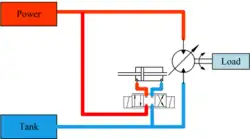
Secondary-controlled hydraulic drive is a type of hydraulic drive in which a variable-displacement hydraulic unit is connected to a pressure-controlled hydraulic network. The unit can operate as either a hydraulic motor or a hydraulic pump, allowing energy to flow in both directions.[1]
System components
The system mainly consists of a constant-pressure hydraulic power supply,[2] a secondary hydraulic unit, a check valve, a mechanical load, an electrohydraulic servo valve, a variable-displacement piston, and various safety[3] and auxiliary components.[4]
The constant-pressure hydraulic power supply provides stable hydraulic pressure and hydraulic flow for the system. The secondary hydraulic unit is the core energy-conversion component and can switch between hydraulic motor mode and hydraulic pump mode under different operating conditions.[5] The check valves control the direction of hydraulic fluid flow and prevent reverse flow.[6] The mechanical load can either be driven by the secondary unit or transmit mechanical energy back to it under certain operating conditions.[7]
The servo valve adjusts the position of the variable-displacement piston according to the control signal, thereby changing the displacement of the secondary unit and regulating its output torque, rotational speed, and operating mode. In addition, safety and auxiliary components, such as pressure relief valves, pressure sensors, filters, and accumulators, are installed to ensure stable, reliable, and safe operation of the entire hydraulic system.[8]
Operating modes

A secondary unit operates according to the four quadrant principle, corresponding to four operating modes:[9]
- First quadrant: Both the torque and rotational speed of the secondary unit are positive, and the unit operates as a hydraulic motor.
- Second quadrant: The torque is positive while the rotational speed is negative, and the unit operates as a hydraulic pump.
- Third quadrant: Both the torque and rotational speed are negative, and the unit operates as a hydraulic motor.
- Fourth quadrant: The torque is negative while the rotational speed is positive, and the unit operates as a hydraulic pump.
Applications
Secondary controlled drive is mainly used in hydraulic systems where the load changes significantly, the direction of motion changes frequently, and energy recovery is required. Common applications include excavator swing systems, crane and winch drives, active heave compensation systems on ships, and other construction and industrial hydraulic equipment.[10]

In hydraulic excavators, the upper structure repeatedly starts, accelerates, and brakes during swing operation. Because a secondary unit can operate in all four quadrants, it can switch between motor mode and pump mode according to the operating condition. During starting and acceleration, it converts hydraulic energy into mechanical energy to drive the swing platform. During braking, it converts part of the rotational kinetic energy back into hydraulic energy, which can be returned to the constant-pressure hydraulic supply or stored in an accumulator. This helps reduce energy losses.[11]

In crane and winch systems, secondary controlled drive can be used to control the lifting, lowering, and braking of heavy loads. When a load is lifted, the secondary unit operates as a motor and drives the winch drum. When the load is lowered, the gravitational potential energy of the load drives the secondary unit, causing it to operate as a pump. Part of this energy can then be recovered and returned to the hydraulic system.[12]
Secondary controlled drive can also be used in active heave compensation systems on ships. These systems control the winding and unwinding of a winch cable according to the vertical motion of the vessel, helping to reduce the movement of a suspended load. Since the secondary unit can switch between forward rotation, reverse rotation, driving, and braking, it can adapt to the changing motion conditions of offshore operations and recover part of the energy generated during repeated movement.[13]
In general, secondary controlled drive offers relatively fast response, a wide speed-control range, four-quadrant operation, and the ability to recover load energy. It is therefore suitable for hydraulic systems involving periodic motion, frequent starting and stopping, and large inertial loads.[14]
Advantages and limitations
One of the main advantages of secondary controlled drive is that it can work under changing loads, changing directions of motion, and operating conditions that switch frequently. Compared with a conventional fixed-displacement hydraulic system, a secondary unit can change its displacement according to the load and control requirements. A smaller displacement can be used for a light load, while a larger displacement can be used for a heavy load. This allows the output torque and speed to better match the actual operating conditions and helps reduce unnecessary energy losses.[15]
A secondary unit can also switch between pump mode and motor mode. When the system needs to drive a load, the unit usually operates as a motor and converts hydraulic energy into mechanical energy. When the load drives the unit, or when the system is braking, the unit can switch to pump mode and convert mechanical energy back into hydraulic energy. If the system includes an accumulator, this recovered hydraulic energy can be stored and reused later.[16]
The main disadvantage of secondary controlled drive is that the system and its control method are relatively complex. The displacement of the secondary unit must be adjusted continuously according to changes in load, speed, and pressure. The unit must also switch smoothly between pump and motor modes. When the displacement is close to zero, or when the operating mode changes, the output torque and the direction of oil flow may change. This can lead to unstable operation near the zero-displacement point, pressure fluctuations, or reduced control accuracy. For this reason, secondary controlled drives usually require reliable sensors, suitable control methods, and additional measures to improve system stability.[17]
See also
References
- ↑ Wang, Zhenyu; Liu, Xiaochao; Mou, Quanrun; Qiu, Zhongyi; Nie, Rui; Jiao, Zongxia (May 2025). "Extended-state-observer-based pressure compensation anti-disturbance control method for hydraulic secondary regulation system". Nonlinear Dynamics. 113 (9): 9931–9948. Bibcode:2025NonDy.113.9931W. doi:10.1007/s11071-024-10622-x.
- ↑ Berg, H.; Ivantysynova, M. (1999). "Design and testing of a robust linear controller for secondary controlled hydraulic drive". Proceedings of the Institution of Mechanical Engineers, Part I: Journal of Systems and Control Engineering. 213 (5): 375–386. doi:10.1243/0959651991540223.
- ↑ Fan, Qingkai; Zhang, Juxin; Li, Ruichuan; Fan, Tongxian (24 January 2025). "Review of Research on Hydrostatic Transmission Systems and Control Strategies". Processes. 13 (2): 317. doi:10.3390/pr13020317.
- ↑ Yao, Jianyong; Jiao, Zongxia; Ma, Dawei (2014-11-01). "Extended-State-Observer-Based Output Feedback Nonlinear Robust Control of Hydraulic Systems With Backstepping". IEEE Transactions on Industrial Electronics. 61 (11): 6285–6293. Bibcode:2014ITIE...61.6285Y. doi:10.1109/TIE.2014.2304912.
- ↑ Kim, C.-S.; Lee, C.-O. (November 1996). "Speed control of an overcentered variable-displacement hydraulic motor with a load-torque observer". Control Engineering Practice. 4 (11): 1563–1570. doi:10.1016/0967-0661(96)00170-0.
- ↑ Wu, Jinbo; Yang, Zeyu; Wu, Donglai (December 2018). "Impedance control of secondary regulated hydraulic crane in the water entry phase". Ocean Engineering. 169: 134–143. Bibcode:2018OcEng.169..134W. doi:10.1016/j.oceaneng.2018.09.025.
- ↑ Yao, Jianyong; Deng, Wenxiang (2017-10-01). "Active Disturbance Rejection Adaptive Control of Hydraulic Servo Systems". IEEE Transactions on Industrial Electronics. 64 (10): 8023–8032. Bibcode:2017ITIE...64.8023Y. doi:10.1109/TIE.2017.2694382.
- ↑ Ho, Triet Hung; Ahn, Kyoung Kwan (March 2012). "Design and control of a closed-loop hydraulic energy-regenerative system". Automation in Construction. 22: 444–458. doi:10.1016/j.autcon.2011.11.004.
- ↑ Wang, Z.; Liu, X.; Qiu, Z.; Jiao, Z. (20 September 2022). "Research on the flow characteristics of the secondary regulation aircraft weapon bay door drive system with accumulator". IET Conference Proceedings. 2022 (7): 1334–1338. doi:10.1049/icp.2022.1867.
- ↑ Wang, Zhenyu; Liu, Xiaochao; Qiu, Zhongyi; Nie, Rui; Chen, Xinghua; Jiao, Zongxia (2025). "Displacement Control Method of Hydraulic Servomotor Based on Swashplate Moment Disturbance Compensation". IEEE Transactions on Automation Science and Engineering. 22: 18570–18579. Bibcode:2025ITASE..2218570W. doi:10.1109/TASE.2025.3586067.
- ↑ Do, Hoang Thinh; Ahn, Kyoung Kwan (March 2013). "Velocity control of a secondary controlled closed-loop hydrostatic transmission system using an adaptive fuzzy sliding mode controller". Journal of Mechanical Science and Technology. 27 (3): 875–884. doi:10.1007/s12206-012-1237-2.
- ↑ Ren, Haoling; Wu, Shiyi; Lin, Tianliang; Zhang, Yonghua; Miao, Cheng; Li, Zhongshen (28 November 2022). "Energy Saving Characteristics of a Winch System Driven by a Four-Quadrant Hydraulic Pump". Machines. 10 (12): 1126. doi:10.3390/machines10121126.
- ↑ Li, Shizhen; Wu, Qinfeng; Liu, Yufeng; Qiao, Longfei; Guo, Zimeng; Yan, Fei (17 February 2024). "Research on Three-Closed-Loop ADRC Position Compensation Strategy Based on Winch-Type Heave Compensation System with a Secondary Component". Journal of Marine Science and Engineering. 12 (2): 346. Bibcode:2024JMSE...12..346L. doi:10.3390/jmse12020346.
- ↑ Li, Wanguo; Fu, Yongling; Chen, Juan; Qi, Xiaoye (May 2015). "Variants of secondary control with power recovery for loading hydraulic driving device". Chinese Journal of Mechanical Engineering. 28 (3): 618–633. Bibcode:2015ChJME..28..618L. doi:10.3901/CJME.2015.0408.038.
- ↑ Liu, Xiaochao; Wang, Zhenyu; Qiu, Zhongyi; Jiao, Zongxia; Chen, Xinghua; Nie, Rui (January 2025). "Cascade control method for hydraulic secondary regulation drive system based on adaptive robust control". ISA Transactions. 156: 479–489. doi:10.1016/j.isatra.2024.11.041. PMID 39638671.
- ↑ Mou, Quanrun; Liu, Xiaochao; Wang, Zhenyu; Qiu, Zhongyi; Qiao, Weizhi; Yao, Jing; Zhang, Pengyuan; Jiao, Zongxia (March 2026). "Energy efficiency mapping-based dual-loop anti-disturbance control for active load-sensitive drive system". Chinese Journal of Aeronautics. 39 (3) 103671. Bibcode:2026ChJAn..3903671M. doi:10.1016/j.cja.2025.103671. hdl:2031/f90bcdd6-c64b-4631-92bb-1c3531e1ef12.
- ↑ Mou, Quanrun; Liu, Xiaochao; Wang, Zhenyu; Qiu, Zhongyi; Li, Juefei; Jiao, Zongxia (January 2025). "Research of the characteristics of the active load-sensitive drive system". IET Conference Proceedings. 2024 (13): 1148–1152. doi:10.1049/icp.2024.3046.