Second Battle of Bedriacum
| Second Battle of Bedriacum | |||||||
|---|---|---|---|---|---|---|---|
| Part of the Year of the Four Emperors | |||||||
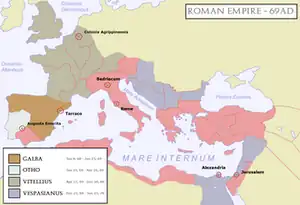 The Roman Empire, AD 69. | |||||||
| |||||||
| Belligerents | |||||||
| Supporters of Vespasian | Supporters of Vitellius | ||||||
| Commanders and leaders | |||||||
| Marcus Antonius Primus |
Aulus Vitellius Aulus Caecina Alienus (deposed) Fabius Fabullus | ||||||
| Units involved | |||||||
|
Legio III Gallica Legio VIII Augusta Legio VII Claudia Legio VII Galbiana Legio XIII Gemina |
Legio XXI Rapax Legio V Alaudae Legio I Italica Legio XXII Primigenia Legio IV Macedonica | ||||||
| Strength | |||||||
| 5 legions | 5 legions | ||||||
| Casualties and losses | |||||||
| c. 15,000 | c. 38,000 | ||||||
The Second Battle of Bedriacum, also known as the Second Battle of Cremona, was a decisive engagement fought on 24–25 October AD 69 during the Year of the Four Emperors. Two armies of Roman legions, one supporting the emperor Vitellius and the other supporting his Flavian rival Vespasian, clashed near the village of Bedriacum (modern Calvatone in Italy), about 35 km from Cremona in what is now Lombardy. The actual fighting took place between Bedriacum and Cremona, and the battle is therefore sometimes also called the Second Battle of Cremona.[1]
The Flavian victory destroyed the Vitellian field army and opened the road to Rome. Within two months Vitellius had been killed and Vespasian had become undisputed emperor, ending the civil wars of 69.
Background
After the defeat of Otho at the First Battle of Bedriacum in April 69, the eastern provinces of Judaea and Syria proclaimed Vespasian emperor. Vespasian had been entrusted with the command in Judaea by Nero in 67, with the task of suppressing the Jewish revolt. He also gained the support of the governor of Syria, Gaius Licinius Mucianus, and dispatched a strong force drawn from the Judaean and Syrian legions under Mucianus's command to march on Rome, while Vespasian himself went to Egypt to secure control of the grain supply to Rome.[2]
Before the eastern legions could reach Rome, the Danube frontier legions of Raetia and Moesia also acclaimed Vespasian. Three of them, Legio III Gallica, Legio VIII Augusta and Legio VII Claudia, had been on the march to support Otho when they heard of his defeat; they had been forced to swear allegiance to Vitellius, but on hearing of Vespasian's bid for power they at once transferred their support to him. They persuaded two other legions to join them, Legio VII Galbiana and Legio XIII Gemina. In the case of the Thirteenth the decision was easy, since as one of the legions defeated at the first Bedriacum it had been set to building amphitheatres for Aulus Caecina Alienus and Fabius Valens, Vitellius's commanders at that battle, as a punishment.[3]
Led by the commander of the VII Galbiana, Marcus Antonius Primus, the rebel legions marched on Rome and, having a much shorter distance to cover, reached Italy before Mucianus's troops.[1]
When Vitellius learned of Marcus Antonius's approach, he dispatched Caecina at the head of a powerful army composed of XXI Rapax, V Alaudae, I Italica and XXII Primigenia, together with vexillationes from seven other legions and auxiliary forces.[4] The first of Antonius's legions had arrived at Verona and although Caecina was urged to attack before the rest of the Flavian army could come up—Fabius Valens having been detained at Rome by illness—he refused to do so. Caecina was in fact plotting with Lucilius Bassus, commander of the Classis Ravennas, the Roman fleet at Ravenna, to bring it over to Vespasian's cause. Caecina's own troops refused to follow Bassus and arrested Caecina;[5] they elected as their leaders the legate of the V Legion, Fabius Fabullus, and the camp prefect (praefectus castrorum) Cassius Longus.[4]
Battle

Caecina's army, now without its general, continued its advance on Cremona. Antonius, who was at Bedriacum, advanced toward Cremona at the head of a force of cavalry (equites) and on 24 October encountered the vanguard of the Vitellian army on the road, leading to a skirmish. After sending word back to Bedriacum to summon the legions, Antonius had the better of the engagement and drove the Vitellian troops back into their camp at Cremona.[1]
Antonius's forces then advanced along the Via Postumia toward Cremona. They found themselves in front of the now-powerful Vitellian army, which had been reinforced by further legions including Legio IV Macedonica, but which was still without a commander, as Valens had not yet arrived. By now night had fallen, and the battle continued in the dark. The VII Galbiana, Antonius's own legion, suffered heavy losses, and lost its eagle for a time; one of its centurions later sacrificed his life to recover it. Eventually Antonius's troops began to gain the upper hand, and the turning point came when day broke.[6]
Antonius's Legio III Gallica, which had served for many years in Syria, had adopted a local custom of saluting the rising sun. As the sun rose the men of the legion turned to the east and cheered it. This was misinterpreted by the Vitellian forces, who concluded that they were greeting reinforcements coming from the east and were demoralised. The Vitellian camp, to which their forces had retreated, was taken by Antonius, who then attacked Cremona. The city surrendered but was nevertheless sacked and burned by the victorious troops over four days.[7]
Aftermath
Antonius continued his march on Rome, where Vitellius, finding himself unable to hold power, sought to abdicate. He was nevertheless taken prisoner and executed in Rome on 22 December AD 69. The road was now clear for Vespasian to assume the throne, an event that brought the bloody crisis of 69 to an end.[8]
See also
References
Bibliography
- Tacitus. Histories.
- Josephus, Flavius. The Jewish War.
- Dupuy, Richard Ernest; Dupuy, Trevor N. (1986). The Encyclopedia of Military History: From 3500 B.C. to the Present (2nd revised ed.). Harper & Row. pp. 127–128.
- Greenhalgh, P. A. L. (1975). The Year of the Four Emperors. Weidenfeld and Nicolson.
- Grant, Michael (1975). The Twelve Caesars. Weidenfeld and Nicolson.
- Wellesley, Kenneth (2000). The Year of the Four Emperors (3rd ed.). Routledge.