Seaweed cultivator
A seaweed cultivator is a device used to grow and harvest seaweed biomass, usually in weekly or bi-weekly cycles.[1] It remains distinct from manual seaweed cultivation using large nets in open waters, mainly in Asia.
The devices are slowly becoming available to the public, mainly because the implementation of LED has made waterproof illumination low-cost and reliable.[2]
Currently, chlorophyta are the most practical species for cultivation using this device due to their high tolerance to temperature, salinity, and light intensity.[3] Species such as sea lettuce can be grown at room temperature,[4] whereas others such as nori require more complex control of the water temperature and other variables, making them harder to cultivate at scale.[5]
Background
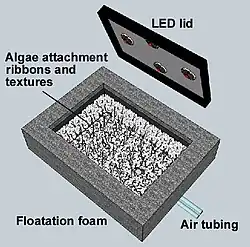
Seaweed cultivators have been developing in recent years in response to demands for seaweed in food, medicine, and biofuels. They emerged as an adaptation of the algae scrubber, invented in the 1970s by Smithsonian scientist Dr. Walter Adey.[6] The algae scrubber was initially designed to remove harmful, excess nutrients from aquariums, and use them to stimulate biomass growth.[6]
The seaweed cultivator adapts this technology to maximize biomass production. By replacing an aquarium with a reservoir of fertilized seawater, a stand-alone cultivator becomes a sound mechanism for seaweed production.[7]
Applications
In addition to a growing demand for traditional uses of seaweed across disciplines, seaweed aquaculture has been proposed as a mechanism for long-term carbon sequestration.[8]
Through a rapid photosynthetic process, seaweed can convert anthropogenic carbon into biomass. In addition to the biomass that sinks naturally into seabeds, intentional sinking of farmed seaweed below 2,000 meters serves as a longer-lasting method of sequestration.[9]
Scaling carbon dioxide removal is an urgent next step to limit global warming to 1.5º C, a key goal set by the 2015 Paris Agreement.[10] There is a necessity for reaching net-zero emissions, which is impossible without extracting existing CO2 from the atmosphere.
While this work began in Asia, interest has spread to Europe, where the EU has a goal of producing eight million tons of seaweed by 2030.[11] Seaweed has been widely recognized as a mechanism to help the EU meet climate targets, but sources agree that it must work in tandem with existing industries to scale profitably and effectively. [10]
See also
References
- ↑ Zhang, Lizhu; Liao, Wei; Huang, Yajun; Wen, Yuxi; Chu, Yaoyao; Zhao, Chao (2022). "Global seaweed farming and processing in the past 20 years". Food Production, Processing and Nutrition. 4 (23). doi:10.1186/s43014-022-00103-2.
- ↑ Schmitz, Tonia Annick; Kraft, Eckhard (2022-02-01). "Pilot scale photobioreactor system for land-based macroalgae cultivation". Journal of Applied Phycology. 34 (1): 507–516. doi:10.1007/s10811-021-02617-7. ISSN 1573-5176.
- ↑ Moreira, Anthony; Cruz, Sónia; Marques, Rúben; Cartaxana, Paulo (20 June 2021). "The underexplored potential of green macroalgae in aquaculture". Reviews in Aquaculture. 14 (1): 5–26. doi:10.1111/raq.12580. hdl:10773/42234. ISSN 1753-5123.
- ↑ Chamily, Farjana Akter; Mohiuddin, Md; Mostakim, Mohammad Shakline; Rahman, Md Moshiur; Souhardya, Sazeed Mehrab; Nahiduzzaman, Md; Khan, Md Sadequr Rahman; Asaduzzaman, Md (2025-01-15). "Production performance and biochemical profile of sea lettuce (Ulva lactuca): Influence of site-specific ecological factors and cultivation strategies". Aquaculture. 594 741436. doi:10.1016/j.aquaculture.2024.741436. ISSN 0044-8486.
- ↑ "Pyropia - an overview | ScienceDirect Topics". www.sciencedirect.com. Retrieved 2026-04-10.
- 1 2 "The Complete Guide to Algae Turf Scrubbers: Part 1". www.bulkreefsupply.com. Retrieved 2026-04-10.
- ↑ "Seaweed Aquaculture | California Sea Grant". caseagrant.ucsd.edu. Retrieved 2026-04-10.
- ↑ Thomsen, Marianne; Bruhn, Annette; Kotta, Jonne; Buck, Bela H.; Hall, Jack R.; Martin, Georg; Agüera, Antonio; Maar, Marie; Chakraborty, Manali; Ekoule, Maxime; Overton, Ian; Budhathoki, Mausam (2026-02-01). "Advancing a restorative blue Economy: A DPSIR–Ecosystem services framework for sustainable seaweed aquaculture". Ecosystem Services. 77 101800. doi:10.1016/j.ecoser.2025.101800. ISSN 2212-0416.
- ↑ Fakhraee, Mojtaba; Planavsky, Noah J. (2026-01-08). "Seaweed farms enhance alkalinity production and carbon capture". Communications Sustainability. 1 (1): 1. doi:10.1038/s44458-025-00004-8. ISSN 3059-4308.
- 1 2 Hughes, Adam D.; Fedenko, Jeffrey; O'Dell, Alasdair; Swanlund, Hayley (May 2025). "Seaweed Aquaculture for Carbon Farming: An Assessment Under the EU 's QU .A.L. ITY (Quantification, Additionality, Long‐Term Storage, Sustainability) Framework". Corporate Social Responsibility and Environmental Management. 32 (3): 3078–3087. doi:10.1002/csr.3098. ISSN 1535-3958.
- ↑ "Seaweed, scaled: C-FAARER builds bridges for Europe's seaweed industry | Research and Innovation". projects.research-and-innovation.ec.europa.eu. Retrieved 2026-04-21.