Scaevola oldfieldii
| Scaevola oldfieldii | |
|---|---|
 | |
| In Kings Park Botanic Gardens | |
Scientific classification  | |
| Kingdom: | Plantae |
| Clade: | Embryophytes |
| Clade: | Tracheophytes |
| Clade: | Angiosperms |
| Clade: | Eudicots |
| Clade: | Asterids |
| Order: | Asterales |
| Family: | Goodeniaceae |
| Genus: | Scaevola |
| Species: | S. oldfieldii |
| Binomial name | |
| Scaevola oldfieldii | |
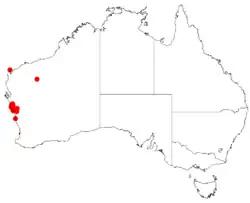 | |
| Occurrence data from AVH | |
| Synonyms[1] | |
Scaevola oldfieldii is a species of flowering plant in the family Goodeniaceae and is endemic to the south-west of Western Australia. It is an erect shrub with lance-shaped leaves, spikes of white flowers with maroon streaks, and barrel-shaped fruit.
Description
Scaevola oldfieldii is an erect shrub that typically grows up to 2.3 m (7 ft 7 in) and has glabrous stems. Its leaves are lance-shaped, sometimes with the narrower end towards the base, 75.7–92.3 mm (2.98–3.63 in) long and 12.1–19.7 mm (0.48–0.78 in) wide with smooth or toothed edges. The flowers are white with maroon streaks along the veins, sessile, 11–21 mm (0.43–0.83 in) long and 10–15 mm (0.39–0.59 in) wide, borne singly in leaf axils or in spikes usually up to 30 mm (1.2 in) long, with dagger-shaped bracteoles more than 3/4 the length of the petals. The ovary is barrel-shaped with a single locule with two ovules. Flowering occurs from August to December and the fruit is barrel-shaped, 3.2 mm (0.13 in) long and 1.4 mm (0.055 in) wide.[2][3]
Taxonomy
Scaevola oldfieldii was first formally described in 1860 by Ferdinand von Mueller in his Fragmenta Phytographiae Australiae from specimens collected near the Murchison River by Augustus Oldfield.[4][5] The specific epithet (oldfieldii) honours the collector of the type specimens.[6]
Distribution and habitat
This species of Scaevola grows on rocky slopes in mixed shrubland growing on shallow, sandy soils between the Murchison River and Geraldton in the Geraldton Sandplains bioregion of south-western Western Australia.[2]
Conservation status
Scaevola oldfieldii is listed as "Priority Three" by the Government of Western Australia Department of Biodiversity, Conservation and Attractions,[3] meaning that it is poorly known and known from only a few locations but is not under imminent threat.[7]
References
- 1 2 "Scaevola oldfieldii". Australian Plant Census. Retrieved 31 July 2026.
- 1 2 Howell, G.J. (1996). "Reappraisal of Scaevola oldfieldii (Goodeniaceae) and recognition of a new species S. kallophylla from south-west Western Australia". Nuytsia. 11 (1): 26–28. Retrieved 31 July 2026.
- 1 2 "Scaevola oldfieldii". FloraBase. Western Australian Government Department of Biodiversity, Conservation and Attractions.
- ↑ "Scaevola oldfieldii". Australian Plant Name Index. Retrieved 31 July 2026.
- ↑ Mueller, Ferdinand von (1860). Fragmenta Phytographiae Australiae. Melbourne: Victorian Government Printer. p. 19. Retrieved 31 July 2026.
- ↑ George, Alex S.; Sharr, Francis A. (2023). Western Australian Plant Names and Their Meanings - A Glossary (fifth ed.). Kardinya: Four Gables Press. p. 348. ISBN 9780645629538.
- ↑ "Conservation codes for Western Australian Flora and Fauna" (PDF). Government of Western Australia Department of Parks and Wildlife. Retrieved 31 July 2026.