Scaevola myrtifolia
| Scaevola myrtifolia | |
|---|---|
 | |
Scientific classification  | |
| Kingdom: | Plantae |
| Clade: | Embryophytes |
| Clade: | Tracheophytes |
| Clade: | Angiosperms |
| Clade: | Eudicots |
| Clade: | Asterids |
| Order: | Asterales |
| Family: | Goodeniaceae |
| Genus: | Scaevola |
| Species: | S. myrtifolia |
| Binomial name | |
| Scaevola myrtifolia | |
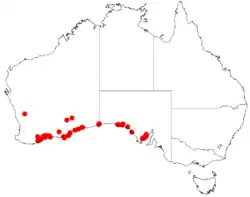 | |
| Occurrence data from AVH | |
| Synonyms[1] | |
Scaevola myrtifolia is a species of flowering plant in the family Goodeniaceae and is endemic to coastal areas of south-western Australia. It is a spreading, slightly sticky shrub with elliptic to oblong leaves, sometimes with a few teeth on the edges, white flowers sometimes singly or in cymes in leaf axils, and glabrous, green, cylindrical fruit.
Description
Scaevola myrtifolia is a spreading shrub that typically grows to a height of 0.4–1.5 m (1 ft 4 in – 4 ft 11 in) and is slightly sticky when young, with scattered, more or less star-shaped hairs. Its leaves are elliptic to oblong, sometimes with a few teeth on the edges, 17–40 mm (0.67–1.57 in) long and 1–12 mm (0.039–0.472 in) wide on a short petiole. The flowers are borne singly or in cymes in leaf axils on a peduncle up to 5 mm (0.20 in) long, with linear bracteoles 5–8 mm (0.20–0.31 in) long. The sepals are joined to form a tube about 1 mm (0.039 in) long, and the petals 13–16 mm (0.51–0.63 in) long and white, glabrous or sparsely hairy outside and bearded inside. Flowering mainly occurs from May to October, and the fruit is about 3 mm (0.12 in) long, rough, green and glabrous.[2][3]
Taxonomy
This species was first formally described in 1854 by Willem Hendrik de Vriese who gave it the name Merkusia myrtifolia in the journal Natuurkundige verhandelingen van de Hollandsche Maatschappij der Wetenschappen te Haarlem.[4][5] In 1912, Kurt Krause transferred the species to Scaevola as S. myrtifolia in Engler's Das Pflanzenreich.[6] The specific epithet (myrtifolia) means 'myrtle-leaved'.[7]
Distribution
Scaevola myrtifolia grows in stony soil, often over limestone, in mallee in near coastal areas from near Albany in Western Australia[3] to the Eyre Peninsula in South Australia.[2]
References
- 1 2 "Scaevola myrtifolia". Australian Plant Census. Retrieved 25 July 2026.
- 1 2 "Scaevola myrtifolia". FloraSA. Retrieved 25 July 2026.
- 1 2 Carolin, Roger C. "Scaevola myrtifolia". Flora of Australia. Australian Biological Resources Study, Department of Climate Change, Energy, the Environment and Water: Canberra. Retrieved 25 July 2026.
- ↑ "Merkusia myrtifolia". Australian Plant Name Index. Retrieved 25 July 2026.
- ↑ de Vriese, Willem H. (1854). "Goodenovieae". Natuurkundige Verhandelingen van de Hollandsche Maatschappij der Wetenschappen te Haarlem series 2. 10: 72–73. Retrieved 25 July 2026.
- ↑ "Scaevola myrtifolia". Australian Plant Name Index. Retrieved 25 July 2026.
- ↑ George, Alex S.; Sharr, Francis A. (2023). Western Australian Plant Names and Their Meanings - A Glossary (fifth ed.). Kardinya: Four Gables Press. p. 266. ISBN 9780645629538.