Scaevola linearis
| Scaevola linearis | |
|---|---|
 | |
Scientific classification  | |
| Kingdom: | Plantae |
| Clade: | Embryophytes |
| Clade: | Tracheophytes |
| Clade: | Angiosperms |
| Clade: | Eudicots |
| Clade: | Asterids |
| Order: | Asterales |
| Family: | Goodeniaceae |
| Genus: | Scaevola |
| Species: | S. linearis |
| Binomial name | |
| Scaevola linearis | |
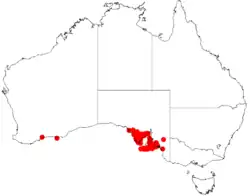 | |
| Occurrence data from AVH | |
| Synonyms[1] | |
| |
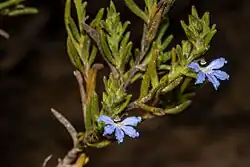
Scaevola linearis, commonly known as rough fanflower,[2] is a species of flowering plant in the family Goodeniaceae and is endemic to South Australia. It is an erect to prostrate shrub with simple, and often glandular hairs, sessile, sometimes clustered, linear to narrowly elliptic leaves, blue flowers and elliptic to oval fruit.
Description
Scaevola linearisis an erect to prostrate shrub that typically grows to a height of up to 60 cm (24 in) and has many woody stems with many branches covered with simple and glandular hairs. Its leaves are sometimes clustered, linear to narrowly elliptic, 2–85 mm (0.079–3.346 in) long and 1–7 mm (0.039–0.276 in) wide with the edges curved down or rolled under, sometimes with prominent silvery hairs in the leaf axils. The flowers are borne in leafy spikes up to 60 mm (2.4 in) long on the ends of branches or in leaf axils, with leafy bracts and elliptic bracteoles 4–9 mm (0.16–0.35 in) long and up to 1.5 mm (0.059 in) wide. The sepals are joined to form a tube with a wavy rim up to 1 mm (0.039 in) long, and the petals 12–20 mm (0.47–0.79 in) long and blue, hairy outside and bearded inside. The style is 6–9 mm (0.24–0.35 in) long and the ovary is elliptic and about 3 mm (0.12 in) long. The fruit is elliptic to oval, 4–6 mm (0.16–0.24 in) long with a single seed.[2][3]
Taxonomy
Scaevola linearis was first formally described in 1810 by Robert Brown in his Prodromus Florae Novae Hollandiae et Insulae Van Diemen.[4][5] The specific epithet (linearis) means 'linear', usually referring to the leaves.[6]
In 1990, Roger Carolin described two subspecies of S. linearis, and the names are accepted by the Australian Plant Census:
- Scaevola linearis subsp. confertifolia (J.M.Black) Carolin (previously known as Scaevola linearis var. confertifolia J.M.Black)[7] has leaves 2–15 mm (0.079–0.591 in) long, 1–3 mm (0.039–0.118 in) wide and clustered on very short side branches, egg-shaped bracteoles, petals 7–10 mm (0.28–0.39 in) long and flowers mainly from August to January.[8]
- Scaevola linearis R.Br. subsp. linearis[9] has leaves 6–85 mm (0.24–3.35 in) long, 1–7 mm (0.039–0.276 in) wide and not clustered, elliptic bracteoles 4–9 mm (0.16–0.35 in) long petals 12–19 mm (0.47–0.75 in) long, and flowers mainly from August to December.[10]
Distribution
Subspecies confertifolia occurs on the Yorke Peninsula, on the Mount Lofty Ranges and on Kangaroo Island and subsp. linearis occurs on the Eyre Peninsula and in the Gawler Ranges of South Australia.[8][10]
References
- 1 2 "Scaevola linearis". Australian Plant Census. Retrieved 20 July 2026.
- 1 2 "Scaevola linearis". FloraSA. Retrieved 20 July 2026.
- ↑ Carolin, Roger C. "Scaevola linearis". Flora of Australia. Australian Biological Resources Study, Department of Climate Change, Energy, the Environment and Water: Canberra. Retrieved 20 July 2026.
- ↑ "Acacia linearis". Australian Plant Name Index. Retrieved 20 July 2026.
- ↑ Brown, Robert (1810). Prodromus florae Novae Hollandiae et insulae Van-Diemen, exhibens characteres plantarum quas annis 1802-1805. London: Typis R. Taylor et socii. p. 586. Retrieved 20 July 2026.
- ↑ George, Alex S.; Sharr, Francis A. (2023). Western Australian Plant Names and Their Meanings - A Glossary (fifth ed.). Kardinya: Four Gables Press. p. 247. ISBN 9780645629538.
- ↑ "Scaevola linearis subsp. confertifolia". Australian Plant Census. Retrieved 20 July 2026.
- 1 2 Carolin, Roger C. "Scaevola linearis subsp. confertifolia". Flora of Australia. Australian Biological Resources Study, Department of Climate Change, Energy, the Environment and Water: Canberra. Retrieved 20 July 2026.
- ↑ "Scaevola linearis subsp. linearis". Australian Plant Census. Retrieved 20 July 2026.
- 1 2 Carolin, Roger C. "Scaevola linearis subsp. linearis". Flora of Australia. Australian Biological Resources Study, Department of Climate Change, Energy, the Environment and Water: Canberra. Retrieved 20 July 2026.