Scaevola lanceolata
| Scaevola lanceolata | |
|---|---|
 | |
Scientific classification  | |
| Kingdom: | Plantae |
| Clade: | Embryophytes |
| Clade: | Tracheophytes |
| Clade: | Angiosperms |
| Clade: | Eudicots |
| Clade: | Asterids |
| Order: | Asterales |
| Family: | Goodeniaceae |
| Genus: | Scaevola |
| Species: | S. lanceolata |
| Binomial name | |
| Scaevola lanceolata | |
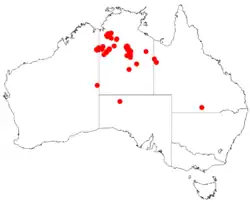 | |
| Occurrence data from AVH | |
| Synonyms[1] | |
|
List
| |
Scaevola lanceolata, commonly known as long-leaved scaevola,[2] is a species of flowering plant in the family Goodeniaceae and is endemic to the south-west of Western Australia. It is an erect perennial herb with linear to lance-shaped leaves with the narrower end towards the base, white to pale blue flowers with brownish markings, and rough, more or less spherical fruit.
Description
Scaevola lanceolatais an erect, perennial herb that typically grows to a height of up to 10–50 cm (3.9–19.7 in) and has many stems. Its leaves are linear to lance-shaped with the narrower end towards the base, 60–200 mm (2.4–7.9 in) long and 1–10 mm (0.039–0.394 in) wide, mostly towards the base of the stem. The flowers are borne in spikes up to 100 mm (3.9 in) long on the ends of stems, with lance-shaped bracts up to 40 mm (1.6 in) long and linear bracteoles up to 6 mm (0.24 in) long. The sepals form a toothed tube up to 2 mm (0.079 in) long, and the petals 7–15 mm (0.28–0.59 in) long, white to pale blue with brownish markings, hairy outside and bearded inside. Flowering mainly occurs from August to December, and the fruit is more or less spherical, up to 4 mm (0.16 in) in diameter, rough, sometimes covered with soft hairs, otherwise glabrous.[2][3]
Taxonomy
Scaevola lanceolata was first formally described in 1837 by George Bentham in Enumeratio plantarum quas in Novae Hollandiae ora austro-occidentali ad fluvium Cygnorum et in sinu Regis Georgii collegit Carolus Liber Baro de Hügel from specimens collected in the Swan River Colony by Charles von Hügel.[4][5] The specific epithet (lanceolata) means 'lanceolate'.[6]
Distribution and habitat
This species of scaevola grows in heath between the Murchison and Fitzgerald Rivers[3] in the Avon Wheatbelt, Esperance Plains, Geraldton Sandplains, Jarrah Forest, Swan Coastal Plain and Warren bioregions in the south-west of Western Australia.[2]
Conservation status
Scaevola lanceolata is listed as 'not threatened' by the Government of Western Australia Department of Biodiversity, Conservation and Attractions.[2]
References
- 1 2 "Scaevola lanceolata". Australian Plant Census. Retrieved 18 July 2026.
- 1 2 3 4 "Scaevola lanceolata". FloraBase. Western Australian Government Department of Biodiversity, Conservation and Attractions.
- 1 2 Carolin, Roger C. "Scaevola lanceolata". Flora of Australia. Australian Biological Resources Study, Department of Climate Change, Energy, the Environment and Water: Canberra. Retrieved 18 July 2026.
- ↑ "Acacia lanceolata". Australian Plant Name Index. Retrieved 18 July 2026.
- ↑ Bentham, George (1837). Endlicher, Stephan F.L.; Fenzl, Edouard; Bentham, George; Schott, Heinrich Wilhelm (eds.). Enumeratio plantarum quas in Novae Hollandiae ora austro-occidentali ad fluvium Cygnorum et in Sinu Regis Georgii collegit Carolus liber baro de Hügel. p. 69. Retrieved 18 July 2026.
- ↑ George, Alex S.; Sharr, Francis A. (2023). Western Australian Plant Names and Their Meanings - A Glossary (fifth ed.). Kardinya: Four Gables Press. p. 240. ISBN 9780645629538.