Scaevola chrysopogon
| Scaevola chrysopogon | |
|---|---|
 | |
Scientific classification  | |
| Kingdom: | Plantae |
| Clade: | Embryophytes |
| Clade: | Tracheophytes |
| Clade: | Angiosperms |
| Clade: | Eudicots |
| Clade: | Asterids |
| Order: | Asterales |
| Family: | Goodeniaceae |
| Genus: | Scaevola |
| Species: | S. chrysopogon |
| Binomial name | |
| Scaevola chrysopogon | |
Scaevola chrysopogon is a species of flowering plant in the family Goodeniaceae and is endemic to Western Australia. It is a small, understorey shrub with narrowly elliptic stem leaves, fan-shaped cream or white flowers and a hairy ovary.
Description
Scaevola chrysopogon is a small, understorey shrub up to 60 cm (24 in) high, with glabrous, slender, ridged stems, or sometimes with scattered hairs flattened against the surface, especially near leaf axils. The leaves at the base of the plant are egg-shaped and toothed, 10–40 mm (0.39–1.57 in) long and 3–10 mm (0.12–0.39 in) wide. The stem leaves are sessile, narrowly elliptic with smooth margins and 2.5–10 mm (0.098–0.394 in) long. The flowers are borne in spikes or thyrses up to 25 cm (9.8 in) long with bracts similar to the stem leaves, on a peduncle less than 2 mm (0.079 in) long. The corolla is cream to white, 13–23 mm (0.51–0.91 in) long, covered with fine, flattened or curved hairs on the outside, thickly bearded inside, and with wings about 1 mm (0.039 in) wide. The ovary is covered with erect, short white hairs. Flowering occurs from August to October.[2][3][4]
Taxonomy and naming
Scaevola chrysopogon was first formally described in 1990 by Roger Charles Carolin and the description was published in Telopea.[3][5] The specific epithet (chrysopogon) means "golden" and "bearded".[6]
Distribution
This scaevola grows near Shark Bay and south to Kalbarri National Park in Western Australia.[7]
Conservation status
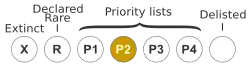
Scaevola chrysopogon is listed as "Priority Two" by the Western Australian Government Department of Biodiversity, Conservation and Attractions,[7] meaning that it is poorly known and from only one or a few locations.[8]
References
- ↑ "Scaevola chrysopogon". Australian Plant Census. Retrieved 30 May 2022.
- ↑ Carolin, Roger. "Scaevola chrysopogon". Flora of Australia. ABRS-Commonwealth of Australia. Retrieved 1 June 2022.
- 1 2 Carolin, Roger (1990). "Scaevola chrysopogon". Telopea. 3 (4): 143. Retrieved 1 June 2022.
- ↑ Carolin, Roger (1990). Flora of Australian Volume 35 (PDF). Canberra: Australian Biological Resources Study. pp. 143–144. Retrieved 6 June 2026.
- ↑ "Scaevola chrysopogon". Australian Plant Name Index. Retrieved 1 June 2022.
- ↑ Sharr, Francis Aubi; George, Alex (2021). Western Australian Plant Names and Their Meanings (4th ed.). Kardinya, WA: Four Gables Press. p. 166. ISBN 9780958034180.
- 1 2 "Scaevola chrysopogon". FloraBase. Western Australian Government Department of Biodiversity, Conservation and Attractions.
- ↑ "Conservation codes for Western Australian Flora and Fauna" (PDF). Government of Western Australia Biodiversity, Conservation and Attractions. Retrieved 6 June 2026.