Scaevola canescens
| Scaevola canescens | |
|---|---|
 | |
Scientific classification  | |
| Kingdom: | Plantae |
| Clade: | Embryophytes |
| Clade: | Tracheophytes |
| Clade: | Angiosperms |
| Clade: | Eudicots |
| Clade: | Asterids |
| Order: | Asterales |
| Family: | Goodeniaceae |
| Genus: | Scaevola |
| Species: | S. canescens |
| Binomial name | |
| Scaevola canescens | |
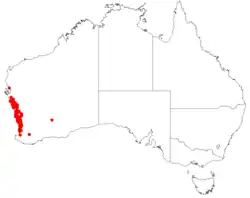 | |
| Occurrence data from AVH | |
| Synonyms[1] | |
|
Dampiera canescens (Benth.) de Vriese | |
Scaevola canescens, commonly known as grey scaevola,[2] is a species of flowering plant in the family Goodeniaceae, and is endemic to the west of Western Australia. It is a shrub with woolly hairs, sessile narrowly oblong to lance-shaped leaves, white flowers with brownish veins, and egg-shaped fruit.
Description
Scaevola canescens is a shrub that typically grows to a height of up to 60 cm (24 in), and is covered with woolly hairs, the stems brittle. Its leaves are sessile, narrowly oblong to lance-shaped with the narrower end towards the base, 12–85 mm (0.47–3.35 in) long and 4–15 mm (0.16–0.59 in) wide and covered with simple hairs. The flowers are borne in spikes up to 100 mm (3.9 in) long in leaf axils with concave, egg-shaped bracts 4.0–6.5 mm (0.16–0.26 in) long and bracteoles 2.5–4.0 mm (0.098–0.157 in) long. The sepals are wavy, up to 0.5 mm (0.020 in) long and the petals are white with brownish veins, softly hairy on the outside and bearded inside, the wings up to 0.5 mm (0.020 in) wide. Flowering occurs from March to November, and the fruit is egg-shaped with the narrower end towards the base, 2–4 mm (0.079–0.157 in) long and usually contains a single seed.[2][3]
Taxonomy
Scaevola canescens was first formally described in 1837 by George Bentham from specimens collected by Charles von Hügel near King Georges Sound.[4][5] The specific epithet (canescens) means 'becoming somewhat white or hoary', referring to the hairs on the stems and leaves.[6]
Distribution and habitat
This scpecies of Scaevola grows in sand, often with gravel or limestone, in open forest and heath from south of Shark Bay to near Perth, in the Avon Wheatbelt, Geraldton Sandplains, Jarrah Forest, Swan Coastal Plain, and Yalgoo bioregions of western Western Australia.
References
- 1 2 "Scaevola canescens". Australian Plant Census. Retrieved 7 June 2026.
- 1 2 "Scaevola canescens". FloraBase. Western Australian Herbarium, Biodiversity and Conservation Science, Department of Biodiversity, Conservation and Attractions. Retrieved 7 June 2026.
- ↑ Carolin, Roger C. "Scaevola canescens"". Flora of Australia. Australian Biological Resources Study, Department of Climate Change, Energy, the Environment and Water: Canberra. Retrieved 7 June 2026.
- ↑ "Scaevola canescens". Australian Plant Name Index. Retrieved 4 June 2026.
- ↑ Bentham, George (1837). Endlicher, Stephan F.L.; Fenzl, Edouard; Bentham, George; Schott, Heinrich Wilhelm (eds.). Enumeratio plantarum quas in Novae Hollandiae ora austro-occidentali ad Fluvium Cygnorum et in Sinu Regis Georgii collegit Carolus liber baro de Hügel. Vienna: Apud Fr. Beck Universitatis Bibliopolam. p. 69. Retrieved 7 June 2026.
- ↑ George, Alex; Sharr, Francis (2021). Western Australian Plant Names and Their Meanings (3rd ed.). Kardinya, WA: Four Gables Press. p. 158. ISBN 9780958034180.