Santo André, Póvoa de Varzim
Santo André | |
|---|---|
Neighbourhood | |
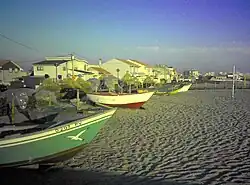 Boats and sargassum medas | |
  Santo André Location in Portugal | |
| Coordinates: 41°24′17″N 8°47′02″W / 41.4048°N 8.7838°W | |
| Country |  Portugal |
| Municipality | Póvoa de Varzim |
| Parish | A Ver-o-Mar / Aguçadoura |
Santo André is a fishing neighbourhood in Póvoa de Varzim, Portugal, surrounding Cape Santo André. Its territory extends along the northern shoreline of A Ver-o-Mar and the southern shoreline of Aguçadoura. The area is also known locally as Quião.[1]
The neighbourhood is deeply rooted in the Poveiro maritime culture and is the site of unique traditions regarding the cult of the dead and the protection of shipwrecked souls.
History
Santo André originated as a fishing settlement on the northern limits of Póvoa de Varzim. Historical and archaeological accounts identify Cape Santo André with the ancient Auarius Promontorium (Ancient Greek: Αὔαρον ἄκρον, Auaron), mentioned by the geographer Ptolemy. Archaeological evidence suggests the site has held strategic and religious importance since antiquity.[2]
The community was profoundly shaped by the maritime tragedy of 27 February 1892, in which a violent storm resulted in the deaths of 105 local fishermen.[3] This disaster solidified the area's devotion to Saint Andrew as a protector. Through the continuous urban expansion of Póvoa de Varzim, the southern portion of the neighbourhood was eventually integrated into the city's urban area.
Geography
Cape Santo André (Cabo de Santo André) forms the tip of Póvoa de Varzim's cuspate foreland, separating Santo André Beach to the north from Quião Beach to the south.[4] The shoreline is characterised by rocky formations and kelp forests, which historically supported the local seaweed industry. The Estalagem de Santo André (Santo André Inn) is located directly on the beachfront.
Culture

The neighbourhood is a centre for the preservation of Poveiro culture, including the historic use of siglas poveiras (family marks) on boats and property. In local belief, Saint Andrew acts as the Fisher of Souls (Pescador das Almas), who rescues the spirits of those drowned at sea from the depths of the ocean to guide them to the afterlife.[2]
A prominent local belief holds that those who do not visit the 16th-century Santo André Chapel during their lifetime must do so after death. Near the cape lies the Penedo do Santo (Saint's Rock), a geological formation with a depression traditionally identified by fishermen as the footprint left by the saint.
The ritual known as the Ponto das Almas (Souls' Point) is performed at dawn on 30 November. Groups of pilgrims process along the beach to the chapel, circling the building while chanting prayers to rescue the souls of the deceased, particularly those lost to the sea.[3]
The area is also historically associated with the Sargaceiros, traditional labourers who harvested sargassum seaweed from the surf. The seaweed was used as fertiliser for the surrounding agricultural fields, known as masseiras.
Gallery
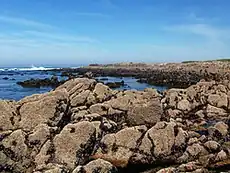 Cape Santo André
 Coastal flora
 Praia de Santo André
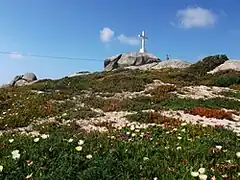 Penedo do Santo
See also
References
- ↑ "A Ver-o-Mar" (in Portuguese). Câmara Municipal da Póvoa de Varzim. Retrieved 29 March 2026.
- 1 2 Graça, António dos Santos (1992) [1932]. "IX A Crença". O Poveiro (in Portuguese). Lisbon: Etnográfica Press.
- 1 2 "Resgatar das Almas a Santo André" (in Portuguese). Câmara Municipal da Póvoa de Varzim. November 2013. Retrieved 29 March 2026.
- ↑ "Praia de Santo André / Praia dos Cabos" (in Portuguese). Turismo de Portugal. Retrieved 30 March 2026.
External links
- A Ver-o-Mar parish at Câmara Municipal da Póvoa de Varzim (in Portuguese)
- Festas de Santo André at Câmara Municipal da Póvoa de Varzim (in Portuguese)
- Praia de Santo André / Praia dos Cabos at Turismo de Portugal (in Portuguese)