San Juan Bautista, Nueva Esparta
San Juan Bautista
El Valle de San Juan Bautista | |
|---|---|
Town | |
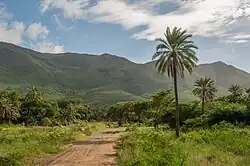 The San Juan valley seen from the Los Fermines hill | |
| Motto(s): "Industrious silence and perennial green" | |
 San Juan Bautista parish, shown in pink | |
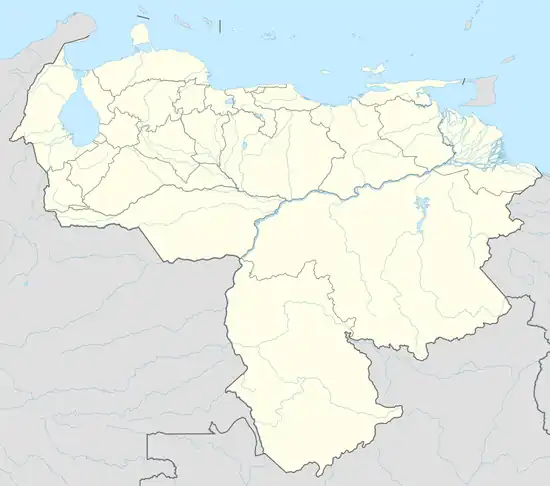  San Juan Bautista Location within Venezuela | |
| Coordinates: 11°00′51″N 63°56′42″W / 11.0142°N 63.9451°W | |
| Country |  Venezuela |
| State | Nueva Esparta |
| Municipality | Antonio Díaz |
| Founded | 1529 |
| Founded by | Pedro de Alegría |
| Government | |
| • Mayor | Marisel Velásquez (PSUV) |
| Highest elevation | 910 m (2,990 ft) |
| Lowest elevation | 100 m (330 ft) |
| Population (2023) | |
• Total | 81,466 |
| • Demonym | Sanjuanero |
| Time zone | UTC−04:00 (VET) |
| Postal code | 6301 |
San Juan Bautista also known as El Valle de San Juan or simply San Juan, is a town on Margarita Island in Nueva Esparta State, Venezuela. It is the seat of Antonio Díaz Municipality and one of the oldest Spanish settlements in Venezuela, founded in 1529 by Pedro de Alegría. The town lies in a valley on the slopes of Cerro Copey, at elevations ranging from 100 to 910 m (330 to 2,990 ft).[1] Its mountain location gives it a temperate climate uncommon in the otherwise arid Margarita Island. The population was 81,466 inhabitants in 2023.[1]
The town's name comes from its patron saint, John the Baptist (San Juan Bautista), whose feast day on 24 June is the main local celebration. The town centre is built around the Plaza Antonio Díaz, on which stands the parish church of San Juan Bautista, one of the oldest parishes in Venezuela.[2]
San Juan Bautista was historically a centre of livestock breeding for the Caribbean and the Spanish Main, and is the only town in Venezuela where the date palm (Phoenix dactylifera) is widely cultivated. The valley remains noted for its traditional crafts, including handwoven hats made from date-palm fibre (sombrero de cogollo), gold and silver work combined with Margarita pearls, and the local sweet piñonate.
Geography
San Juan Bautista lies in a valley on the southern foothills of Cerro Copey, the highest point of Margarita Island. The town extends from 100 m (330 ft) at the lower end of the valley up to 910 m (2,990 ft) at the summit of Cerro San Juan.[1] The surrounding hills include Cerro Copey, Cerro Ochenta, Cerro Valle Hondo and Cerro San Juan, which together create a microclimate cooler and wetter than the rest of the island.
The San Juan River crosses the valley but has been dry since the mid-1950s, when its source springs were diverted to feed the San Juan reservoir.[3]
History

Foundation (1525–1540)
In 1525, former settlers of Cubagua Island crossed to Margarita in search of fresh water. Drawn by the valley's springs, temperate climate and fertile land, they decided to establish a permanent settlement there.[4] In 1529, San Juan Bautista was formally founded by Pedro de Alegría, then the lieutenant governor of Margarita representing the heirs of Marcelo Villalobos and the successor of Francisco Fajardo.[4][5] The Diocese of Margarita's records show that the Parish of San Juan Bautista was created in the same year, making it one of the oldest parishes in Venezuela.[6] A royal decree issued in Valladolid on 7 December 1537 acknowledged Pedro de Alegría as "the first settler of the island of Margarita and the first to work the land for bread and to raise cattle".[4]
Cattle ranching

The first bovine, equine and caprine livestock arrived in San Juan in 1528, and adapted well to local conditions.[5] By the 1540s, the valley was supplying cattle to the Province of Venezuela, the New Kingdom of Granada and even more distant territories.[5] In 1527, animals from San Juan had already been used in bullfights at Nueva Cádiz on Cubagua,[2] and the valley was the source of livestock for several Spanish expeditions, including that of Diego Fernández de Serpa in 1569, who acquired 800 cows and horses for the campaign on the Venezuelan Llanos.[5]
After the tsunami of 1541 devastated Cubagua and a French pirate raid struck the island in 1543, Spanish artisans and farmers from Cubagua migrated to San Juan. Among them was the family of Rodrigo de Fuentidueña, after whom the neighbouring village of Fuentidueño is named.[7]
Colonial census of 1757
A census carried out by governor Alonso del Río y Castro in 1757 recorded 203 households and 589 inhabitants in the San Juan valley, including 28 free Black residents and nine enslaved people. The census also listed local occupations — labourers, divers, seamstresses, weavers, cobblers, sailors and fishermen — providing one of the earliest detailed demographic snapshots of any Venezuelan settlement.[2]
Burnings of San Juan (1816–1817)
San Juan Bautista contributed several volunteers to the Venezuelan War of Independence. In January 1816, the Royalist brigadier Pardo dispatched a column under Urreiztieta into the valley. The Royalist troops met no resistance, looted the town and set fire to both the parish church and every house in the colonial centre.[8]
In 1817, at the request of the local population, the island's government built a coastal battery at Caranay equipped with a 12-pounder cannon. On 7 July 1817, Spanish troops under Pablo Morillo retook San Juan Bautista and tried to advance northward, but were halted at Boquerón by 200 infantry and 100 cavalry led by colonel José Joaquín Maneiro, then patriot chief of staff on the island.[8] A further clash took place at Boquerón on 20 July 1853, when revolutionary forces commanded by general León Campos were defeated by colonel Pedro Vicente Aguado, the military commander of Margarita.[8]
After independence
From 1830 onwards the territory of San Juan Bautista underwent several administrative reorganisations. A San Juan Bautista District was created in 1863; in 1881 the town became part of Marcano District, and in 1899 of Aragua-Margarita State. The 1990 territorial law established the present-day Antonio Díaz Municipality with its seat at San Juan Bautista.[2]
Demographics
The 2011 national census recorded 75,800 inhabitants in the civil parish of San Juan Bautista, while the 2023 municipal estimate is 81,466.[1] The predominant religion is Catholicism, a legacy of the early parish foundation in 1529.
Education
San Juan Bautista is the seat of one of the campuses of the Universidad Nacional Experimental de la Seguridad (UNES), Venezuela's national security force training university.[9]
Culture
Religion

The patronal feast on 24 June, the day of John the Baptist, is the main local celebration. Although the original date of the church's construction is uncertain, both the church and the parish are believed to predate the 1529 record, making the Parish of San Juan Bautista one of the oldest in Venezuela.[2] The parish church houses three images of John the Baptist: one on the façade, made by Jesús Noriega in 1929; one in the nave, brought from Spain by Father Silvano Marcano Maraver; and a more recent third image.[2]
The town has produced a number of Catholic priests over the centuries, including, in the 20th century, the Reverend Julián Ramírez and Monsignor José Antonio Constenla Garrido, who in turn taught a further generation of clerics including Jaime Villarroel, later Bishop of Carúpano.[2]
Plaza Dr. Vicente Marcano

Plaza Dr. Vicente Marcano, one block from Plaza Antonio Díaz, is a designated national historical monument of Venezuela. The rectangular plaza is centred on a marble bust erected in 1950 in honour of Dr. Vicente Marcano (1848–1891), considered the first internationally recognised Venezuelan scientist and grandson of Gaspar Marcano. The bust was executed by the Roversi Artistic Studio and Marble Works of Bologna and Caracas, as confirmed by a bas-relief seal at its base.[10]
Flanking the pedestal stand two allegorical sculptures by the same studio: a female figure with a compass and book, representing knowledge; and a male figure with a chisel and hammer, representing labour.[10] Construction of the plaza was carried out in phases from 1927 under the orders of Agustín Delgado Lozano, then civil chief of the Antonio Díaz District, on land donated by Luis Felipe Millán.[10]
Cuisine
Piñonate
The Fuentidueño hamlet, at the foot of Cerro Copey within the San Juan parish, is the traditional centre of production of piñonate, a sweet made from green papaya and unrefined cane sugar (papelón). Green papayas, including their seeds, are grated in a wooden container known as a canoa using tin graters. The resulting pulp is mixed in a copper pan with sugar, papelón and water, and slowly cooked into a syrup. The mixture is then continuously stirred over a wood fire for three to four hours; once thick enough, it is removed from the heat, beaten for another two hours, poured onto a wooden table to set and cut into pieces wrapped in dried plantain leaves (cachipos).[11]
Traditional crafts
Goldsmithing
San Juan Bautista is considered the cradle of goldsmithing on Margarita Island. The craft, practised since the mid-colonial period, is one of the most refined expressions of the island's folk art. Gold and silver pieces from San Juan often incorporate locally fished Margarita pearls, giving them a distinctive cultural value.[12] The tradition has declined sharply since the late 20th century; in the 2020s, only a small number of artisans, including master Jesús Velásquez, remain active.
Date-palm hats and basketry
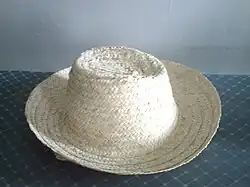
San Juan Bautista is the only town in Venezuela where the date palm (Phoenix dactylifera) is widely cultivated; the species was brought to the island by Spanish colonists.[13] Locally, the male tree (which bears no fruit) is harvested for the tender shoots (cogollo) used in weaving, while the female tree yields both shoots and fruit. The classic finished product is the sombrero de cogollo, a wide-brimmed hat woven from the dried, sliced shoots. The same material is used for alpargatas, reed bags (mapires), baskets and small leather goods.[14]
Weaving is divided by gender: men climb the palm trunks barefoot to cut the shoots, then bundle and sell them to women weavers (tejedoras). The weavers dry the shoots in the sun for several days, then split them into 3–4 mm strips and plait them into braids (crinejas) of 7, 11, 15 or 19 strips. The braids are then sewn in a spiral on a sewing machine to form the crown and brim of the hat without using a mould.[15]
The final step, known locally as despicar la crineja (sewing the very ends of the braid), is traditionally seen as a moment of courtship: a young suitor would help the weaver finish her work as a way of declaring his intentions.[15]
Gallery
 Hector Millán corner
 Parish church of San Juan Bautista
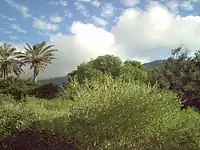 Dates from San Juan, with Cerro Copey in the background
 Plaza el Gallo
 Road towards Fuentidueño
 Dry bed of the San Juan River
 Casa Libertador
See also
References
- 1 2 3 4 XIV Censo Nacional de Población y Vivienda 2011: Resultados por Entidad Federal y Municipio del Estado Nueva Esparta (PDF) (Report) (in Spanish). Instituto Nacional de Estadística (Venezuela). 2011. Archived from the original (PDF) on 1 March 2021.
- 1 2 3 4 5 6 7 Salazar, Verni (2021). "Valle de San Juan: Primer asiento europeo en la isla de Margarita, Venezuela, desde 1525" (PDF). Congreso de Historia (in Spanish). Centro de Estudios Histórico-Genealógicos del Frente Antártico (COFFAR).
- ↑ "Agua… una historia de sequía". El Sol de Margarita (in Spanish). Retrieved 2 October 2020.
- 1 2 3 Verni Salazar. "Pedro de Herrera y El Valle de San Juan". El Sol de Margarita (in Spanish). Retrieved 3 November 2020.
- 1 2 3 4 Martínez de Salinas Alonso, Luisa (2009). "El gobierno de la isla Margarita en el siglo XVI: herencia y presencia femenina" (PDF). Chronica Nova (in Spanish) (35). Universidad de Granada.
- ↑ Verni Salazar (16 June 2020). "Huellas y Presencias Insulares: Escudo de la ciudad de San Juan Bautista". Otilca Radio (in Spanish). Retrieved 7 November 2020.
- ↑ "Fuentidueño: San Juan Bautista" (in Spanish). Koina, Infocentro.
- 1 2 3 Hadgialy Divo, Miguel (1951). La Virgen del Valle en la vida margariteña: de la historia y la leyenda (in Spanish). Caracas: Editorial Ávila Gráfica.
- ↑ "En Nueva Esparta ingresan más de 300 jóvenes a la UNES". El Sol de Margarita (in Spanish). Retrieved 22 January 2024.
- 1 2 3 "Conservación y restauración" (in Spanish). 18 October 2023. Retrieved 28 December 2023.
- ↑ "Piñonates de San Juan" (in Spanish). Venezuela Tuya.
- ↑ Escalona, Yanet. "Eustiquio Velásquez: joyero y compositor" (in Spanish). El Sol de Margarita. Archived from the original on 22 May 2012.
- ↑ Bracho Toro, Cecilia; Lunar Leandro, Rafael Antonio. "Los conocimientos tradicionales de la palma datilera y sus derivados como atractivo turístico-cultural del municipio Díaz, Estado Nueva Esparta" (PDF) (in Spanish). Universidad de Oriente, Núcleo de Nueva Esparta.
{{cite journal}}: Cite journal requires|journal=(help) - ↑ "Artesanía en la Isla de Margarita" (in Spanish). Instituto Nacional de Turismo. Archived from the original on 20 September 2009. Retrieved 30 September 2009.
- 1 2 "Venezuela Tuya" (in Spanish). Retrieved 7 November 2020.
External links

- Antonio Díaz Municipality profile (in Spanish)
- Nueva Esparta profile, Gobierno en Línea (in Spanish)