Spinocerebellar ataxia type 7
| Spinocerebellar ataxia type 7 | |
|---|---|
| Other names | Olivopontocerebellar Atrophy Type III (OPCA3), Autosomal dominant cerebellar ataxia type II (ADCA, type II).[1] |
 | |
| Brain MRI of the patient with SCA7. in Fig.A (Axial T2) aand Fig.B (Sagittal T1), a global cerebellar and pontine atrophy can be seen. In Fig.C supratentorial gray matter volume loss can be seen. | |
| Specialty | Neurology |
| Symptoms | Ataxia, pyramidal signs, cone-rod dystrophy. |
| Usual onset | Usually 20 to 40 years of age |
| Duration | 20-30 years |
| Causes | CAG expansion in ATXN7 gene |
| Prevention | Genetic counseling |
| Treatment | Symptomatic |
Spinocerebellar ataxia type 7 (SCA7) is a rare genetic (autosomal dominant) disorder caused by a CAG nucleotide expansion in a gene ATXN7.[1] This disorder belongs to polyglutamine disorders due to elongation of the polyglutamine tract.[2] Symptoms usually begin between 20 and 40 years of age, and usual symptoms include ataxia, dysarthric speech, slow saccadic eye movements, pyramidal signs, difficulty swallowing, opthalmoplegia, and cone-rod dystrophy which can progress into blindness; it is one of the distinctive signs of this disorder.[3] Duration is usually 20 to 30 years, but varies with age of onset.[4]
Prevalence of this disorder is less than 1:300 000, also this disorder represented 2% of the SCA cases; over 1000 individuals with SCA7 have been reported.[4] SCA7 usually can be seen in Scandinavia, Africa, and Mexico, due to founder effect.[5][4]
Symptoms

In SCA7 patients, cerebellar ataxia is usually the first sign, but in some cases, visual impairment or both may also be the first sign (it correlates with CAG expansion size).[6] Patients usually experience gait ataxia, dysmetria of limbs, dysarthria, intentional tremor, and dysdiadochokinesia, slow saccade (which is caused by pons degeneration), macular problems; also pyramidal signs can be seen, such as hyperreflexia of limbs and spasticity.[6] Some patients can also experience ophthalmoplegia, nystagmus, snoring, inability to fall asleep; autonomic disturbances such as gastrointestinal and urinary issues (both of them are common), rarely they have issues with thermoregulation.[6] In much rare cases restless leg syndrome.[6] Visual loss starts as a loss of color perception (specifically tritan, which is caused by cones dysfunction), which then progresses to blindness.[7] Patient usually have spared cognition.[7]
Infantile-onset and juvenile-onset
Patients with infantile-onset (which can begin at the age of 0 to 1.5) SCA7 can present with ataxia and visual impairment which is accompanied by seizures, involuntary muscle jerk, severe decrease in muscle tone, enlarged liver, heart diseases (such as persistent ductus arteriosus and heart failure).[7][8] Infantile-onset SCA7 can progress rapidly and cause death in a few months or years.[7]
In case of juvenile-onset (which can begin at the age of 1.5 to 15) patients experience the same symptoms as adults, but much faster and severe.[8] Early-juvenile cases begin as an ataxia, and late-juvenile might begin as a visual impairment or ataxia.[8]
Diagnosis
Diagnosis of SCA7 might be suspected by its symptoms (such as cone and rod anomalies on ERG, cerebellar and brainstem deterioration); and diagnosis can be confirmed by genetic testing.[9]
In order to confirm CAG expansions in the ATXN7 gene, conventional PCR can be used, but it cannot detect extremely expanded CAGs (especially in patients with childhood-onset); consequently, southern blot (a technique where purified DNA from tissue would be digested and separated using electric currents[10]) analysis can be used to confirm diagnosis or PCR in combination with capillary electrophoresis (which can estimate allele size more properly).[11]
Cause
SCA7 is caused by pathogenic CAG nucleotide expansion in a gene ATXN7.[1] Normally ATXN7 allele contains 4 to 34 repeats and patients have 37 repeats to more than 300 CAG expansions.[12] Anticipation (a phenomenon where disorder becomes much severe and appears early as this allele passed to another generation[13]) occurs and males with SCA7 pass more CAG expansions.[4] HIghest repeat that was ever reported was 460.[7]
| Age of onset | Allele size |
|---|---|
| Normal allele | 7-27 CAG |
| Unstable normal allele | 28-33 CAG |
| Reduced penetrance | 34-36 CAG |
| Adult onset (more than 3rd decade) | <59 CAG |
| Adult onset (less than 3rd decade) | 59-100 CAG |
| Childhood onset | >100 CAG |
| Infantile onset | 200-400 CAG |
Pathophysiology
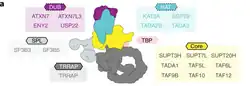
ATXN7 consists of 803 amino acids and has polyglutamine expandable region near to the N-terminus.[2]
ATXN7 protein is a subunit of SAGA complex which is known to acetylate (to add acetate on substrate[14])and de-ubuqinate histone which are important for transcription.[15] Mutated ATXN7 (mATXN7) might cause sequestration of SAGA, p53, CBP, FIP200.[15] SAGA dysregulation might cause decreased levels of cerebellar-identity genes and decreased activity of CRX, which in turn causes photoreceptor gene expression to decrease; also p53 sequestration causes deregulation of proteins which participates in metabolic processes (such as NOX1, AIF) which causes reduction of respiratory capacity of cell which in turn decreases levels of ATP.[15][16] p53 abnormally interacts with FIP200 in mATXN7 aggregates which causes reduction of FIP200 levels which destabilize ULK1 which in turn impairs autophagy.[15] Also, mATXN7 can interact with CRX directly and consequently intrfer with its activity.[17] mATXN7 induces dysregulation of genes which are related to DNA repair, NAD+ synthesis; consequently aberrant activation of PARP occurs and causes depletion of NAD+ which in turn decrases activity of Sirtuin 1.[17] Sirtuin 1 normally deacetylates PGC-1α which inhibits its activity, but in SCA7, PGC-1α remains acetylated which in turn inhibits genes related calcium homeostasis (which can cause neuronal dysfunction).[17]
SAGA complex can induce transcription of miR-124, which can regulate levels of ATXN7 mRNA. but in SCA7, miR-124 levels are decreased due to SAGA complex dysfunction (as mentioned before, caused by polyQ-expanded ATXN7) which might account for tissue-specific pathology.[18]
Treatment
Management of SCA7 is symptomatic as there is no cure. UV light should be avoided in order to preserve retinal function, and walkers can be used in order to sustain activity. Feeding tubes can be used to decrease the risk of aspiration pneumonia.[9]
Research
In 2013, researchers found that interferon beta in mice models of SCA7 could stimulate transcription of PML, which in turn can clear mATXN7 proteins and reduce symptoms.[19] In 2014, researchers used siRNA to decrease levels of ATXN7 mRNA level in retina of mice, which preserved function of retina.[20]
History
This disorder was first described by Froment and colleagues in 1937.[21] Benomar and colleagues mapped SCA7 to the part of the short arm of the chromosome 3 in 1995, and in 1996 David and colleagues mapped SCA7 to a specific region on chromosome 3 (3p12-p13); in 1997, it was found that CAG expansion caused this disorder.[22][23] ADCA II was coined by Harding in 1993 due to the pigmentary retinopathy feature of this disorder.[24]
References
- 1 2 3 "ATAXIN 7 - omim.org". OMIM.
- 1 2 Scheel, Hartmut; Tomiuk, Stefan; Hofmann, Kay (2003-11-01). "Elucidation of ataxin-3 and ataxin-7 function by integrative bioinformatics". Human Molecular Genetics. 12 (21): 2845–2852. doi:10.1093/hmg/ddg297. ISSN 0964-6906. PMID 12944423.
- ↑ Michalik, A.; Martin, J.-J.; Van Broeckhoven, C. (2003-10-22). "Spinocerebellar ataxia type 7 associated with pigmentary retinal dystrophy". European Journal of Human Genetics. 12 (1): 2–15. doi:10.1038/sj.ejhg.5201108. ISSN 1476-5438. PMID 14571264.
- 1 2 3 4 5 La Spada, Albert R. (1993), Adam, Margaret P.; Bick, Sarah; Mirzaa, Ghayda M.; Pagon, Roberta A. (eds.), "Spinocerebellar Ataxia Type 7", GeneReviews®, Seattle (WA): University of Washington, Seattle, PMID 20301433, retrieved 2026-05-12
- ↑ Jonasson, Jenni; Juvonen, Vesa; Sistonen, Pertti; Ignatius, Jaakko; Johansson, Daniel; Björck, Erik J.; Wahlström, Jan; Melberg, Atle; Holmgren, Gösta; Forsgren, Lars; Holmberg, Monica (2000-12-20). "Evidence for a common Spinocerebellar ataxia type 7 (SCA7) founder mutation in Scandinavia". European Journal of Human Genetics. 8 (12): 918–922. doi:10.1038/sj.ejhg.5200557. ISSN 1476-5438. PMID 11175279.
- 1 2 3 4 Velázquez-Pérez, L.; Cerecedo-Zapata, C. M.; Hernández-Hernández, O.; Martínez-Cruz, E.; Tapia-Guerrero, Y. S.; González-Piña, R.; Salas-Vargas, J.; Rodríguez-Labrada, R.; Gurrola-Betancourth, R.; Leyva-García, N.; Cisneros, B.; Magaña, J. J. (2015-01-01). "A comprehensive clinical and genetic study of a large Mexican population with spinocerebellar ataxia type 7". Neurogenetics. 16 (1): 11–21. doi:10.1007/s10048-014-0424-y. ISSN 1364-6753. PMID 25318446.
- 1 2 3 4 5 Martin, J. J. (2012-01-01), "Spinocerebellar ataxia type 7", Ataxic Disorders, Handbook of Clinical Neurology, vol. 103, Elsevier, pp. 475–491, doi:10.1016/B978-0-444-51892-7.00030-9, ISBN 978-0-444-51892-7, PMID 21827908, retrieved 2026-05-14
- 1 2 3 Bah, M. G.; Rodriguez, D.; Cazeneuve, C.; Mochel, F.; Devos, D.; Suppiej, A.; Roubertie, A.; Meunier, I.; Gitiaux, C.; Curie, A.; Klapczynski, F.; Allani-Essid, N.; Carneiro, M.; Van Minkelen, R.; Kievit, A. (2020). "Deciphering the natural history of SCA7 in children". European Journal of Neurology. 27 (11): 2267–2276. doi:10.1111/ene.14405. hdl:11392/2455721. ISSN 1468-1331.
{{cite journal}}: CS1 maint: unflagged free DOI (link) - 1 2 "Spinocerebellar ataxia type 7". www.orpha.net. Retrieved 2026-05-14.
- ↑ "Southern Blot". www.genome.gov. Retrieved 2026-05-16.
- ↑ Cagnoli, Claudia; Brussino, Alessandro; Mancini, Cecilia; Ferrone, Marina; Orsi, Laura; Salmin, Paola; Pappi, Patrizia; Giorgio, Elisa; Pozzi, Elisa; Cavalieri, Simona; Di Gregorio, Eleonora; Ferrero, Marta; Filla, Alessandro; De Michele, Giuseppe; Gellera, Cinzia (2018-05-01). "Spinocerebellar Ataxia Tethering PCR: A Rapid Genetic Test for the Diagnosis of Spinocerebellar Ataxia Types 1, 2, 3, 6, and 7 by PCR and Capillary Electrophoresis". The Journal of Molecular Diagnostics. 20 (3): 289–297. doi:10.1016/j.jmoldx.2017.12.006. ISSN 1525-1578. PMID 29462666.
- ↑ Garden, Gwenn A.; La Spada, Albert R. (2008-06-01). "Molecular pathogenesis and cellular pathology of spinocerebellar ataxia type 7 neurodegeneration". The Cerebellum. 7 (2): 138–149. doi:10.1007/s12311-008-0027-y. ISSN 1473-4230. PMC 4195584. PMID 18418675.
- ↑ "What do geneticists mean by anticipation?: MedlinePlus Genetics". medlineplus.gov. Retrieved 2026-05-14.
- ↑ "Definition of ACETYLATE". www.merriam-webster.com. Retrieved 2026-05-14.
- 1 2 3 4 Niewiadomska-Cimicka, Anna; Trottier, Yvon (2019-10-01). "Molecular Targets and Therapeutic Strategies in Spinocerebellar Ataxia Type 7". Neurotherapeutics. 16 (4): 1074–1096. doi:10.1007/s13311-019-00778-5. ISSN 1878-7479. PMC 6985300. PMID 31432449.
- ↑ Niewiadomska-Cimicka, Anna; Doussau, Frédéric; Perot, Jean-Baptiste; Roux, Michel J.; Keime, Celine; Hache, Antoine; Piguet, Françoise; Novati, Ariana; Weber, Chantal; Yalcin, Binnaz; Meziane, Hamid; Champy, Marie-France; Grandgirard, Erwan; Karam, Alice; Messaddeq, Nadia (2021-06-02). "SCA7 Mouse Cerebellar Pathology Reveals Preferential Downregulation of Key Purkinje Cell-Identity Genes and Shared Disease Signature with SCA1 and SCA2". Journal of Neuroscience. 41 (22): 4910–4936. doi:10.1523/JNEUROSCI.1882-20.2021. ISSN 0270-6474. PMC 8260160. PMID 33888607.
- 1 2 3 Switonski, Pawel M.; La Spada, Albert R. (2023), "Spinocerebellar Ataxia Type 7: From Mechanistic Pathways to Therapeutic Opportunities", in Soong, Bing-wen; Manto, Mario; Brice, Alexis; Pulst, Stefan M. (eds.), Trials for Cerebellar Ataxias: From Cellular Models to Human Therapies, Cham: Springer International Publishing, pp. 433–467, doi:10.1007/978-3-031-24345-5_17, ISBN 978-3-031-24345-5
- ↑ Tan, Jennifer Y.; Vance, Keith W.; Varela, Miguel A.; Sirey, Tamara; Watson, Lauren M.; Curtis, Helen J.; Marinello, Martina; Alves, Sandro; Steinkraus, Bruno R.; Cooper, Sarah; Nesterova, Tatyana; Brockdorff, Neil; Fulga, Tudor A.; Brice, Alexis; Sittler, Annie (2014-10-12). "Cross-talking noncoding RNAs contribute to cell-specific neurodegeneration in SCA7". Nature Structural & Molecular Biology. 21 (11): 955–961. doi:10.1038/nsmb.2902. ISSN 1545-9985. PMC 4255225. PMID 25306109.
- ↑ Chort, Alice; Alves, Sandro; Marinello, Martina; Dufresnois, Béatrice; Dornbierer, Jean-Gabriel; Tesson, Christelle; Latouche, Morwena; Baker, Darren P.; Barkats, Martine; El Hachimi, Khalid H.; Ruberg, Merle; Janer, Alexandre; Stevanin, Giovanni; Brice, Alexis; Sittler, Annie (2013-03-21). "Interferon β induces clearance of mutant ataxin 7 and improves locomotion in SCA7 knock-in mice". Brain: A Journal of Neurology. 136 (Pt 6): 1732–1745. doi:10.1093/brain/awt061. ISSN 1460-2156. PMID 23518714.
- ↑ Ramachandran, Pavitra S.; Bhattarai, Sajag; Singh, Pratibha; Boudreau, Ryan L.; Thompson, Stewart; LaSpada, Albert R.; Drack, Arlene V.; Davidson, Beverly L. (2014-04-23). "RNA Interference-Based Therapy for Spinocerebellar Ataxia Type 7 Retinal Degeneration". PLOS ONE. 9 (4) e95362. Bibcode:2014PLoSO...995362R. doi:10.1371/journal.pone.0095362. ISSN 1932-6203. PMC 3997397. PMID 24759684.
- ↑ Lebre, A.-S.; Brice, A. (2003). "Spinocerebellar ataxia 7 (SCA7)". Cytogenetic and Genome Research. 100 (1–4): 154–163. doi:10.1159/000072850. ISSN 1424-8581. PMID 14526176. Archived from the original on 2025-04-15.
- ↑ Benomar, A.; Krols, L.; Stevanin, G.; Cancel, G.; LeGuern, E.; David, G.; Ouhabi, H.; Martin, J.-J.; Dürr, A.; Zaim, A.; Ravisé, N.; Busque, C.; Penet, C.; Regemorter, N. Van; Weissenbach, J. (1995-05-01). "The gene for autosomal dominant cerebellar ataxia with pigmentary macular dystrophy maps to chromosome 3p12–p21.1". Nature Genetics. 10 (1): 84–88. doi:10.1038/ng0595-84. ISSN 1546-1718. PMID 7647798.
- ↑ David, Gilles; Abbas, Nacer; Stevanin, Giovanni; Dürr, Alexandra; Yvert, Gaël; Cancel, Géraldine; Weber, Chantal; Imbert, Georges; Saudou, Frédéric; Antoniou, Eric; Drabkin, Harry; Gemmill, Robert; Giunti, Paola; Benomar, Ali; Wood, Nick (1997-09-01). "Cloning of the SCA7 gene reveals a highly unstable CAG repeat expansion". Nature Genetics. 17 (1): 65–70. doi:10.1038/ng0997-65. ISSN 1546-1718. PMID 9288099.
- ↑ Mundwiler, A.; Shakkottai, V. G. (2018-01-01), "Autosomal-dominant cerebellar ataxias", Neurogenetics, Part I, Handbook of Clinical Neurology, vol. 147, Elsevier, pp. 173–185, doi:10.1016/B978-0-444-63233-3.00012-9, ISBN 978-0-444-63233-3, PMID 29325610, retrieved 2026-05-14