Ryan Burge (political scientist)
Ryan Burge | |
|---|---|
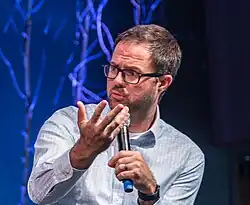 Burge speaks at a Portland Seminary event in 2025. | |
| Born | 1982 (age 43–44) |
| Title | Professor of Practice |
| Academic background | |
| Education | Greenville College (B.A.), Southern Illinois University Carbondale (M.A., Ph.D.) |
| Alma mater | Southern Illinois University Carbondale |
| Thesis | Religion and Political Behavior: Studies of Political Tolerance, Voting, and Public Opinion (2011) |
| J. Tobin Grant | |
| Academic work | |
| Discipline | Political scientist, statistician |
Sub-discipline | American religion |
| Institutions |
|
| Website | drburge graphsaboutreligion |
Ryan P. Burge (born 1982) is an American political scientist, statistician, and former pastor. He is currently a professor of practice at Washington University in St. Louis in the John C. Danforth Centre on religion and politics.
Early life
Burge began to be involved in the church at around 14 years of age in which he took part in a vote which would freeze the salary of his Church, the First Baptist Church of Salem in Illinois.[1]
Career
For 17 years until summer 2024, Burge was pastor at an American Baptist church in Mount Vernon, Illinois.[2][3] He is currently a professor of practice at Washington University in St. Louis, and works in the John C. Danforth Centre on religion and politics.[1][4] He had previously been an associate professor at Eastern Illinois University, he is best known for his work on religion in the United States.[5][6] 60 Minutes has termed him one of the "leading data analysts on religion and politics" within the United States.[7]
Views
Burge has argued that secular voters represent a growing force in American politics.[8] His research finds that the majority of "nones" have religion-like beliefs and believe in some conception of a higher power, despite not affiliating with a religion.[9][10] According to Burge, over 30% of people are "nones" compared to 5% in 1972.[11] Burge has argued that the term "evangelical" is becoming more descriptive of politics than religion, particularly that of conservatism, rather than its traditional association with adherence to evangelical theology.[5][12]
In Burge's book The Vanishing Church, he argued that it has become rarer for congregations of both Democrats and Republicans to come together. He argues that this has been caused by increasing hostility to religion in the liberal part of society contrasted to increasing conservatism within the Christian movement. In his book, he writes that people are going to church to affirm their political views rather than for religious reasons.[13] He further argues that Christian congregations are declining such as his own due to less young people going to church. In an America Magazine article on him, they call this phenoma "polarization". Although Burge talks about decreasing congregations, he admitted that for every seven Americans who believed in God, there was one who didn't.[14] In an interview with the Commonweal magazine, Burge said that the issue was that there were no longer congregations with mixed religious views. He believes that this has a widespread effect on society and politics by people only interacting with those with similar views and loosing the skills for engaging with different points of view. In the interview, he added that diversity in ideas was important for democracy.[15]
Bibliography
- The Nones: Where They Came From, Who They Are, and Where They Are Going (Fortress Press, 2021) ISBN 9781506465852
- 20 Myths about Religion and Politics in America (Fortress Press, 2022) ISBN 9781506482019
- (with Collin Hansen, Jim Davis, and Michael Graham) The Great Dechurching: Who's Leaving, Why Are They Going, and What Will It Take to Bring Them Back? (Zondervan, 2023) ISBN 9780310147435
- The American Religious Landscape: Facts, Trends, and the Future (Oxford University Press, 2025) ISBN 9780197762844
- The Vanishing Church: How the Hollowing Out of Moderate Congregations Is Hurting Democracy, Faith, and Us (Brazos Press, 2026) ISBN 9781587436697
- (with Michael Graham) The Great American Church Migration: A Landmark Study of How, Why, and When People Switch Faiths (Zondervan, 2027) ISBN 9780310176343)
References
- 1 2 Manzhos, Mariya (2026-01-18). "Ryan Burge's church closed. But his ministry is not over". Deseret News. Retrieved 2026-08-15.
- ↑ Challis, Mallory (January 4, 2023). "Interpreting the recent dramatic decrease in American teen pregnancy rates". Baptist News Global. Retrieved January 10, 2023.
- ↑ Burge, Ryan (2024-07-25). "How do you close a church? Ryan Burge learned firsthand". Deseret News. Retrieved 2024-10-28.
{{cite news}}: CS1 maint: deprecated archival service (link) - ↑ "Ryan Burge". John C. Danforth Center on Religion and Politics. Retrieved 2026-08-15.
- 1 2 Burge, Ryan (October 26, 2021). "Why 'Evangelical' Is Becoming Another Word for 'Republican'". The New York Times. ISSN 0362-4331. Retrieved 2023-01-10.
- ↑ Smith, Peter (December 3, 2022). "Nonreligious voters wield increasing clout in Democratic base". Los Angeles Times. Retrieved January 10, 2023.
- ↑ Staff (October 14, 2022). "Dr. Ryan Burge to lead new center on faith & society". Religion News Service. Retrieved January 10, 2023.
- ↑ Burge, Ryan (April 16, 2021). "It's Not Just Young White Liberals Who Are Leaving Religion". FiveThirtyEight. Archived from the original on April 16, 2021. Retrieved January 10, 2023.
- ↑ Burge, Ryan (February 24, 2021). "Most 'Nones' Still Keep the Faith". Research. Christianity Today.
What I discovered was that while many people have walked away from a religious affiliation, they haven't left all aspects of religion and spirituality behind. So, while growing numbers of Americans may not readily identify as Christian any longer, they still show up to a worship service a few times a year or maintain their belief in God. The reality is that many of the nones are really "somes."...The center of the Venn diagram indicates that just 15.3 percent of the population that are nones on one dimension are nones on all dimensions. That amounts to just about 6 percent of the general public who don't belong to a religious tradition and don't attend church and hold to an atheist or agnostic worldview.
- ↑ "'Rise of the Nones' with Ryan Burge". The Weight. Retrieved 2026-01-20.
- ↑ "The Vanishing Church, and Why it Matters, with Ryan Burge". The Trinity Forum. Retrieved 2026-08-15.
- ↑ Walker, Andrew; Burge, Ryan (June 1, 2022). "Is 'Evangelical' a Historical, Theological, or Political Identity?". The Gospel Coalition. Retrieved January 10, 2023.
- ↑ Wear, Michael (2026-01-01). "THE HOLLOWING OUT OF AMERICAN RELIGIOUS LIFE. | EBSCOhost". openurl.ebsco.com. Retrieved 2026-08-15.
- ↑ Sankowski, Kelly (2026-08-13). "Moderates and liberals stopped going to church. We're only beginning to see the effects". America Magazine. Retrieved 2026-08-15.
- ↑ Schlumpf, Heidi (2026-05-01). "The 'Great Sort' in American Religion. | EBSCOhost". openurl.ebsco.com. Retrieved 2026-08-15.