Rudolf J. Siebert
Rudolf J. Siebert | |
|---|---|
 Rudolf J. Siebert | |
| Born | 1927 (age 98–99) Frankfurt am Main, Germany |
| Academic background | |
| Education | Johannes Gutenberg University Mainz Catholic University of America |
| Academic work | |
| Discipline | Religious studies |
Sub-discipline | Critical theory, sociology of religion, political theology |
| Institutions | Western Michigan University |
Main interests | Critical theory of religion, dialectical religiology, Frankfurt School |
Notable works | The Critical Theory of Religion: The Frankfurt School (1985) From Critical Theory to Critical Political Theology (1994) Manifesto of the Critical Theory of Society and Religion (2010) |
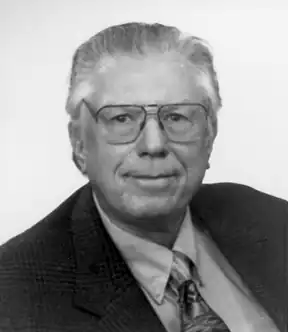
Rudolf J. Siebert (born 1927) is a German-born scholar of religion and critical theorist who is professor emeritus of comparative religion at Western Michigan University (WMU). He taught religion and society at WMU for 54 years, from 1965 until his retirement in 2019.[1][2]
Siebert's scholarship centers on the critical theory of religion, an approach that he and his collaborators have also termed comparative dialectical religiology. The approach developed from the social theory of the Frankfurt School and applies critical theory to the study of religion, theology, secularization, politics and society.[3] His work has been the subject of scholarly collections published in his honor in 1992 and 2020.[4][5]
Early life and education
Siebert was born in Frankfurt am Main, Germany, in 1927.[5] He studied history, philology, philosophy, psychology, sociology, social work and theology at institutions including the universities of Frankfurt, Mainz and Münster and the Catholic University of America in Washington, D.C.[3][5] He later received a doctorate from Johannes Gutenberg University Mainz before beginning his appointment at Western Michigan University in 1965.[1]
Siebert grew up in Frankfurt during the period of Nazi Germany. In later interviews, he described his involvement in Catholic youth circles opposed to National Socialism and said that he resisted being drafted before being compelled to enter the German Air Force at the age of 15.[6][2] Near the end of World War II, Siebert became a prisoner of war in American custody. He was eventually transferred to Camp Allen in Norfolk, Virginia, where he was among German prisoners considered unsympathetic to Nazism and exposed to educational programs intended to promote democratic political ideas in postwar Germany.[2]
After the war, he returned to Germany and continued his university education. He later studied in the United States at the Catholic University of America before ultimately returning to the United States in the early 1960s.[6]
Academic career
Before moving to Michigan, Siebert taught in Baltimore, Maryland.[6] In 1965, he joined Western Michigan University's developing program in religion, where his areas of teaching included ethics, sociology of religion, critical theory and the relationship between religion and society.[1]
Siebert remained at WMU for 54 years. During his career he served as director of the university's Center for Humanistic Future Studies for 39 years and was one of the founders of WMU's chapter of the American Association of University Professors.[1] He also organized long-running international academic programs devoted to religion and society.
One of these was the international course on the Future of Religion at the Inter-University Centre in Dubrovnik, which Siebert directed beginning in the 1970s. The program brought together scholars from different countries to examine religion, secularization, social theory and political conflict.[3][4] He later organized a related international course on Religion and Civil Society in Yalta.[5]
Western Michigan University's history of its religion department has described the Dubrovnik program as an international forum for scholarship on the critical theory of religion. Siebert continued teaching, writing and participating in international academic activity into his later career before retiring from WMU in August 2019.[1]
Critical theory of religion
Siebert's principal scholarly project is the development of a critical theory of religion from the broader critical theory associated with the Institute for Social Research and the Frankfurt School. His work draws on thinkers including Immanuel Kant, Georg Wilhelm Friedrich Hegel, Karl Marx, Sigmund Freud, Max Horkheimer, Walter Benjamin, Theodor W. Adorno, Erich Fromm, Herbert Marcuse and Jürgen Habermas.[3][5]
In a 2013 article written with Michael R. Ott and Dustin J. Byrd, Siebert described critical theory of religion, or comparative dialectical religiology, as developing out of the Frankfurt School's critical theory of society. The authors connected the project to the critique of religion found in German idealism, Marxism and psychoanalysis as well as to religious traditions themselves.[3]
The approach treats religion dialectically rather than interpreting it as either entirely emancipatory or entirely reactionary. The 2020 Brill volume The Critique of Religion and Religion's Critique describes dialectical religiology as concerned both with religion's capacity to criticize modern society and with the criticism of religion by modern philosophical and social thought.[5] In this framework, religious traditions may contain emancipatory ideas concerning justice, solidarity and reconciliation while also containing elements capable of supporting domination, exclusion or social regression.[5]
A recurrent concern in Siebert's work is the relationship between religious and secular reason. Rather than treating secularization as the simple disappearance of religion, his writings examine the continuing interaction between religious traditions and modern philosophy, politics and civil society. Other recurring subjects include the theodicy problem, political theology, fascism, nationalism, war and peace, the relationship between personal autonomy and social solidarity, and the possibility of reconciliation between religious and secular worldviews.[7][8]
Major works
Siebert's 1985 book The Critical Theory of Religion: The Frankfurt School: From Universal Pragmatic to Political Theology presented an extensive account of the relationship between Frankfurt School social theory, religion and political theology.[9] The book was later republished in a new edition.
In From Critical Theory to Critical Political Theology: Personal Autonomy and Universal Solidarity (1994), Siebert connected critical social theory to developments in political theology and communicative rationality, with particular attention to the problem of theodicy and the relationship between autonomy, reconciliation and solidarity.[7]
His three-volume Manifesto of the Critical Theory of Society and Religion was published by Brill in 2010. The work further developed his theory of religion through engagement with psychology, sociology, philosophy, comparative religion and theology.[8]
Reception and legacy
In 1992, theologian A. James Reimer edited The Influence of the Frankfurt School on Contemporary Theology: Critical Theory and the Future of Religion, a collection of papers published in honor of Siebert and associated with the international discussions on the Future of Religion in Dubrovnik.[4] The volume was subsequently reviewed in scholarly journals, including a 1996 review by sociologist and philosopher Michael Löwy in Archives de sciences sociales des religions.[10]
A second scholarly collection devoted to Siebert's work, The Critique of Religion and Religion's Critique: On Dialectical Religiology, was edited by Dustin J. Byrd and published by Brill in 2020. The volume brought together essays examining the development and application of dialectical religiology and was explicitly dedicated to Siebert and his more than five-decade academic career.[5]
Following his retirement, Western Michigan University held the conference Critical Theory and the Study of Religion: A Conference in Honor of Dr. Rudolf Siebert in November 2019. Scholars presented research on critical theory and the academic study of religion in recognition of his career.[11]
Selected bibliography
Books
- Siebert, Rudolf J. (1985). The Critical Theory of Religion: The Frankfurt School: From Universal Pragmatic to Political Theology. De Gruyter. doi:10.1515/9783110859157. ISBN 9783110107296.
- Siebert, Rudolf J. (1994). From Critical Theory to Critical Political Theology: Personal Autonomy and Universal Solidarity. Peter Lang. ISBN 9780820425719.
- Siebert, Rudolf J. (2010). Manifesto of the Critical Theory of Society and Religion: The Wholly Other, Liberation, Happiness and the Rescue of the Hopeless. Vol. 3 vols. Brill. doi:10.1163/9789004191259. ISBN 9789004184367.
Articles
- Siebert, Rudolf J.; Ott, Michael R.; Byrd, Dustin J. (2013). "The critical theory of religion: From having to being". Critical Research on Religion. 1 (1): 33–42. doi:10.1177/2050303213476109.
References
- 1 2 3 4 5 "Beloved WMU religion and society professor retires after a more than five-decade career". Western Michigan University. 2019.
- 1 2 3 Flynn, Erin (December 18, 2019). "Finding Common Ground". W Magazine. Western Michigan University.
- 1 2 3 4 5 Siebert, Rudolf J.; Ott, Michael R.; Byrd, Dustin J. (April 2013). "The critical theory of religion: From having to being". Critical Research on Religion. 1 (1): 33–42. doi:10.1177/2050303213476109.
- 1 2 3 Reimer, A. James, ed. (1992). The Influence of the Frankfurt School on Contemporary Theology: Critical Theory and the Future of Religion: Dubrovnik Papers in Honour of Rudolf J. Siebert. Toronto Studies in Theology. Vol. 64. Edwin Mellen Press. ISBN 9780773491694.
- 1 2 3 4 5 6 7 8 Byrd, Dustin J., ed. (2020). The Critique of Religion and Religion's Critique: On Dialectical Religiology. Studies in Critical Social Sciences. Vol. 165. Brill. doi:10.1163/9789004419049. ISBN 9789004419032.
- 1 2 3 Miller, Kayla (October 22, 2019). "WMU professor, a German soldier during WWII, made theory of peace his life's work". Kalamazoo Gazette.
- 1 2 Siebert, Rudolf J. (1994). From Critical Theory to Critical Political Theology: Personal Autonomy and Universal Solidarity. Peter Lang. ISBN 9780820425719.
- 1 2 Siebert, Rudolf J. (2010). Manifesto of the Critical Theory of Society and Religion: The Wholly Other, Liberation, Happiness and the Rescue of the Hopeless. Studies in Critical Social Sciences. Vol. 20. Brill. doi:10.1163/9789004191259. ISBN 9789004184367.
- ↑ Siebert, Rudolf J. (1985). The Critical Theory of Religion: The Frankfurt School: From Universal Pragmatic to Political Theology. De Gruyter. doi:10.1515/9783110859157. ISBN 9783110107296.
- ↑ Löwy, Michael (1996). "Reimer (A James) éd. The Influence of the Frankfurt School on Contemporary Theology. Critical Theory and the Future of Religion. Dubrovnik Papers in Honour of Rudolf J. Siebert". Archives de sciences sociales des religions (94): 98–99.
- ↑ Flynn, Erin (November 15, 2019). "Former students honor legacy of world-renowned WMU religion and society professor". Western Michigan University.