Roof-end Tile with Human Face Motif
| Roof-end Tile with Human Face Motif | |
|---|---|
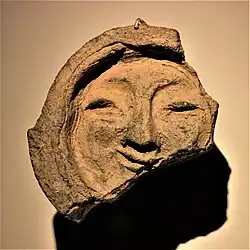 The tile | |
| Discovered | 1932 Gyeongju, Korea under Japanese rule |
The Roof-end Tile with Human Face Motif (Korean: 경주 얼굴무늬 수막새), commonly called a sumaksae (convex roof-end tile) and nicknamed the Smile of Silla (신라의 미소), is a Silla-era (57 BCE – 935 CE) ornamental roof tile found in Gyeongju, South Korea.[1] It was designated as Treasure of South Korea No. 2010 on November 27, 2018.[2]
The tile depicts a smiling human face and is considered an iconic symbol of Gyeongju.[3] It is held in the collection of the Gyeongju National Museum.[4] While most Silla eave tiles were produced using molds, this piece is the only known surviving example made by hand.[1]
History
The tile was recovered from the former site of Yeongmyosa, a Silla temple in Gyeongju (initially identified as Hŭngnyunsa at the time of discovery).[2][3]
In June 1934, Ōsaka Kintarō (大坂金太郞; 1877–1974), then director of the Gyeongju branch of the Government-General Museum, published a paper on the tile.[1][3] Later that year, Japanese doctor and art collector Tanaka Toshinobu (田中敏信; 1908–1993) bought the piece from an antique dealer in Korea and took it to Japan between 1935 and 1940, in violation of heritage export restrictions.[1][5]
In February 1972, Park Il-hun (박일훈; 1913–1975), director of the Gyeongju National Museum, traveled to Japan and requested the return of the artifact.[3] Tanaka agreed and formally donated the tile to the Gyeongju National Museum on October 14, 1972.[1][2]
Artistic significance
Unlike most contemporary East Asian eave tiles, which featured lotus motifs or grotesque masks (Gwi-myeon-wa) intended to ward off evil spirits, this piece shows a human face with a distinct smile.[2]
Art historians note the subtle smile formed by the lips, cheeks, and eyes, which gave rise to its popular nickname, the "Smile of Silla" (Korean: 신라의 미소).[2] Although the lower-right section is missing, the surviving portion retains high-relief details, showing the technique of Silla craftsmen.[1][2]
Legacy
The tile's motif has been widely adapted for public symbolism and commercial design. Regionally, it served as the official mascot for the 1998 Gyeongju World Culture Expo[3] and was later incorporated into the official emblem for the 2025 APEC Summit held in Gyeongju.[6] In commercial design, its iconic smile served as the inspiration for the corporate logo of LG Corporation.[7]
References
- 1 2 3 4 5 6 "The Roof-end Tile with Human Face Motif of Gyeongju - Heritage Search". Korea Heritage Service. Retrieved 2026-08-09.
{{cite web}}: CS1 maint: url-status (link) - 1 2 3 4 5 6 보물 '경주 얼굴무늬 수막새' 지정. Korea Heritage Service (in Korean). Retrieved 2026-08-09.
- 1 2 3 4 5 보물 '얼굴무늬 수막새' 사연 깃든 곳. Gyeongju Sinmun (in Korean). 2025-01-09. Retrieved 2025-01-09.
- ↑ "얼굴무늬 수막새" [Roof-end Tile With Human Face Motif]. Gyeongju National Museum (in Korean). Archived from the original on 2024-05-15. Retrieved 2025-01-23.
- ↑ 조선보물고적명승천연기념물보존령 [Chōsen Treasure, Historic Site, Scenic Beauty and Natural Monument Preservation Decree]. National Legal Information Center (in Korean). 1933-08-09. Retrieved 2026-08-09.
- ↑ "Unveiling of the Official Emblem for the 2025 APEC Summit". Ministry of Foreign Affairs, Republic of Korea. Retrieved 2026-08-09.
- ↑ "LG Brand Story: Corporate Identity Inspiration". LG Corporation. Retrieved 2026-08-09.