Ritápolis National Forest
| Ritápolis National Forest | |
|---|---|
| Floresta Nacional de Ritápolis | |
IUCN category VI (protected area with sustainable use of natural resources) | |
 Ruins of the sugar mill at Fazenda do Pombal, inside Ritápolis National Forest | |
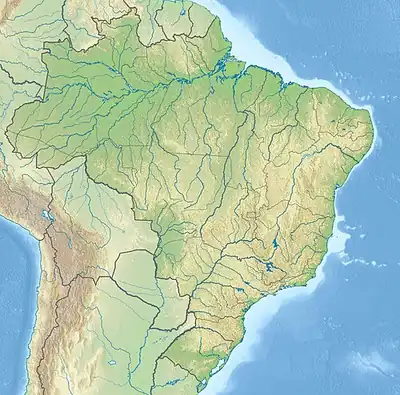  Location within Brazil | |
| Location | Ritápolis, Minas Gerais, Brazil |
| Nearest city | Ritápolis |
| Coordinates | 21°03′21″S 44°15′35″W / 21.05583°S 44.25972°W |
| Area | 89.19 ha (220.4 acres) |
| Designation | National forest |
| Established | 21 September 1999 |
| Administrator | Chico Mendes Institute for Biodiversity Conservation |
Ritápolis National Forest (Portuguese: Floresta Nacional de Ritápolis), also known as FLONA de Ritápolis, is a Brazilian national forest in the municipality of Ritápolis, in Minas Gerais, southeastern Brazil. The federal conservation unit was created on 21 September 1999 and covers 89.19 ha (220.4 acres) in the Atlantic Forest biome. It is administered by the Chico Mendes Institute for Biodiversity Conservation (ICMBio).[1][2][3]
The forest is part of Brazil's National System of Nature Conservation Units (SNUC), where national forests are sustainable-use conservation units. Its purposes include the management of natural resources, protection of water resources, scenic landscapes, and historical and archaeological sites, and support for scientific research, environmental education, recreation, leisure and tourism.[4][2][note 1]
The unit protects secondary forest formations, riparian areas and watercourses in the Rio das Mortes basin. It also contains the ruins of the former Fazenda do Pombal, a rural property linked to the family history of Tiradentes and to the memory of the Inconfidência Mineira.[5][6]
Creation and objectives
Ritápolis National Forest was created by a federal decree of 21 September 1999. The decree assigned its administration to the federal environmental agency then responsible for national conservation units and set out a management plan for the area with natural and cultural preservation goals.[3] ICMBio later became the federal agency responsible for the unit.[1]
The forest was established to promote suitable management of natural resources, protect water resources and scenic landscapes, preserve historical and archaeological sites, and encourage scientific research, environmental education, recreation, leisure and tourism.[3] In the national conservation registry, the unit is classified as a sustainable-use conservation unit and as IUCN category VI.[2]
The SNUC law, adopted in 2000, defines national forests as public-domain areas with forest cover, chiefly native species, intended for multiple sustainable use of forest resources and scientific research, with emphasis on methods for sustainable use of native forests.[4] Ritápolis National Forest fits this framework through a combination of local habitat protection, controlled public use, research and heritage management.[5]
Environmental characteristics
Location and physical setting
Ritápolis National Forest is in the municipality of Ritápolis, in the Campo das Vertentes region of Minas Gerais. The unit lies near the Rio das Mortes, in the hydrographic region of the Paraná. Streams of Rio das Mortes and the Santo Antônio are watercourses found in the area.[2][5]
It is located at 885 to 970 m (2,904 to 3,182 ft) above sea level. The local climate is classified as Cwa in the Köppen climate classification, with warm, rainy summers and dry winters. The rainy season runs mainly from October to March, while the drier season extends from April to September. Mean annual precipitation is about 1,470.4 mm (57.89 in), and the mean annual temperature is about 19.14 °C (66.45 °F).[5]
Vegetation
The forest is within the Atlantic Forest biome. Its vegetation includes seasonal semideciduous forest formations, riparian vegetation and elements associated with the Cerrado.[1][2][5] The area has a long history of human use, including farming, pasture, orchards and eucalyptus plantings connected with the former Fazenda do Pombal. The remaining native vegetation is therefore made up mainly of secondary forest fragments at different stages of regeneration.[5]
The Rio das Mortes and the Santo Antônio stream influence the forest's riparian vegetation and floristic composition. These wetter areas differentiate the vegetation near the watercourses from drier parts of the unit, where semi-deciduous forest and savanna-like elements occur in a mosaic.[5]
Fauna

Surveys conducted in the forest and its surrounding area list amphibians, reptiles, birds and small mammals, together with species commonly associated with secondary Atlantic Forest and Cerrado transition environments.[5] In 2012 a survey recorded 283 individual frogs and toads from 19 species in the national forest and its buffer zone. Rhinella rubescens was the most frequently recorded species in that survey.[7] Another survey in the broader area of the Rio das Mortes and associated forest fragments recorded 29 snake species between January 2012 and July 2013. The study treated the area as a transition between seasonal semideciduous forest and Cerrado within the Atlantic Forest domain.[8]
Fazenda do Pombal
The former Fazenda do Pombal is the principal historic site within Ritápolis National Forest. The estate stood on the right bank of the Rio das Mortes, near the old settlement of Santa Rita do Rio Abaixo, in a rural landscape tied to agriculture, mineral extraction and the routes that connected the interior of Minas Gerais during the eighteenth century.[5][9][10]

The site is closely associated with the childhood of Joaquim José da Silva Xavier, better known as Tiradentes. His parents, Domingos da Silva Santos and Antônia da Encarnação Xavier, lived on the property, and he was born there in 1746, and remained at Pombal until 1757, when, after being orphaned, he went to live with his godfather Sebastião Ferreira Leitão in São José del-Rei, now the city of Tiradentes.[5][9]

It was a working rural and mining estate, producing sugar and gold and had at least 35 enslaved people. The main house had two floors, with the family quarters above and storage, tools and a blacksmithing area below; nearby were slave quarters and a communal kitchen. Water reached the mill through a channel made with hollowed palm trunks over a course of about 4 km (2.5 mi).[5]
The original house and chapel did not survive intact. In 1884, Colonel Emídio de Mendonça dismantled the headquarters and the chapel of Nossa Senhora da Ajuda, reusing their materials at Fazenda Ouro Fino, about 3 km (1.9 mi) from the old Pombal site. Baroque images, the bell, the altar and the chapel door were also removed; some of these objects later entered the Museum of Sacred Art in São João del-Rei.[5][9]
By the twentieth century, the old estate had been reduced to 89.50 ha (221.2 acres). The Ministry of Agriculture acquired the area in 1948, apparently including the portion where the principal house had stood and where the ruins of the headquarters and mill remained.[5]
The area was altered again between 1945 and 1950, when the ground around the former main house was leveled for an agricultural station with orchards and livestock. Within the conservation unit, the remaining foundations, mill ruins and associated structures form part of the site’s heritage landscape, alongside its forest fragments, watercourses and public-use areas.[5]
The remnants of Fazenda do Pombal were entered into the federal heritage-protection process under no. 832/1970, and IPHAN. [11][12] In 1999, the site entered the federal conservation-unit system with the creation of Ritápolis National Forest, whose objectives include the protection of natural resources, watercourses, scenic landscapes, and historical and archaeological sites.[5]
Management, public use and conservation
Ritápolis National Forest is managed by ICMBio. Its management combines the conservation of Atlantic Forest fragments, protection of local water resources, environmental education, controlled visitation, research and the care of historic remains inside the unit.[1][2][5]
Public use is centered on environmental education, guided visitation, local schools, research and interpretation of the forest's natural and historical features. Research activities require authorization and are connected with the unit's management needs, especially the monitoring of fauna, vegetation, water resources and pressures from the surrounding area.[5]
The historic remains of Fazenda do Pombal are managed as part of the national forest. Visitors encounter the ruins in a setting tied to the memory of Tiradentes and to the forested landscape around the Rio das Mortes. Access to the ruins of the farm is free and self-guided.[13] This creates a management setting in which vegetation recovery, visitor access, archaeological care and historical interpretation must be handled within the same protected area.[5][note 2]
See also
Notes
- ↑ In Brazil, national forests are sustainable-use conservation units. They differ from full-protection reserves because controlled use, research and public visitation may be allowed under the management plan.
- ↑ Historical and archaeological assets inside Brazilian federal conservation units must be managed in ways that do not conflict with the environmental purpose of the protected area.
References
- 1 2 3 4 "Flona de Ritápolis". Instituto Chico Mendes de Conservação da Biodiversidade (in Brazilian Portuguese). Government of Brazil. Retrieved 20 May 2026.
- 1 2 3 4 5 6 Relatório do Cadastro Nacional de Unidades de Conservação: Floresta Nacional de Ritápolis (Report) (in Brazilian Portuguese). Ministério do Meio Ambiente e Mudança do Clima. 20 May 2026. Retrieved 20 May 2026.
- 1 2 3 "Decreto de 21 de setembro de 1999" [Decree of 21 September 1999] (PDF) (in Brazilian Portuguese). Presidência da República. 21 September 1999. Retrieved 20 May 2026.
- 1 2 "Lei No. 9.985, de 18 de julho de 2000" [Law No. 9,985 of 18 July 2000] (in Brazilian Portuguese). Presidência da República. 18 July 2000. Retrieved 20 May 2026.
- 1 2 3 4 5 6 7 8 9 10 11 12 13 14 15 16 17 18 Plano de Manejo da Floresta Nacional de Ritápolis/MG, volume 1: Diagnóstico (PDF) (Report) (in Brazilian Portuguese). Instituto Brasileiro do Meio Ambiente e dos Recursos Naturais Renováveis. Retrieved 20 May 2026.
- ↑ Furtado, João Pinto (2002). O manto de Penélope: História, mito e memórias da Inconfidência Mineira (1788-1789) (in Brazilian Portuguese). São Paulo: Companhia das Letras. pp. 83–85. ISBN 9788535902631.
- ↑ D'Angelo, Letícia Romanna Batista; Santos, Ivan Carlos dos; Carrara, Eula Regina; Sousa, Bernadete Maria de; Hudson, Alexandre de Assis (2013). Comportamento defensivo e características das toxinas dos anfíbios anuros das espécies Rhinella schneideri e Rhinella rubescens na Floresta Nacional de Ritápolis (PDF). V Seminário de Pesquisa e Iniciação Científica do Instituto Chico Mendes de Conservação da Biodiversidade (in Brazilian Portuguese). Instituto Chico Mendes de Conservação da Biodiversidade. pp. 28–29. Retrieved 20 May 2026.
- ↑ Carrara, Eula Regina; Santos, Ivan Carlos dos; Sousa, Bernadete Maria de; Souza, Edilberto Magalhães de; Hudson, Alexandre de Assis; Bager, Alex (2013). Herpetofauna squamata afetada por atropelamento na Floresta Nacional de Ritápolis (PDF). V Seminário de Pesquisa e Iniciação Científica do Instituto Chico Mendes de Conservação da Biodiversidade (in Brazilian Portuguese). Instituto Chico Mendes de Conservação da Biodiversidade. pp. 65–66. Retrieved 20 May 2026.
- 1 2 3 "Ritápolis". Biblioteca IBGE (in Brazilian Portuguese). Instituto Brasileiro de Geografia e Estatística. Retrieved 20 May 2026.
- ↑ Maxwell, Kenneth (2010). A devassa da devassa: A Inconfidência Mineira: Brasil e Portugal (1750-1808) (in Brazilian Portuguese). São Paulo: Paz e Terra. pp. 52–55. ISBN 9788577531028.
- ↑ Bens tombados e processos de tombamento em andamento: Minas Gerais (PDF) (Report) (in Brazilian Portuguese). Instituto do Patrimônio Histórico e Artístico Nacional. 17 November 2017. Retrieved 20 May 2026.
- ↑ "1ª fase: Ata da 55ª Reunião Ordinária do Conselho Consultivo - 22/05/1971". Biblioteca Digital do IPHAN (in Brazilian Portuguese). Instituto do Patrimônio Histórico e Artístico Nacional. 22 May 1971. Retrieved 20 May 2026.
- ↑ "Fazenda do Pombal". Portal Minas Gerais (in Brazilian Portuguese). Secretaria de Estado de Cultura e Turismo de Minas Gerais. Retrieved 20 May 2026.
External links
- Official website
 Media related to Floresta Nacional de Ritápolis at Wikimedia Commons
- CNUC report for Ritápolis National Forest
- Protected Planet profile