Richard Francis-Jones
Richard Francis-Jones (born 1960, Hertfordshire, England) is a highly awarded Australian architect. He is the design director of the multidisciplinary design practice Francis-Jones Carpenter (fjcstudio), formerly Francis-Jones Morehen Thorp (fjmt).[1][2] He is a Life Fellow of the Australian Institute of Architects, an honorary fellow of the American Institute of Architects[3] and a Member of the Royal Institute of British Architects.
Education
Francis-Jones graduated from the University of Sydney with a Bachelor of Science (Architecture) in 1981 and a Bachelor of Architecture with First Class Honours and the University Medal in 1985. He attended Columbia University on an ITT Fellowship, where he studied under Kenneth Frampton, completing a Master of Science in Architecture and Building Design in 1987. He subsequently taught at Columbia University as an Adjunct Associate Professor of Architecture. Francis-Jones has taught at many Schools of architecture in Australia, is a former Visiting Professor at the University of New South Wales, and most recently has been teaching at the University of Technology Sydney.
Practice
Following his studies at Columbia University, Francis-Jones practised at firms in New York, Los Angeles and Paris before returning to Sydney in 1989 where he joined fjcstudio’s predecessor, MGT Sydney. He became a director of the firm in 1996 and was a founding partner of Francis-Jones Morehen Thorp in 2003 and Francis-Jones Carpenter in 2023.
fjcstudio (formerly fjmt) has a reputation as an ideas-driven practice "with an agenda for strong public engagement and masterful resolution of tectonics"[4] and the firm’s work demonstrates "an extraordinary ability to uncover the real and often contradictory issues and potentials of a project by a very careful analysis of purpose and place".[5]
Most of the firm’s major commissions have been won by competition and Francis-Jones is supportive of the power of the architectural competition to produce good architecture and create new opportunities for practices: "the more public the competition… the greater the contribution to the wider culture of architecture."[4]
Francis-Jones’ approach is a response to the transition from industrial to digital economies and investigations utilising emerging sciences and technologies are evident. Yet, Francis-Jones considers the potential of this knowledge to address society’s challenges and give architects new scope for imagination is limited by the tendency for architecture to be reduced to fetishised object for consumption.[6] "An authentic contemporary architecture should not only attempt to somehow begin to reconcile humanity’s place in the world but also be directed towards rejuvenating, repoliticising our desiccated public realm. We should pursue an architecture appropriate to citizens rather than consumers."[7]
'…Francis-Jones has possibly been at his best in civic works... More than any other contemporary practice of comparable calibre in Australia, FJMT has been consistently engaged in the design and construction of large-scale public and/or commercial buildings ...Many of these works derive their plastic character from the unique, rather theatrical concept of lateral exfoliation, that is to say the folding out of brises soleil so as to visually engage the surrounding landscape, thereby emphasising a topographical affinity between the building and its context. In all of this work the issue of sustainability is given priority…'
Richard Francis-Jones has led the design for numerous award-winning projects, including the WAF World Building of the Year in 2013 and 2024, the RIBA International Award, the AIA Jørn Utzon Award, the NZ Architecture Medal, AIA Sir Zelman Cowen Award, the AIA William Wardell Award and the Sir John Sulman Medallion.[8]
Francis-Jones was the creative director of the Australian Institute of Architects’ 2008 National Conference, Critical Visions: Form Representation and the Culture of Globalisation, and is an editor of Skyplane and Content: a journal of architecture. Francis-Jones was President of the RAIA (NSW Chapter) from 2001–2002 and was a member of the NSW Architects Registration Board from 2001-2004. He is the Creative Director of ‘circlesix’, a design and architecture venue for critical debate and idea exchange (2025-present)[9]
He is the author of a recently published book on architecture with a second publication due for release in 2026.
Truth and Lies in Architecture (2021)[10]
'These essays written by a leading Australian architect represent a level of comprehensive critical awareness rarely found within the architectural profession and one would be hard pressed to find another comparable figure in contemporary architectural practice...The entire argumentation is impressive, challenging, intellectually at the highest level and beautifully written' – Kenneth Frampton[11]
'Truth and Lies is a tour de force of big architectural issues: truth, lies, theory, image, intuition and consciousness, to name a few... it is both confronting and inspiring in its scope, capturing perfectly the enormity and terror of the architect's task.' – Chris Barton, Architecture Now[12]
Books
Notable projects
- UTS Central[15]
- Darlington Public School[16]
- Surry Hills Library & Community Centre[17]
- Inner Sydney High School[18]
- EY Centre[19]
- Te Ao Mārama - Auckland War Memorial Museum[20]
- The Frank Bartlett Library and Moe Service Centre[21]
- Auckland Art Gallery Toi o Tamaki[22]
- Craigieburn[23]
- Bankstown Library and Knowledge Centre
- Sydney Law School, University of Sydney
- The John Niland Scientia, University of New South Wales[24]
- The Red Centre, University of New South Wales[25]
- St. Barnabas, Broadway
- Darling Quarter, Sydney[26]
- The Waterfront Pavilion – Australian National Maritime Museum
- Bunjil Place
- Sofitel Sydney Darling Harbour[27]
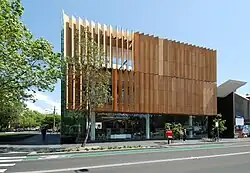 Surry Hills Library
 Auckland Art Gallery redevelopment
Awards
- Australia Award for Urban Design 2012, PIA
- City of Sydney Lord Mayor’s Prize 2013, AIA (NSW)
- Greenway Award for Conservation 2005, AIA
- International Award 2012, RIBA
- International Public Library of the Year 2014, Danish Agency for Culture
- John Verge Award for Interior Architecture 2010, 2015 AIA (NSW)
- Jorn Utzon Award for International Architecture 2012, AIA
- Lachlan Macquarie Award for Heritage 2005, AIA
- Lloyd Rees Award for Excellence in Civic Design 2000, 2013, AIA (NSW)
- Milo Dunphy Award for Sustainable Architecture 2010, 2013, AIA (NSW)
- National Architecture Award for Public Architecture 2010, AIA
- National Architecture Award for Sustainable Architecture 2010, AIA
- NZ Architecture Medal 2012, NZIA
- Sir Arthur G Stephenson Award for Best Commercial Architecture 2013, AIA (NSW)
- Sir John Sulman Award for Outstanding Public Architecture
- Sir Zelman Cowen Award 2000, AIA
- WAF Office Category Winner 2011, 2014
- World Building of the Year Award 2013, WAF
- World Building of the Year Award 2024, WAF[28]
- William Wardell Award 2018[29]
Bibliography
- fjmt studio I Maestri dell'Architettura Collector's Edition - Hachette Publishing, 2019
- Architecture as Material Culture: The Work of Francis-Jones Morehen Thorp with Kenneth Frampton - Oro Editions, 2013
- In the Realm of Learning - The University of Sydney's New Law School by Richard Francis-Jones: Images Publishing, 2009
- The Mint Project by Robert (Editor) Griffin, Paul Berkemeier, Richard Francis-Jones, Gerard Reinmuth, Peter Watts, Philip Thalis, 2009
- World of Art Modern Architecture: A Critical History (Fifth Edition) by Kenneth Frampton, 2020[30]
References
- ↑ "fjmtstudio becomes fjcstudio". fjc studio. 3 April 2023. Retrieved 6 August 2023.
- ↑ "FJMT becomes fjc". LinkedIn. 3 April 2023. Retrieved 6 August 2023.
- ↑ http://www.aia.org/practicing/awards/2012/honorary-fellows/index.htm "2012 Honorary FAIA Announcement"
- 1 2 Watson, F. & Hook, M. (March–April 2010). "Francis-Jones Morehen Thorp (FJMT)". Architectural Design. 80 (2): 118–125. doi:10.1002/ad.1055.
- ↑ Heneghan, T. (May–June 2006). "Max Webber Library". Architecture Australia. 95 (3): 86–95. Archived from the original on 23 July 2011. Retrieved 1 December 2010.
- ↑ Jackson, Davina (2005). "Francis-Jones Morehen Thorp, Sydney". 10 x 10_2: 10 Critics 100 Architects. Phaidon Press. pp. 120–123. ISBN 978-0-7148-3922-6.
- ↑ Francis-Jones, Richard (2000). "The (im)possibility of slowness: a note on globalisation, ideology and speed in contemporary architecture". 10 x 10: 10 Critics 100 Architects. Phaidon Press Limited. pp. 433–434. ISBN 978-0-7148-3922-6.
- ↑ "Awards - fjcstudio". Retrieved 22 April 2026.
- ↑ "circlesix". circlesix. Retrieved 22 April 2026.
- ↑ "Truth and Lies in Architecture". Oro Editions - Publishers of Architecture, Art, and Design. Retrieved 22 April 2026.
- ↑ Ibrahim, Naser Nader (7 March 2022). "'Truth and Lies in Architecture' Delves Deep Into the Soul of Architects and Their Work". AmazingArchitecture. Retrieved 22 April 2026.
- ↑ "Review: Truth and Lies in Architecture". Architecture Now. Retrieved 22 April 2026.
- ↑ "Architecture as Material Culture, the Work of Francis-Jones Morehen Thorp with Kenneth Frampton by Richard Francis-Jones | 9781935935148 | Booktopia".
- ↑ "Truth and Lies in Architecture : Richard Francis-Jones : 9781954081659".
- ↑ "UTS Central".
- ↑ "Darlington Public School - fjcstudio". 30 November 2016. Retrieved 22 April 2026.
- ↑ Surry Hills Library & Community Centre
- ↑ "Inner Sydney High School". 12 March 2021.
- ↑ "EY Centre by fjmtstudio". 20 June 2017.
- ↑ "Te Ao Mārama Project, Auckland War Memorial Museum/ Tāmaki Paenga Hira | Best Awards".
- ↑ "The Frank Bartlett Library and Moe Service Centre - FJMT". 15 May 2017.
- ↑ Architecture Now: "Auckland Art Gallery Toi o Tamaki"
- ↑ "Craigieburn Library". 20 July 2016.
- ↑ John Niland Scientia, University of New South Wales
- ↑ Red Centre, University of New South Wales
- ↑ Darling Quarter, Sydney
- ↑
- ↑ "Sydney public school named best building worldwide". ABC News. 11 December 2024. Retrieved 29 January 2026.
- ↑ "Bunjil Place Awards". Bunjil Place. 7 May 2018. Retrieved 22 April 2026.
- ↑ "Modern Architecture". Thames & Hudson Australia. Retrieved 22 April 2026.