Religious Freedom & Business Foundation

Religious Freedom & Business Foundation (RFBF) is an international relations foundation, founded by Brian J. Grim, that works with global business, policymakers, non-government organizations (NGOs), and consumers that develop freedom of religion or belief (FoRB) pluralist corporate education[1] on issues related to religion and economic development.[2]

Its human resources management job analysis and labor relations studies[3] are responsible for its justice equity diversity inclusion (JEDI) cultural diplomacy framework,[4] the Religious Equity Diversity Inclusion (REDI) Index[5] international ranking,[6] Dare to Overcome (DTO), and the creation of several multifaith spaces along interfaith employee resource groups (ERGs) worldwide.[7]
History
In 2014 the foundation was established by Brian J. Grim.[8][9][10][11][12]
Methodology
RFBF's Researches produces open publications on the relationship between religion and economic activity, contributing to broader academic and policy discussions on religion’s role in society on a body of scholarship by it founder and collaborators on religious demography, regulation of religion, and global religious trends[13][14] that have been cited in policy and nonprofit discussions highlighting religion as a contributor to national economies.[15]
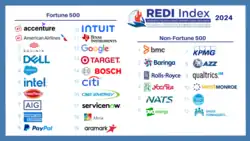
Religious Equity, Diversity & Inclusion (REDI) Index is an initiative that evaluates companies corporative policies and practices related to religious inclusion in the workplace and has been referenced in reporting on the growing role of religion in corporate belonginf programs, including the expansion of faith-based employee resource groups and accommodation policies.[16]
Dare to Overcome (DTO) is a conference series that focuses on religion in the workplace and interfaith collaboration in business contexts to discuss religious inclusion and workplace practices [17][18][19] being recognized as a broader international religious best practice in civil participation engagement with its forums like the International Religious Freedom (IRF) Builders Forum.[20]
Training and workplace engagement provided by the foundation develops training and advisory services related to religion in the workplace, including guidance on religious accommodation and inclusion so reflecting workplace trends in which employers are increasingly addressing religion alongside other dimensions of employee identities.his approach aligns with wider public and policy discussions about religion’s role in workplace expression and employee rights.[21]
Recognition
RFBF's focus on the intersection of religion and business on the international markets that associates it with economic outcomes and societal stability[22][23] led the nonpartisan[24] religious role in the workplace promotion organization to be recognized by the World Economic Forum (WEF),[25] influence the Fortune 500,[26][27] and be used by the G20 Interfaith Forum (IF20).[28]
See also
References
- ↑ "About Our Work". Religious Freedom & Business Foundation (RFBF). 2022-04-08. Retrieved 2026-03-16.
- ↑ "Can global religious freedom support equal rights?". USCIRF.
- ↑ Hasan, Ed (2022), "Praying for Faith-Based Employee Resource Groups in America", Palgrave Studies in Equity, Diversity, Inclusion, and Indigenization in Business, Cham: Springer International Publishing, pp. 77–87, ISBN 978-3-030-89772-7, retrieved 2026-03-16
- ↑ Miller, Jennifer (2023-09-22). "What Happens When the Boss Invites You to Bible Study?". The New York Times. ISSN 0362-4331. Retrieved 2026-03-16.
- ↑ "REDI Index". Religious Freedom & Business Foundation (RFBF). 2019-12-12. Retrieved 2026-03-16.
- ↑ DeRose, Jason (2023-05-22). "Intel named most faith-friendly company". NPR. Retrieved 2026-03-16.
- ↑ Ahmad, Sumreen (2025-05-29). "Why We Need Faith Inclusion in the Workplace". Interfaith America. Retrieved 2026-03-16.
- ↑ "Dr. Brian J. Grim". Boston University Institute on Culture, Religion & World Affairs.
- ↑ "Brian Grim". Berkley Center for Religion, Peace, and World Affairs.
- ↑ "Brian J. Grim". Baylor Institute for Studies of Religion.
- ↑ "Brian J. Grim". Google Scholar.
- ↑ "Mapping the global religious landscape". BBC News.
- ↑ The World's Religions in Figures. Wiley. 2013.
- ↑ The Global Religious Landscape (Report). Pew Research Center. 2012.
- ↑ "Religion a major driver of national economy". Nonprofit Quarterly.
- ↑ "More firms are boosting faith-based support for employees". Fox Business.
- ↑ "Dare to Overcome".
- ↑ "Global Forums and Conferences". Religious Freedom & Business Foundation.
- ↑ "Dare to Overcome Conference BYU–Hawaii". Brigham Young University–Hawaii.
- ↑ "IRF Builders Forum". IRF Secretariat.
- ↑ "Federal workers and religious expression debates". The Washington Post.
- ↑ Grim, Brian J. (2008). "Religious freedom: Good for what ails us?". The Review of Faith & International Affairs.
- ↑ Grim, Brian J. (2016). "The socio-economic contributions of religion to American society". Interdisciplinary Journal of Research on Religion.
- ↑ "Religious Freedom & Business Foundation". APPG for International Freedom of Religion or Belief.
- ↑ "Religious Freedom and Business Foundation (RFBF)". World Economic Forum. 2026-03-16.
- ↑ Boyle, Gavin (2025-05-23). "Religion on the Rise at Fortune 500 Companies". Movieguide | The Family Guide to Movies & Entertainment. Retrieved 2026-03-16.
- ↑ Fuzy, Jeremy (2024-05-21). "New Report Finds 'Surge' in Corporate Attention to Religious Diversity". Word&Way. Retrieved 2026-03-16.
- ↑ "Bringing Faith and Policy Together". G20 Interfaith Forum (IF20). Retrieved 2026-03-16.