Reinforced concrete bridge

A reinforced concrete bridge is a bridge constructed using reinforced concrete as the primary material. It is a structure in which concrete serves as the main component, with internal steel reinforcement arranged to work compositely to withstand tensile and compressive stresses.[1] Within the broader classification of concrete bridges, they are distinct from plain concrete bridges, which are constructed without reinforcement and rely purely on the compressive strength of the concrete.[2]
Due to the cost-effectiveness, durability and structural flexibility of reinforced concrete, this type of bridge came to dominate modern infrastructure construction throughout the 20th century.[3]
History and development

The practice of incorporating steel reinforcement into concrete to form reinforced concrete and utilizing it in engineering structures began around 1861, initially appearing in dams, pipelines, and floor slabs.[4][5] Reinforced concrete bridges emerged shortly after in the latter half of the 19th century.[6]
In 1875, Joseph Monier (1828–1906), a French horticulturist, constructed the world’s first reinforced concrete bridge in Paris.[7] This pedestrian arch bridge featured a span of 16 metres and a width of 4 metres. Although its structural design was constrained by the limited understanding of structural mechanics at the time, it marked humanity’s official entry into the era of reinforced concrete bridge construction.[3]
Subsequent development proceeded at a rapid pace. Through continuous research into the mechanical properties of reinforced concrete and extensive experimentation, reinforced concrete bridges with designs that generally followed mechanical principles and featured relatively reasonable reinforcement were widely applied worldwide over the course of more than a century, particularly for working bridges in river valleys and water conservancy projects with small to medium spans.[8]
Advantages and disadvantages
Compared to alternative structures, such as steel bridges or prestressed concrete bridges, reinforced concrete bridges offer distinct advantages and disadvantages in both engineering and economic terms.[9]

The primary bulk materials, specifically sand and gravel aggregates, can frequently be sourced locally, significantly reducing material transportation costs.[9] This type of bridges require substantially less steel than full steel structures and generally incur lower long-term maintenance costs.[10] They can be constructed rapidly on a large scale utilizing industrialized, mechanized, and prefabricated assembly methods.[11] Reinforced concrete structures also typically exhibit lower traffic noise, high structural stiffness, and a long service life under standard environmental conditions.[12]
However, the high self-weight of concrete limits its efficiency. For extra-large-span bridges, this type is generally less competitive than prestressed concrete or steel bridges regarding span capacity, construction speed, and structural efficiency.[13] These bridges are also highly prone to reinforcement corrosion initiated by concrete carbonation, chloride penetration and the propagation of cracks within the structural girders.[14] Repairing corroded structures requires specialized remediation techniques, such as removing the carbonated concrete layer and patching the zone with epoxy resin mortar or fine-aggregate concrete mixed with anti-corrosion materials.[15]
Classification
Reinforced concrete bridges are primarily classified based on their structural mechanics and load-transfer mechanisms into three major types: arch bridges, beam bridges, and rigid-frame bridges.[16]
Arch bridges

Long-span reinforced concrete bridges are most commonly found among arch bridges. An arch bridge is a compression-bending member that primarily withstands axial compression, allowing it to fully leverage concrete’s high compressive strength.[17]
With the integration of steel reinforcement, modern reinforced concrete arch bridges can be constructed to be highly slender and lightweight while still achieving substantial spans.[18] A prominent example is the Wanzhou Yangtze River Bridge in Chongqing, which features a main span of 420 metres. Depending on the relative position of the bridge deck to the arch ring, reinforced concrete arch bridges include top-supported (deck arch), mid-supported (half-through arch), and bottom-supported (through arch) configurations.[19]
Beam bridges

Beam bridges represent the most widespread and structurally straightforward type of bridge infrastructure. Because conventional concrete possesses low tensile strength, it frequently operates under normal service conditions with cracks, which restricts both its maximum span capacity and long-term durability.[20]
Consequently, the span of ordinary reinforced concrete beam bridges is typically limited to within 20 metres. Common cross-sectional geometries include solid and hollow rectangular slabs, ribbed beams (T-beams)[21], and box girder configurations. These elements are widely utilized both as the traffic deck slabs of arch bridges and as short and medium span beam bridges.[22]
Rigid-frame bridges

Reinforced concrete rigid-frame bridges consist of an upper beam or slab structure integrally connected to the supporting lower columns or piers. Because the structural joints are rigidly connected, the piers and the deck share the bending moment.[23] This mechanism reduces the positive bending moment at the midspan of the main beam, enabling the superstructure to be constructed with a thinner cross-section.[24]
Rigid-frame bridges offer greater vertical clearance beneath the superstructure compared to arch bridges, allowing for smaller total structural spans while satisfying the same clearance requirements. The construction of these systems is relatively complex; thus, they are generally deployed for urban overpasses and highway interchanges with modest spans. Common types include straight-leg (gantry) and slant-leg rigid-frame bridges.[25]
Construction techniques and methods
The construction of reinforced concrete bridges generally falls into two primary methodologies depending on where the concrete is placed and cured: cast-in-place concrete and precast assembly systems.[26]
Cast-in-place concrete

The general workflow for cast-in-place (also known as monolithic) reinforced concrete bridges involves erecting temporary shoring, scaffolding, and formwork directly at the designated bridge site. This is followed by the onsite fabrication and tying of the steel rebar cage, casting ready-mix or site-mixed concrete into the molds, and executing curing protocols.[26] During onsite construction, reinforcing bars must undergo straightening, derusting, and mechanical cutting. Structural elements such as columns and other prefabricated components are typically erected and installed after being assembled offsite as rigid reinforced steel frameworks.[27]
The primary advantages of this method include superior structural integrity due to its monolithic joints, high architectural plasticity, and excellent geometric adaptability to complex alignments and varying spans. However, it requires a longer construction duration and is highly sensitive to on-site weather conditions.[3]
Precast assembly systems

The construction process for precast assembly systems involves casting and curing structural bridge segments or the entire deck grid in advance at a specialized precast yard or manufacturing plant.[28][29] Once the concrete reaches its design strength, these prefabricated elements are transported to the construction site and erected into position utilizing specialized bridge-erection machines or heavy-duty cranes.[30]
This industrialized methodology facilitates accelerated bridge construction (ABC), ensures stricter quality control of the concrete matrix, and reduces vulnerability to onsite human errors and weather uncertainties.[31] Furthermore, it causes minimal disruption to the existing traffic networks and environment beneath the bridge during the span erection phase.[32]
Deterioration and maintenance
The long-term performance of reinforced concrete bridges is significantly governed by environmental degradation and material pathologies, which compromise both structural safety and serviceability. Consequently, various repair and maintenance measures have been developed to ensure the stable performance of reinforced concrete bridges during their service life.[33]
Reinforcement corrosion

Reinforcement corrosion is the primary cause of structural deterioration in reinforced concrete bridges, typically initiated by two distinct environmental mechanisms: carbonation and chloride ingress.[34]
Carbonation-induced corrosion
Concrete carbonation occurs when atmospheric carbon dioxide (CO2) diffuses into the concrete matrix through its capillary pores. The CO2 reacts with free calcium hydroxide (Ca(OH)2) within the pore solution to form calcium carbonate (Ca(CO)3). This chemical reaction neutralizes the concrete, reducing its highly alkaline pH (from approximately 12.5–13.5 to below 9).[35]
When carbonation penetrates beyond the concrete cover and reaches the reinforcement, the protective passivation film on the reinforcement surface is destroyed.[36] In the presence of oxygen and moisture, active uniform corrosion is initiated, leading to a cross-sectional loss of the steel, shrinkage cracking, and the progressive breakdown of the concrete's cement gel structure.[37]
Chloride-induced corrosion
Chloride-induced corrosion is highly prevalent in bridges exposed to deicing salts, marine environments, or coastal atmospheres. Chloride ions (Cl−) gradually accumulate on the surface of reinforced concrete bridges.[38] At the same time, these chloride ions penetrate into the concrete until the concentration on the rebar surface reaches a critical value, causing the oxide film on the rebar surface to break down and leading to pitting corrosion.[39]
As iron oxidizes, the corrosion products (rust) undergo volume expansion, occupying 2 to 6 times the volume of the original steel. This volumetric expansion exerts immense internal expansive pressure, exceeding the ultimate tensile strength of the concrete cover. Consequently, this leads to cracking along the bar longitudinal axis and eventual spalling. Both the material properties and the overall performance of the bridge deteriorate significantly.[40]
The transport mechanism of chloride ions through concrete is mathematically modeled using Fick's second law of diffusion:[41]
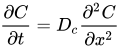
where represents the chloride concentration at depth and time , and is the apparent chloride diffusion coefficient.


Other structural defects
Beyond reinforcement corrosion, reinforced concrete bridges are susceptible to several other material and environmental defects:
- Freeze-thaw damage: Cyclic freezing and thawing of water within the concrete pores generates hydraulic pressure, leading to cracking, scaling, and severe strength degradation.[42][43]
- Alkali-aggregate reaction (AAR): Specifically alkali–silica reaction (ASR), where reactive silica in the aggregates reacts with alkaline hydroxides in the cement, forming an expansive gel that causes widespread cracking.[44][45]
- Concrete spalling: The breaking away of concrete fragments from the bridge, often accelerated by external impact, thermal shocks, or internal expansive pressure from embedded rust growth.[46]
Repair techniques

The repair of deteriorated reinforced concrete bridges typically involves a multi-step intervention strategy designed to restore cross-sectional integrity and halt further environmental ingress:[47]
- Crack remediation: Crack sealing or grouting is performed on structural girders to seal cracks, closing the pathways for moisture and aggressive agents.[48]
- Substrate preparation: Carbonated concrete is chiseled away until uncarbonated concrete is reached. This is followed by sandblasting of both the concrete substrate and the exposed reinforcement surfaces to completely remove loose rust.[33]
- Cross-sectional restoration and barrier coating: The original structural geometry is restored using epoxy resin mortar. Subsequently, a protective polyurethane-based surface coating is applied. This barrier not only decelerates atmospheric carbonation but also blocks the penetration of harmful chemical species such as chloride ions.[49]
This repair method not only delays concrete carbonation but also effectively prevents the ingress of harmful ions such as chloride ions, achieving excellent repair results.[50] Additionally, for corroded reinforcement where complete rust removal and chiseling out of contaminated concrete is difficult, repair mortar or fine-aggregate concrete mixed with anti-corrosion materials can be used to treat the corroded areas. In addition to isolating the corrosive environment, this mortar or concrete primarily relies on its anti-corrosion components to inhibit the action of harmful ions within the concrete, thereby preventing further corrosion of the reinforcement.[51][52]
Notable global examples
The following historical and contemporary structures represent major engineering milestones in the evolution, scaling, and structural capacity of reinforced concrete bridge engineering:
- Alvord Lake Bridge (United States, 1889) – Located in San Francisco, California, this structure is widely recognized as the oldest surviving reinforced concrete bridge in the world. Built by concrete pioneer Ernest L. Ransome, it utilized his patented cold-twisted square reinforcement.[53]
- Plougastel Bridge (France, 1930) – Also known as the Albert-Louppe Bridge, this three-span continuous arch bridge featured a single span of 188 metres, which was a record at the time of its completion. Designed by the structural engineer Eugène Freyssinet, it was a pioneer in advanced decentered and formwork methodologies.[54]
- Krk Bridge (Croatia, 1980) – Spanning the Krk Channel, this monumental structure held the world record for the longest concrete arch span at 390 metres at the time of its completion, a record it successfully maintained for 17 years.[55]
- Wanzhou Yangtze River Bridge (China, 1997) – Located in Wanzhou, Chongqing, this massive infrastructure project was at its completion the world’s longest-span reinforced concrete arch bridge, featuring a single main arch span of 420 metres.[56]
- Tian'e Longtan Bridge (China, 2024) – Crossing the Hongshui River, this bridge has a span of 600 metres and is currently the world's longest-span reinforced concrete arch bridge.[57]
See also
References
- ↑ Nilson, Arthur H.; Darwin, David; Dolan, Charles W. (2010). Design of Concrete Structures (14th ed.). McGraw-Hill. p. 150. ISBN 978-0073293493.
- ↑ Billington, D. P. (1979). "History and aesthetics of modern concrete bridges". ASCE Journal of the Structural Division. 105 (11): 2355–2376. doi:10.1061/JSDEAG.0005312.
- 1 2 3 Fernández Troyano, Leonardo (2003). Bridge Engineering: A Global Perspective. Thomas Telford. p. 152. ISBN 978-0727732156.
- ↑ Moussard, M.; Garibaldi, P.; Curbach, M. (2017). "The invention of Reinforced concrete (1848–1906)". High Tech Concrete: Where Technology and Engineering Meet: Proceedings of the 2017 fib Symposium. Cham: Springer International Publishing. pp. 2785–2794.
- ↑ Billington, D. P. (2004). "Historical perspective on concrete bridge engineering". Progress in Structural Engineering and Materials. 6 (1): 48–56. doi:10.1002/pse.166.
- ↑ Radić, J.; Kindij, A.; Mandić, A. (2008). "History of concrete application in development of concrete and hybrid arch bridges". Proceedings of The Chinese-Croatian Joint Colloquium on Long Arch Bridges. Croatian University of Zagreb, University of FuZhou. pp. 9–118.
- ↑ Collins, M. P. (2001). "A century of successful reinforced concrete bridges". Concrete International. 23 (11): 44–51.
- ↑ Chen, Wai-Fah; Duan, Lian (2014). Bridge Engineering Handbook: Substructure Design (2nd ed.). CRC Press. p. 420. ISBN 978-1439810293.
- 1 2 Horvath, A.; Hendrickson, C. (1998). "Steel versus steel-reinforced concrete bridges: Environmental assessment". ASCE Journal of Infrastructure Systems. 4 (3): 111–117. doi:10.1061/(ASCE)1076-0342(1998)4:3(111).
- ↑ Mailyan, D.; Kubasov, A.; Mailyan, L. (2016). "Ecological-Economic and Technical Advantages of Reinforced Concrete Girders with Combined Reinforcement". MATEC Web of Conferences. 73: 04019.
- ↑ Rwamamara, R.; Simonsson, P.; Ojanen, J. (2010). "Advantages of industrialized methods used in small bridge construction". Annual Conference of the International Group for Lean Construction. Technion-Israel Institute of Technology. pp. 569–579.
- ↑ Mehta, P. Kumar; Monteiro, Paulo J. M. (2014). Concrete: Microstructure, Properties, and Materials (4th ed.). McGraw-Hill. p. 310. ISBN 978-0071797870.
- ↑ Diers, J.; Schacht, G. (2025). "Modification of the partial safety factor for dead loads of existing concrete bridges". ce/papers. 8 (3–4): 212–218.
- ↑ Vu, K. A. T.; Stewart, M. G. (2000). "Structural reliability of concrete bridges including de-icing salts and carbonation". Structural Safety. 22 (4): 315–333. doi:10.1016/S0167-4730(00)00018-7.
- ↑ Grantham, Michael G. (2011). Concrete Repair: A Practical Guide. Spon Press. p. 78. ISBN 978-0415222945.
- ↑ Bruun, E. P. (2014). "Robert Maillart: The Evolution of Reinforced Concrete Bridge Forms". 9th International Conference on Short and Medium Span Bridges. pp. 15–18.
- ↑ Salonga, J.; Gauvreau, P. (2014). "Comparative study of the proportions, form, and efficiency of concrete arch bridges". ASCE Journal of Bridge Engineering. 19 (3): 04013010.
- ↑ Au, F. T. K.; Wang, J. J.; Liu, G. D. (2003). "Construction control of reinforced concrete arch bridges". Journal of Bridge Engineering. 8 (1): 39–45.
- ↑ Zanardo, G.; Pellegrino, C.; Bobisut, C.; Modena, C. (2004). "Performance evaluation of short span reinforced concrete arch bridges". Journal of Bridge Engineering. 9 (5): 424–434.
- ↑ Nilson, Arthur H.; Darwin, David; Dolan, Charles W. (2010). Design of Concrete Structures (14th ed.). McGraw-Hill. p. 190. ISBN 978-0073293493.
- ↑ Shreedhar, R.; Mamadapur, S. (2012). "Analysis of T-beam bridge using finite element method". International Journal of Engineering and Innovative Technology (IJEIT). 2 (3): 340–346.
- ↑ Bazant, Z. P.; Oh, B. H. (1983). "Crack spacing and crack width in reinforced concrete". ACI Journal Proceedings. 80 (5): 390–397. doi:10.14359/10865.
- ↑ Huang, H. (2012). "Design of long-span continuous rigid frame bridges". ASCE Journal of Bridge Engineering. 17 (2): 340–348. doi:10.1061/(ASCE)BE.1943-5592.0000252.
- ↑ Chen, Wai-Fah; Duan, Lian (2014). Bridge Engineering Handbook: Substructure Design (2nd ed.). CRC Press. p. 445. ISBN 978-1439810293.
- ↑ Peng, Y.; Zhang, Z. (2020). "Development of a novel type of open-web continuous reinforced-concrete rigid-frame bridge". Journal of Bridge Engineering. 25 (8): 05020005.
- 1 2 Simonsson, P. (2008). Industrial bridge construction with cast in place concrete: new production methods and lean construction philosophies (Doctoral dissertation thesis). Luleå tekniska universitet.
- ↑ Russell, H. G. (2004). "Concrete bridge technology". Concrete International. 26 (8): 55–60.
- ↑ Lounis, Z.; Cohn, M. Z. (1993). "Optimization of precast prestressed concrete bridge girder systems". PCI Journal. 38 (4): 60–78.
- ↑ fib (2004). Precast Concrete Bridges (Bulletin 29). fib. p. 42. ISBN 978-2883940697.
- ↑ Hieber, D. G.; Wacker, J. M.; Eberhard, M. O.; Stanton, J. F. (2005). State-of-the-art report on precast concrete systems for rapid construction of bridges (Report).
- ↑ Khan, Mohiuddin Ali (2014). Accelerated Bridge Construction: Best Practices and Techniques. Elsevier. p. 112. ISBN 978-0124072244.
- ↑ Attanayake, U.; Aktan, H. (2015). "First-generation ABC system, evolving design, and half a century of performance: Michigan side-by-side box-beam bridges". Journal of Performance of Constructed Facilities. 29 (3): 04014090.
- 1 2 Klym, A.; Blikharskyy, Y.; Gunka, V.; Poliak, O; Selejdak, J.; Blikharskyy, Z. (2025). "An Overview of the Main Types of Damage and the Retrofitting of Reinforced Concrete Bridges". Sustainability. 17 (6): 2506.
- ↑ Zhou, Y.; Gencturk, B.; Willam, K.; Attar, A. (2015). "Carbonation-induced and chloride-induced corrosion in reinforced concrete structures". Journal of Materials in Civil Engineering. 27 (9): 04014245.
- ↑ Fuhaid, A. F. A.; Niaz, A. (2022). "Carbonation and corrosion problems in reinforced concrete structures". Buildings. 12 (5): 586.
- ↑ Gonzalez, J. A.; Algaba, J. S.; Andrade, C. (1980). "Corrosion of reinforcing bars in carbonated concrete". British Corrosion Journal. 15 (3): 135–139.
- ↑ Papadakis, V. G.; Vayenas, C. G.; Fardis, M. N. (1991). "Experimental investigation and mathematical modeling of the concrete carbonation problem". Chemical Engineering Science. 46 (5–6): 1333–1338. doi:10.1016/0009-2509(91)85060-B.
- ↑ Hájková, K.; Šmilauer, V.; Jendele, L.; Červenka, J. (2018). "Prediction of reinforcement corrosion due to chloride ingress and its effects on serviceability". Engineering Structures. 174: 768–777.
- ↑ El Alami, E.; Fekak, F. E.; Garibaldi, L.; Elkhalfi, A. (2021). "A numerical study of pitting corrosion in reinforced concrete structures". Journal of Building Engineering. 43: 102789.
- ↑ Zhang, R.; Castel, A.; François, R. (2010). "Concrete cover cracking with reinforcement corrosion of RC beam during chloride-induced corrosion process". Cement and Concrete Research. 40 (3): 415–425.
- ↑ Poulsen, Ervin; Mejlbro, Leif (2006). Chloride Penetration into Concrete: Concepts and Predictions. Thomas Telford. p. 12. ISBN 978-0727734501.
- ↑ Mehta, P. Kumar; Monteiro, Paulo J. M. (2014). Concrete: Microstructure, Properties, and Materials (4th ed.). McGraw-Hill. p. 135. ISBN 978-0071797870.
- ↑ Sakulich, A. R.; Bentz, D. P. (2012). "Increasing the service life of bridge decks by incorporating phase-change materials to reduce freeze-thaw cycles". Journal of Materials in Civil Engineering. 24 (8): 1034–1042.
- ↑ Mehta, P. Kumar; Monteiro, Paulo J. M. (2014). Concrete: Microstructure, Properties, and Materials (4th ed.). McGraw-Hill. p. 155. ISBN 978-0071797870.
- ↑ Fournier, B.; Bérubé, M. A. (2000). "Alkali-aggregate reaction in concrete: a review of basic concepts and engineering implications". Canadian Journal of Civil Engineering. 27 (2): 167–191.
- ↑ Angst, U.; Elsener, B.; Jamali, A.; Adey, B. (2012). "Concrete cover cracking owing to reinforcement corrosion—theoretical considerations and practical experience". Materials and Corrosion. 63 (12): 1069–1077. doi:10.1002/maco.201206669.
- ↑ Jumaat, M. Z.; Kabir, M. H.; Obaydullah, M. (2006). "A review of the repair of reinforced concrete beams". Journal of Applied Science Research. 2 (6): 317–326.
- ↑ Hopper, T.; Manafpour, A.; Warn, G.; Rajabipour, F.; Morian, D.; Jahangirnejad, S. (2015). Bridge deck cracking: effects on in-service performance, prevention, and remediation (Report).
- ↑ Grantham, Michael G. (2011). Concrete Repair: A Practical Guide. Spon Press. p. 78. ISBN 978-0415222945.
- ↑ Delatte, N., ed. (2009). Failure, Distress and Repair of Concrete Structures. Elsevier. ISBN 978-1845694036.
- ↑ Grantham, Michael G. (2011). Concrete Repair: A Practical Guide. Spon Press. p. 95. ISBN 978-0415222945.
- ↑ Al Hawarneh, A.; Shahria Alam, M. (2025). "Maintenance optimization model for existing reinforced concrete bridge piers based on an integrated life-cycle cost and performance-based design approach". Journal of Structural Engineering. 151 (10): 04025157.
- ↑ Reis, E. E. (1999). "Historical Concrete Bridges". Concrete International. 21 (6): 55–58.
- ↑ Billington, D. P. (1981). "The Albert Louppe Bridge and Eugène Freyssinet". ASCE Journal of the Structural Division. 107 (10): 1995–2001. doi:10.1061/JSDEAG.0005792.
- ↑ Šavor, Z.; Šavor, M.; Srbić, M. (2009). "Krk bridge from inception to today". Construction of Arch Bridges. pp. 377–395.
- ↑ Chen, Q.; Zhang, Y.; Xiang, H. W.; Wang, S. G. (2015). "Construction control techniques of long-span steel truss arch bridges". Journal of Highway and Transportation Research and Development (English Edition). 9 (1): 35–44.
- ↑ Luo, Chao; Zhou, Jianting; Xin, Jingzhou; Fan, Yonghui; Zhou, Yin; Tang, Qizhi; Yang, Jun (2024). "Large-scale model test on the construction process of a stiff skeleton arch bridge with the span of 600 m". Case Studies in Construction Materials. 21 e03783. doi:10.1016/j.cscm.2024.e03783.
Further reading
- Barker, R. M.; Puckett, J. A. (2013). Design of Highway Bridges: An LRFD Approach (3rd ed.). John Wiley & Sons. ISBN 978-1118316443. – A guide on structural mechanics and loading protocols for concrete and steel bridges.
- Cope, R. J. (1987). Concrete Bridge Engineering: Performance and Advances. Elsevier Applied Science. ISBN 978-0853344407. – A reference focusing on the material performance and experimental testing of reinforced concrete bridge components.
- fib (2008). Bulletin 43: Structural connections for precast concrete bridges. International Federation for Structural Concrete. ISBN 978-2883940833. – A report detailing seismic and structural detailing for prefabricated assembly systems.
- Melchers, R. E.; Beck, A. T. (2018). Structural Reliability Analysis and Prediction (3rd ed.). John Wiley & Sons. ISBN 978-1119265993. – Recommended for understanding the spatio-temporal variability, degradation modeling, and structural reliability of deteriorating concrete infrastructure.
External links
- American Concrete Institute (ACI) – Official website of the global authority on concrete design, structural codes, and material certifications.
- International Federation for Structural Concrete (fib) – The leading non-profit organization dedicated to the advancement of concrete structural performance and precast infrastructure globally.
- American Society of Civil Engineers (ASCE) – Official portal containing international engineering journals, structural asset management guidelines, and bridge engineering codes.
- Institution of Civil Engineers (ICE) – A premier global charter based in the UK, providing historical archives, technological briefs, and asset preservation strategies for major concrete crossings.