Pythagoras number
In mathematics, the Pythagoras number or reduced height of a field describes the structure of the set of squares in the field. The Pythagoras number of a field is the smallest positive integer such that every sum of squares in is a sum of squares.


A Pythagorean field is a field with Pythagoras number 1: that is, every sum of squares is already a square.
Examples
- Every non-negative real number is a square, so .
- For a finite field of odd characteristic, not every element is a square, but all are the sum of two squares,[1] so .
- By Lagrange's four-square theorem, every positive rational number is a sum of four squares, and not all are sums of three squares, so .


Properties
- Every positive integer occurs as the Pythagoras number of some formally real field.[2]
- The Pythagoras number is related to the Stufe by .[3] If is not formally real then ,[4] and both cases are possible: for we have , whereas for we have , .[5]


- As a consequence, the Pythagoras number of a non-formally-real field is either a power of 2, or 1 more than a power of 2. All such cases occur: i.e., for each pair of the form or , there exists a field such that .[6] For example,
- quadratically closed fields and fields of characteristic 2 give ;
- for primes , and the p-adic field give ;
- for primes , gives and gives ;
- gives , and
- the function field gives .






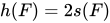
- The Pythagoras number is related to the height of a field : if is formally real then is the smallest power of 2 which is not less than ; if is not formally real then .[7]


Notes
- ↑ Lam (2005), p. 36.
- ↑ Lam (2005), p. 398.
- ↑ Rajwade (1993), p. 44.
- ↑ Rajwade (1993), p. 228.
- ↑ Rajwade (1993), p. 261.
- ↑ Lam (2005), p. 396.
- ↑ Lam (2005), p. 395.
References
- Lam, Tsit-Yuen (2005). Introduction to Quadratic Forms over Fields. Graduate Studies in Mathematics. Vol. 67. American Mathematical Society. ISBN 0-8218-1095-2. MR 2104929. Zbl 1068.11023.
- Rajwade, A. R. (1993). Squares. London Mathematical Society Lecture Note Series. Vol. 171. Cambridge University Press. ISBN 0-521-42668-5. Zbl 0785.11022.
Categories: