Definition
A real hyperelliptic curve of genus g over K is defined by an equation of the form  where
 has degree not larger than g+1 while
 must have degree 2g+1 or 2g+2. This curve is a non singular curve where no point
 in the algebraic closure of
 satisfies the curve equation
 and both partial derivative equations:
 and
 . The set of (finite) –rational points on C is given by
 where
 is the set of points at infinity. For real hyperelliptic curves, there are two points at infinity,
 and
 . For any point
 , the opposite point of
 is given by
 ; it is the other point with x-coordinate a that also lies on the curve.
Arithmetic in a real hyperelliptic curve
In real hyperelliptic curve, addition is no longer defined on points as in elliptic curves but on divisors and the Jacobian. Let  be a hyperelliptic curve of genus g over a finite field K. A divisor
 on is a formal finite sum of points on . We write
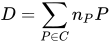 where
 and
 for almost all .
The degree of  is defined by
 is said to be defined over if
 for all automorphisms σ of
 over . The set
 of divisors of defined over forms an additive abelian group under the addition rule

The set  of all degree zero divisors of defined over is a subgroup of .
We take an example:
Let  and
 . If we add them then
 . The degree of
 is
 and the degree of
 is
 . Then,

For polynomials  , the divisor of
 is defined by
 If the function has a pole at a point then
 is the order of vanishing of at . Assume
 are polynomials in
 ; the divisor of the rational function
 is called a principal divisor and is defined by
 . We denote the group of principal divisors by
 , i.e.,
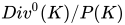
 . The Jacobian of over is defined by
 . The factor group
 is also called the divisor class group of . The elements which are defined over form the group
 . We denote by
 the class of in
 .
There are two canonical ways of representing divisor classes for real hyperelliptic curves which have two points infinity  . The first one is to represent a degree zero divisor by
 such that
 , where
 ,
 , and
 if
 The representative of is then called semi reduced. If satisfies the additional condition
 then the representative is called reduced.[1] Notice that
 is allowed for some i. It follows that every degree 0 divisor class contain a unique representative with
 where
 is divisor that is coprime with both and , and
 .
The other representation is balanced at infinity. Let  , note that this divisor is -rational even if the points and are not independently so. Write the representative of the class as
 ,
where is called the affine part and does not contain and , and let
 . If
 is even then

If is odd then
 For example, let the affine parts of two divisors be given by
- and
then the balanced divisors are
 and

Let be a real quadratic curve over a field . If there exists a ramified prime divisor of degree 1 in then we are able to perform a birational transformation to an imaginary quadratic curve.
A (finite or infinite) point is said to be ramified if it is equal to its own opposite. It means that  , i.e. that
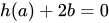 . If is ramified then
 is a ramified prime divisor.[2]
The real hyperelliptic curve of genus  with a ramified -rational finite point
 is birationally equivalent to an imaginary model
 of genus , i.e.
 and the function fields are equal
 .[3] Here:
 and 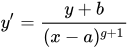 | | i |
In our example  where
 , h(x) is equal to 0. For any point ,
 is equal to 0 and so the requirement for P to be ramified becomes
 . Substituting and
 , we obtain
 , where
 , i.e.,
 .
From (i), we obtain  and
 . For g = 2, we have
 .
For example, let  then
 and , we obtain

To remove the denominators this expression is multiplied by  , then:
 giving the curve
 where

 is an imaginary quadratic curve since
 has degree
 .
References
- ↑ Erickson, Stefan; Jacobson, Michael J., Jr.; Stein, Andreas (2011). "Explicit formulas for real hyperelliptic curves of genus 2 in affine representation". Advances in Mathematics of Communications. 5 (4): 623–666. doi:10.3934/amc.2011.5.623. MR 2855275.
{{cite journal}}: CS1 maint: multiple names: authors list (link)
- ↑ Jacobson, Michael J. Jr.; Scheidler, Renate; Stein, Andreas (2010). "Cryptographic aspects of real hyperelliptic curves". Tatra Mountains Mathematical Publications. 47: 31–65. doi:10.2478/v10127-010-0030-9. MR 2791633.
- ↑ Galbraith, Steven D.; Lin, Xibin; Morales, David J. Mireles (2008). "Pairings on hyperelliptic curves with a real model". In Galbraith, Steven D.; Paterson, Kenneth G. (eds.). Pairing-Based Cryptography – Pairing 2008, Second International Conference, Egham, UK, September 1–3, 2008. Proceedings. Lecture Notes in Computer Science. Vol. 5209. Springer. pp. 265–281. doi:10.1007/978-3-540-85538-5_18. MR 2733918.







