Raymond Spottiswoode
Raymond Spottiswoode | |
|---|---|
 | |
| Born | 1913 |
| Died | 18 August 1970 (aged 56–57) |
| Occupations |
|
| Known for | A Grammar of the Film Film and Its Techniques |
| Relatives | Roger Spottiswoode (son) |
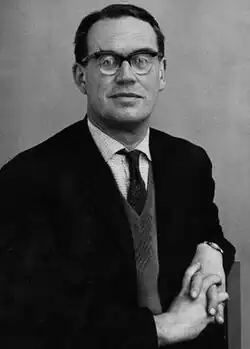
Raymond Spottiswoode (1913 – 18 August 1970) was a British film theorist, documentary filmmaker, producer and technical specialist. He was the father of film director Roger Spottiswoode and worked in documentary filmmaking, film technology and stereoscopic cinema.
Career
Spottiswoode spent three years in England working with John Grierson's original documentary production group and subsequently worked with commercial film companies. He later spent six years in the Canadian film industry, first as a producer and subsequently as a technical supervisor with the National Film Board of Canada (NFB).[1] The NFB maintains an official record of Spottiswoode as a director in its collection.[2] From 1945 to 1948, Spottiswoode wrote, directed and produced documentary films in the United States.[3]
He later became involved in stereoscopic filmmaking and film technology. He worked on three-dimensional film production for the Festival of Britain and was involved in technical research concerning stereoscopic cinematography.[4]
In 1958, Spottiswoode became director of the Film Centre in London. He also taught at universities in Britain and the United States and continued his work in film technology and stereoscopic cinema.[5]
Film theory
Spottiswoode wrote several books on cinema, including A Grammar of the Film and Film and Its Techniques. His writing examined film language, editing, cinematography and other technical and aesthetic aspects of filmmaking.
Film and Its Techniques was reviewed by film theorist Rudolf Arnheim in The Journal of Aesthetics and Art Criticism in 1951.[6]
Spottiswoode's A Grammar of the Film was also influential among later filmmakers. Cinematographer and visual-effects artist Richard Edlund recalled that the book was the only book on cinema available to him at a U.S. Navy base in Japan and became his introduction to film theory. Edlund particularly recalled its discussion of editing and the use of juxtaposed images to construct meaning.[7]
Filmography
| Year | Film | Role |
|---|---|---|
| 1941 | Letter from Camp Borden | Director[8] |
| 1941 | Wings of a Continent | Director |
| 1941 | Guards of the North | Director |
| 1942 | Forward Commandos | Director |
| 1942 | Women Are Warriors | Producer |
| 1942 | The Voice of Action | Producer |
| 1944 | Train Busters | Producer |
| 1944 | Target – Berlin | Producer |
| 1944 | Strategy of Metals | Director |
Death
Spottiswoode died on 18 August 1970.[9]
References
- ↑ Spottiswoode, Raymond (1951). Film and Its Techniques. University of California Press. ISBN 0520311698.
{{cite book}}: ISBN / Date incompatibility (help) - ↑ "Raymond Spottiswoode". National Film Board of Canada. Retrieved 21 August 2026.
- ↑ Spottiswoode, Raymond (1951). Film and Its Techniques. University of California Press. ISBN 0520311698.
{{cite book}}: ISBN / Date incompatibility (help) - ↑ "Progress in Three-Dimensional Films at the Festival of Britain". Journal of the Society of Motion Picture and Television Engineers. 58 (4). 1952. Retrieved 21 August 2026.
- ↑ "SPOTTISWOODE, Raymond". Filmska enciklopedija. Retrieved 21 August 2026.
- ↑ Arnheim, Rudolf (1951). "Film and Its Techniques by Raymond Spottiswoode". The Journal of Aesthetics and Art Criticism. 10 (2): 176. doi:10.2307/426852.
- ↑ Fordham, Joe (7 August 2023). "An Eye for the Cameras: Richard Edlund, ASC". American Cinematographer. Retrieved 21 August 2026.
- ↑ Canada, National Film Board of. "Letter from Camp Borden". National Film Board of Canada. Retrieved 2026-08-21.
- ↑ "A Three Dimensional Life: Charles W. Smith FBKS FRPS". 3-DLegends. Retrieved 21 August 2026.