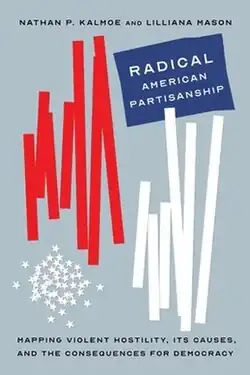
Radical American Partisanship
 | |
| Author | Lilliana Mason and Nathan Kalmoe |
|---|---|
| Language | English |
| Publisher | University of Chicago Press |
| Publication date | May 2022 |
| Publication place | United States |
Radical American Partisanship: Mapping Violent Hostility, Its Causes, and the Consequences for Democracy is a 2022 book by Lilliana Mason and Nathan Kalmoe.[1][2][3] Radical American Partisanship analyzes political violence in America.[4]
Kalmoe and Mason ask a variety of survey questions to determine American support for political violence, and in particular support for partisan political violence.[5][6] Westwood et al. criticized some of these measures – which include questions like "How much do you feel it is justified for [respondent's own party] to use violence in advancing their political goals these days?" – as ambiguous and likely to overestimate American support for political violence.[7]
Radical American Partisanship describes correlations between support for partisan political violence and other traits.[6] For example, they find that ideological extremity is not associated with support for partisan political violence, but that aggressive interpersonal behavior is.[6] One less-central finding of Radical American Partisanship is that people who show hostile sexism are more likely to support partisan political violence.[8]
References
- ↑ Spinelle, Jenna (2022-04-11). "Democracy Works: The roots of radical partisanship". WPSU. Retrieved 2025-09-23.
- ↑ Jakli, Laura (2023-02-01). "Nathan P. Kalmoe and Lilliana Mason. Radical American Partisanship: Mapping Violent Hostility, Its Causes, and the Consequences for Democracy". Public Opinion Quarterly. 87 (1): 235–238. doi:10.1093/poq/nfac054. ISSN 0033-362X. Archived from the original on 2024-01-19.
- ↑ Chotiner, Isaac (2025-09-15). "Where Political Violence Comes From". The New Yorker. ISSN 0028-792X. Retrieved 2025-09-23.
- ↑ "Radical American Partisanship". Kirkus Reviews. February 14, 2022.
- ↑ Kim, Taegyoon (2026-03-01). "The Effects of Partisan Elites' Violent Rhetoric on Support for Political Violence". Political Behavior. 48 (1): 119–184. doi:10.1007/s11109-025-10025-7. ISSN 1573-6687.
- 1 2 3 Landry, Alexander P.; Druckman, James N.; Willer, Robb (2024-12-01). "Need for Chaos and Dehumanization are Robustly Associated with Support for Partisan Violence, While Political Measures are Not". Political Behavior. 46 (4): 2631–2655. doi:10.1007/s11109-024-09934-w. ISSN 1573-6687.
- ↑ Westwood, Sean J.; Grimmer, Justin; Tyler, Matthew; Nall, Clayton (2022-03-22). "Current research overstates American support for political violence". Proceedings of the National Academy of Sciences. 119 (12) e2116870119. doi:10.1073/pnas.2116870119. PMC 8944847. PMID 35302889.
- ↑ Piazza, James A.; O'Rourke, Lauren (13 December 2024). "Hostile Sexism, Social Dominance Orientation, Political Illiberalism, and Support for Political Violence in the United States". Politics & Gender. 21 (2): 144–168. doi:10.1017/S1743923X24000400. ISSN 1743-923X.