Quercus rugosa
| Quercus rugosa | |
|---|---|
 | |
Scientific classification  | |
| Kingdom: | Plantae |
| Clade: | Embryophytes |
| Clade: | Tracheophytes |
| Clade: | Angiosperms |
| Clade: | Eudicots |
| Clade: | Rosids |
| Order: | Fagales |
| Family: | Fagaceae |
| Genus: | Quercus |
| Subgenus: | Quercus subg. Quercus |
| Section: | Quercus sect. Quercus |
| Species: | Q. rugosa |
| Binomial name | |
| Quercus rugosa | |
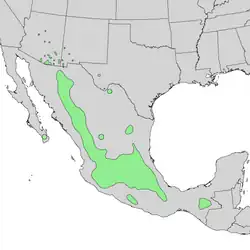 | |
| Natural range of Quercus rugosa | |
| Synonyms[2] | |
|
List
| |

Quercus rugosa, commonly known as the netleaf oak, is a broad-leaved tree in the beech and oak family Fagaceae. It is native to southern North America.
Description
Quercus rugosa is an evergreen shrub or tree.[3] The bark is brown and scaly. The leaves are thick and leathery, rarely flat, usually cupped, up to 15 centimetres (6 inches) long, dark green on the top but covered with a thick of reddish-brown hairs on the underside.[4][5] The young leaves are also very hairy and usually red or yellow.
Name
Quercus rugosa is Latin for "wrinkled oak". In Spanish it has many common names, like "encino negro" (black oak) or "encino quiebra hacha" (axe-breaking oak). Colloquially it is known as "chaparro", a word which has also passed into the lexicon as slang for a short person.
Distribution
It is widespread in Mexico, Guatemala and the southwestern United States (Arizona, New Mexico, western Texas).[6][7][8][9][10] It grows extensively in the temperate highlands of central Mexico, particularly on hillsides and in narrow gorges, between 1,800 and 2,900 meters elevation.[1] It is associated and usually coexists with other oaks, alders, pines and Texas madrones. The Netleaf Oak has been widely planted in California cities as a drought-tolerant street tree, following street tree die-offs during dry spells[11].
Gallery
 Mature specimen
 Underside of the leaves.
 Immature leaves are quite red.
 Leaves and acorns.
 Detail of Bark.
See also
References
- 1 2 Jerome, D. 2017. Quercus rugosa. The IUCN Red List of Threatened Species 2017: e.T194227A2305094. https://dx.doi.org/10.2305/IUCN.UK.2017-2.RLTS.T194227A2305094.en. Accessed on 18 October 2022.
- ↑ Quercus rugosa Née. The World Flora Online. Accessed 17 October 2022.
- ↑ CONABIO, Quercus rugosa
- ↑ Nixon, Kevin C. (1997). "Quercus rugosa". In Flora of North America Editorial Committee (ed.). Flora of North America North of Mexico (FNA). Vol. 3. New York and Oxford: Oxford University Press – via eFloras.org, Missouri Botanical Garden, St. Louis, MO & Harvard University Herbaria, Cambridge, MA.
- ↑ Née, Luis. 1801. Anales de Ciencias Naturales 3(9): 275 short diagnosis in Latin, description and commentary in Spanish
- ↑ NRCS. "Quercus rugosa". PLANTS Database. United States Department of Agriculture (USDA). Retrieved 2008-05-17.
- ↑ Kartesz, John T. (2014). "Quercus rugosa". County-level distribution map from the North American Plant Atlas (NAPA). Biota of North America Program (BONAP).
- ↑ SEINet, Southwestern Biodiversity, arizona chapter
- ↑ McVaugh, Rogers. 1974. Flora Novo-Galiciana: Fagaceae. Contributions from the University of Michigan Herbarium 12(1,3): 1–93.
- ↑ Romero Rangel, S., E. C. Rojas Zenteno & M. L. Aguilar Enríquez. 2002. El género Quercus (Fagaceae) en el estado de México. Annals of the Missouri Botanical Garden 89(4): 551–593
- ↑ Muffly, David (May 2023). "New Oak Introductions for California". International Oak Society. Retrieved April 23, 2026.

External links

- IUCN Red List least concern species
- Quercus
- Flora of the Sierra Madre Occidental
- Flora of the Sierra Madre Oriental
- Flora of the Trans-Mexican Volcanic Belt
- Flora of the Sierra Madre de Oaxaca
- Flora of the Chiapas Highlands
- Flora of Arizona
- Flora of Guatemala
- Flora of Honduras
- Oaks of Mexico
- Flora of New Mexico
- Flora of Texas
- Least concern flora of Central America
- Least concern flora of Mexico
- Least concern flora of the United States
- Trees of Northern America
- Plants described in 1801