Qiang (historical people)
羌 | |
|---|---|
 Depiction of an envoy of Dengzhi, a Qiang ethnic group, from a Portraits of Periodical Offering painting, 6th century CE | |
| Regions with significant populations | |
| Ancient China |
Qiang (Chinese: 羌; pinyin: Qiāng; Wade–Giles: Ch'iang) was a Chinese exonym given to various groups of western semi-nomadic people at different periods in ancient China. The Qiang groups are generally thought to have mainly been of Tibeto-Burman origin,[1][2][3][4][5] though few have also suggested Indo-European origin.[6] The Tangut people of the Western Xia dynasty (1038–1227) were classified by their contemporaries as a branch of Qiang.[1] The modern Qiang people as well as Tibetans may also have been descended in part from the ancient Qiang.[7]
Etymology
According to the Han dynasty dictionary Shuowen Jiezi, the Qiang were shepherds, and the Chinese character for Qiang (羌) was thus formed from the characters for "sheep" (羊) and "man" (人), and pronounced like the word for "sheep".[8][9] Fengsu Tongyi also mentions that the character for Qiang was formed from the words "sheep" and "man". Modern scholars have attempted to reconstruct the ancient pronunciation of Qiang: sinologist Edwin Pulleyblank reconstructs it to *kʰiaŋ in Middle Chinese, while William H. Baxter and Laurent Sagart reconstruct the Old Chinese name of Qiang as *C.qʰaŋ.[10]
Christopher Beckwith proposes that the word "Qiang" may have an Indo-European etymology and that the Qiang were of Indo-European origin; Beckwith compares a proposed reconstruction of Qiang to *klaŋ in Old Chinese to the Tocharian word klānk, meaning "to ride, go by wagon", as in "to ride off to hunt from a chariot", so that Qiang could actually mean "charioteer".[6]
History

Origins and genetics
The term "Qiang" did not represent a singular unified ethnic group. Rather, it was an exonym to denote "western others", and was broadly imposed by the Chinese for non-Han shepherding tribes living to the west of the Central Plains. While the label seemingly referred to tribes living in the diagonal band from northern Shaanxi to northern Henan at first, the scope of the Qiang grew over the centuries as the Han expanded westwards, finally reaching the eastern fringes of the Tibetan-Qinghai Plateau.[11]
Modern scholars generally believe that the Qiang tribes were all, if not mostly, progenitors of Tibeto-Burman-speaking peoples. The ancient Di (氐; not to be confused with the Northern Di) were a semi-nomadic people culturally related to the Qiang, often collectively referred to as the "Di-Qiang". Genetic analyses of Di-Qiang remains at the Mogou site in Lintan County, Gansu found high genetic affinity with modern Sino-Tibetan, particularly modern Qiang people and Han Chinese, as well as with ancient 'Yellow River farmers' associated with the Yangshao culture.[12] The ancient Qiang remains belonged exclusively to paternal haplogroup O-M175 (O3a).[13]
Legends and pre-imperial China
According to legend, the Qiang originated from the tribe of Fuxi, one of the Three Sovereigns, in the area of modern Tianshui, Gansu and were partly descended from the Yan Emperor, the mythical "Flame Emperor" who was defeated along with his tribe by the Yellow Emperor.[14][15] The term "Qiang" first appeared on 3,000 years ago on oracle bone inscriptions, which speaks of a "Qiangfang" (羌方) and was used to describe "a people other than one's people."[16] It appears again in the Classic of Poetry in reference to Tang of Shang (trad. 1675–1646 BC).[17] They were enemy of the Shang dynasty, who mounted expeditions against them, capturing slaves and victims for human sacrifice during ancestor veneration rituals. The Qiang prisoners were also skilled in making oracle bones.[18][19][20][21]
Shuowen Jiezi indicated that the Qiangs were shepherds from the west and that they were part of the Western Rong.[9] During the Shang and Zhou dynasties, the Qiang formed a social and economic community comprising many branches, tribes, groups, and cultures that varied in their differences and networks. They had a close relation to the Zhou,[1] and were mentioned in the Book of Documents and Records of the Grand Historian as one of the allies of King Wu of Zhou who defeated the Shang.[22] It has been suggested that the clan of Jiang Yuan, mother of Houji, a figure of Chinese legends and mythology and an ancestor of the Zhou dynasty, was possibly related to the Qiang, or was Qiang itself.[1][23][24] Some of the ancient groups were called the Ma Qiang (馬羌; "Horse Qiang") or "Duoma Qiang" (多馬羌; "Many-Horses Qiang"), suggesting they may have been horse breeders.[21]
Qin
Though the Qiang tribes were never united, an influential figure in their history was Wuyi Yuanjian during the late Warring States Period. According to the Book of Later Han (compiled in the 5th-century CE), he was initially a slave under Duke Ligong of Qin (r. 476-443 BCE) but later escaped and founded a dynasty in the Huangshui River Basin. While likely a legend, Yuanjian was credited with introducing farming and animal husbandry to the Qiang tribes, as well as establishing several common traditions among them, such as his name "Wuyi" becoming the word for "slave" in their languages.[25]
The Qiang tribes had been facing mounting military pressure since the reign of Duke Mu of Qin (r. 659–621 BCE). As a result, the Qiang followed their migratory routes but expanded into larger-scale and distant migrations. By the time of Duke Xian of Qin (r. 384–362 BCE), the descendants of Wuyi Yuanjian also wished to form separate tribes, clans and branches and migrate on their own will. Among their offshoots were the Maoniu (牦牛; "Yak"), Daya (大雅; "Great Elegant"), Baima (白馬; "White Horse"), Canlang (參狼; "Three Wolves" [a]) and Yan (研; later known as the Shaodang (燒當)) tribes, and the sons of their chieftains continued to form new clans of their own.[25]
Many of the Qiang and Western Rong tribes were brought to submission by Duke Xiao of Qin (r. 361–338 BCE). When Qin Shi Huang began to unify the six states in the second half of the 3rd century BCE, warfare was directed at the feudal lords and former lords still resisting his rule in the east. As the Qin armies stopped marching west, the Qiang branches began to multipy and grow during the time of peace for them. After Qin unified China in 221 BCE, General Meng Tian was dispatched west to seize territory and construct the Great Wall, pushing back the Qiang and Rong.[25]
Relations with Ba-Shu
Prior to the Qin conquest in 316 BCE, the Sichuan Basin was home to the ancient states of Ba and Shu. The tribes of Shu were known as the "Sou" (叟), and by the Han dynasty era, the term was used interchangeable for anyone from the Shu region. The Sou people were long settled in western Sichuan, specifically in the Chengdu Plain. They lived and intermixed with the Di and Qiang peoples, all while maintaining a degree of autonomy to distinguish themselves as a separate ethnic group. Until the Western Jin dynasty, populations of the Sou inhabited the regions of Shaanxi, Gansu and Sichuan. During the fall of Han, the warlord Lü Bu had Sou people in his army, former Shu soldiers who rebelled.[26]
Like the Shu, the Ba people also contained Di-Qiang ancestry, emerging as a fusion of the southern Pu-Yue (濮越) and the northern Di-Qiang populations.[15] Part of the Ba confederation were the Bo people, who existed as early as the Western Zhou as a branch of the Di-Qiang. The Bo were considered humane and benevolent and thus granted the character "rén" (人; meaning "people"). By the Qin-Han period, the Bo had a higher economic, social and cultural development than other barbarians and thus were considered advanced and civilised. The Bo people's records were sparse before the Qin, but Han records indicated they were sparsely distributed throughout the northwestern river basins, extending southwest in eastern Lancang and north of the Red River in modern Yunnan. By the late Eastern Han, the Bo people had intermixed with the Qiang along the river valleys. Due to the phonetic similarity in their name that can indicate interchangeability, the Bo are also thought to be the ancestors of the modern-day Bai people (白族). Another Di-Qiang branch were known as the Hutang (呼唐), who lived west of the Li river, now known as the Min river in Sichuan.[27] The preexistence of the Qiang people in the southwest allowed many of the central Qiang to migrate northward from the Qin Empire into their southwestern region of China.[28]
Western Han
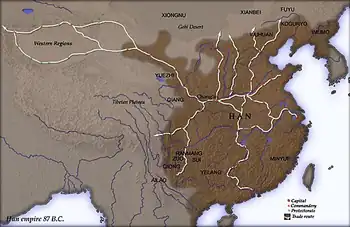
The Han dynasty saw a period of extensive Chinese expansion in the west, annexing the lands of modern-day Gansu and northeastern Qinghai, as well as vassalizing the numerous oasis states of the Tarim Basin. The reference of Qiang during this period were primarily tribes originating from the Gansu and Qinghai regions. Many Qiangs migrated or were forcibly resettled by the Han into China Proper as far east as central Shaanxi, creating a rough distinction between the Western Qiang (西羌; those that remained on or outside the western boundaries in western Gansu and Qinghai) and the Eastern Qiang (東羌; those that settled within the Chinese interior in eastern Gansu, Shaanxi and Shanxi). Relations with the Qiang remained volatile throughout Han rule, as the Qiang were often driven out of their homelands and suffered oppression at the hands of local Chinese officials and magnates. The various tribes formed loose confederations against the Han, and though they were defeated time and time again, the cost of quelling their rebellions were a significant drain on the Han's economy and military, playing a part in their decline and eventual fall.[29]
Around the same time that the Western Han dynasty began to rule China, the Xiongnu Empire of the northern Eurasian steppe were also rising in power. In the mid-2nd century BCE, the Xiongnu defeated their previous overlords, the Yuezhi in the Hexi Corridor. A branch of them, the Lesser Yuezhi, reportedly migrated into southern Gansu, where they subsequently merged with the Qiang population (some scholars speculate that these people later became known as the Lushuihu).[30][31][32] Many of the Qiangs were forced into submission by the Xiongnu, while others moved eastwards to seek protection under the Han. Emperor Jing of Han (r. 157–141 BCE) permitted the submissive Qiang to settle in the counties of Dídao, Angu, Lintao, Dīdao and Qiangdao, where they guarded the frontier.[33]
During the reign of Emperor Wu of Han (r. 141–87 BCE), the Han began a proactive war to neutralize the Xiongnu threat in the north. In 121 BCE, the Han general, Huo Qubing conquered the Hexi Corridor, establishing new frontier commanderies and cutting off the Xiongnu from their Qiang allies. Some of the local and nearby Qiangs were threatened by the Han intrusion into their homelands. In 112 BCE, they formed an alliance, led by the powerful Xianlian tribe (先零), and contacted the Xiongnu to carry out a joint invasion on the Han's western borders. Their invasion was repelled, and subsequently, the Han introduced the Colonel Protector of the Qiang, who was tasked with keeping the Qiangs in check by managing their affairs and suppressing their revolts.[34] As the Xiongnu declined in power in the following centuries, more and more Qiang tribes turned to the Han and moved into their territory.[35]
In 63 BCE, the Xianlian, after their permission to pasture their herds in the Huangshui Valley was rejected by the Han court, swore an oath with the other Qiang tribes to rebel. In 61 BCE, a conspiracy was uncovered between the Xiongnu and a Qiang noble to attack Shanshan and Dunhuang. The court sent an envoy to assess the situation among the tribes, but he instead massacred the Xianlian along with more than thirty of their leaders, causing the Western Qiang to rebel. The Han commander, Zhao Chongguo, famously pacified the rebellion the following year with little bloodshed, largely attributed to his use of tuntian (military-agricultural colonies) and forced resettlement.[36] For the next few decades, the Qiang posed little threat to the western frontier, the only exception being in 42 BCE, when the Shaodang led six other Qiang tribes in rebellion in the Longxi region. The rebels defeated the initial Han forces sent to fight them, but were soon crushed by Feng Fengshi when he returned with 60,000 men the next year.[37][38]
Ruoqiang
During the Western Han dynasty, there were a group of nomads to the southwest of Dunhuang known as the Ruoqiang (若羌 or 婼羌). Their settlement was considered one of the thirty-six city states of the Protectorate of the Western Regions. They were described in the Book of Han as a people who moved with their livestock in search of water and pasture, made military weapons themselves using iron from the mountains, and possessed bows, lances, short knives, swords and armour.[39][28]
Eastern Han
After the fall of the Xin dynasty in 23 CE, the Qiangs took advantage of the Chinese civil war to reassert their dominance over the Xining Valley and Longxi region. The local warlord, Wei Ao, having little success in his battles against the Qiang, decided to enter a loose alliance with the Xianlian and other Qiang tribes, employing their people as auxiliaries in his army. After Wei Ao's death, his son surrendered his territory over to Emperor Guangwu of Han. The emperor sent Lai Xi and later Ma Yuan to subjugate the Qiang in Wei Ao's former domain. In 35 CE, Ma Yuan's campaign drove the rebellious Qiangs out of the border and broke the power of the Xianlian. To relieve pressure on the western frontier, Ma Yuan had Qiang prisoners forcibly resettled away from the frontier to the upper valley of the Wei river within the Guanzhong basin.[40]
The decline of the Xianlian allowed the Shaodang to take their place and seize their territory in 40 CE. In 57 CE, the Shaodang chieftain, Dianyu invaded Jincheng Commandery and incited the other Qiang tribes to rebel. After a string of victories, Dianyu was eventually defeated by Han forces and surrendered in 59 CE. He and his people were forcibly relocated to the commanderies surrounding Chang'an. Dianyu was content with life as a Han subject, but his son, Miyu, was unruly and frequently engaged in plunder. In 76 CE, a short-lived Qiang uprising broke out stemming from an incident where a Chinese county official abducted a Qiang woman from one of the tribes. The following year, when Miyu attempted to leave the frontier with his followers and defeated the Han army in his pursuit, the various Qiang tribes rose up in support of him along with the Lushuihu people. The initial uprising was quelled, but the rebels continued to operate to a minor degree before Miyu's forces routed another army in 86 CE. The next year, Miyu was defeated and asked to surrender. He and his followers were invited to a banquet, where the Colonel Protector had them massacred. This betrayal only encouraged Miyu's son, Mitang to carry on with the rebellion. Mitang launched major raids on the Han frontier in 87, 92, and 97 CE before suffering his final defeat in 101 CE.[41][42]
In 107 CE, the Han court abolished and abandoned the Protectorate of the Western Regions. The Eastern Qiang were conscripted to aid in the withdrawal, but a mutiny broke out within their ranks when rumours spread that they were being exiled instead. The Han generals indiscriminately persecuted their non-Han auxiliaries to restore order, but news of this reached back to the Qiangs' homelands, creating further fear and anxiety. Soon, the Qiang were once again in rebellion. They elected a Xianlian chieftain, Dianlian as their leader and were prominently backed by the Zhong tribe (鍾). The rebels attacked Liang province, and the Han court sent Deng Zhi and Ren Shang against them. Although the Qiang forces suffered significant casualties, the Han army were defeated at Hanyang Commandery, after which Dianlian proclaimed himself emperor. In 109 CE, he conquered Longxi, and the following year, he killed the Administrator of Hanzhong. At the peak of the rebellion, the Qiangs were able to raid Han territory as far south as Hanzhong and as far east as Ji province.[43][44] However, after Dianlian died in 112 CE, he was succeeded by his son, Lianchang, who was too young to exercise authority. Another man of the tribe, Langmo, took charge of strategy, but the new regime was significantly less effective under the regent and failed to make any headway against Han forces. In 116 CE, the Han general Deng Zun led 10,000 Southern Xiongnu cavalry in a raid on Lianchang's headquarters from the north while Ren Shang attacked from the south.[45] Lianchang was assassinated the next year, and forces under Ren Shang ended the Qiang raids.[46]
After Lianchang's defeat, the Han were able to gain a few years to recover and reconstruct the northwestern region from devastation. Qiang revolts and raids persisted during this period, such as the cases of the Chendi (沈氐) in 120 CE and the Shaodang in 121 and 137 CE, but were not as serious and were forcibly put down by the general, Ma Xian.[47][48] However, by 140 CE, another major Qiang uprising had gripped the region, coinciding with the Southern Xiongnu and Wuhuan rebellions on the northern frontier. Ma Xian was killed in battle against Qiang, inspiring more of their tribes to join and placing the key city of Chang'an under threat. The uprising was defeated in 44 CE, but costed the Han government around eight thousand million in cash and put an end to their reconstruction effort.[46][49]
The next fifteen years were relatively peaceful in the northwest, but by 159 CE, a new Qiang disturbance was on the horizon. This time, the Han court employed a certain Duan Jiong to restore the peace on the frontier. His initial military campaigns against the Qiang, while victorious, did not stop them from raiding altogether, and in 161 CE, he was removed from office. The court then entrusted Huangfu Gui with averting a full-scale crisis. Huangfu employed an effective strategy of appeasement by purging many of the local corrupt officials and bribing the Qiangs into surrender, but the court disapproved of his method and subsequently dismissed him as well. Duan Jiong was reinstated in 163 CE, and he continued to deal with the Qiang through military might. In 167 CE, the Xianlian rebelled and invaded the Chang'an region, but were soon defeated. Despite their surrender, Duan Jiong convinced the court that it would not be long before the Xianlian would stir up trouble among the Qiang again, and that the only way to prevent this was to launch a preemptive strike. That same year, Duan Jiong embarked on a brutal two-year-long campaign against the Xianlian. According to the Book of Han, Duan Jiong fought 180 engagements with the Qiang, massacring around 38,000 people from military leaders to children.[50][46]
Duan Jiong's campaigns brought another temporary peace, but ultimately did not solve the Qiang issue. Fifteen years later, the Liang Province rebellion would finally see the Han lose control over the northwest. In 184 CE, remnants of the Xianlian and their allied tribes initially led a minor revolt, but when they were supported by Qiang and Lesser Yuezhi mutineers from the Auxiliary of Loyal Barbarians of Huangzhong, the uprising quickly spread throughout the region and was even joined by the local Han Chinese population. The rebels captured Jincheng and reached Youfufeng Commandery in 185, and from there carried out raids against Chang'an. A Han army was sent out against them led by Huangfu Song and Zhang Wen but they failed to achieve any major victory. That same year, the general Dong Zhuo won a battle against the rebels and forced them to withdraw. The rebellion continued on for years until 189 CE, when the Han government fell into chaos after Dong Zhuo seized the capital at Luoyang and fragmented the rest of the empire.[51]
Despite their roles as initiators, the Qiang tribes seemingly withdrew from the conflict as it carried on and kept to themselves, leaving the northwestern region to be carved up by their Chinese allies. One of the prominent warlords that emerged during this time was Ma Teng, the son of a Chinese father and a Qiang mother who lived among the tribes. When the Han Chancellor, Cao Cao launched his campaign to reclaim the northwest in 211 CE, the Qiang rallied behind Ma Teng's son, Ma Chao and other warlords such as Han Sui and Zhang Lu to oppose the invasion, but were eventually defeated and forced back under Han rule.[52]
Three Kingdoms
The Han dynasty came to an end in 220 CE as China entered the Three Kingdoms period (220–280 CE). The northwest became a heavily contested region between the rival states of Cao Wei in northern China and Shu Han in the Sichuan Basin. The local Qiang tribes were compelled to side with either one of the states, serving as auxiliaries and providing supplies to the frontlines. A core strategy of the Shu Han during their northern expeditions was to win the support of the Qiang, along with other ethnic tribes, and assist them in their uprisings against Wei. When the Qiangs in Wei territory revolted in 247–248, the Shu commander, Jiang Wei led two expeditions to support them, but found no success.[53]
Sixteen Kingdoms
The Qiang were one of the Five Barbarians that founded many of the Sixteen Kingdoms during the 4th century and early 5th century. They, along with many other tribal people in northwestern China, participated in the rebellions of Tufa Shujineng (270–279) and Qi Wannian (296–299) against the Western Jin dynasty. As Jin authority collapsed in northern China during the upheaval of the Five Barbarians, the Qiang tribes waivered their allegiances between Jin and the Xiongnu-led Han-Zhao dynasty before they were all subjected to the latter and its successors.[53]
The first and only Qiang-led state of the Sixteen Kingdoms was the Later Qin (384–417), founded by the Yao clan who claimed descent from the Shaodang Qiang. In the wake of the Former Qin's disastrous defeat at the Battle of Fei River, the Qiang general, Yao Chang rebelled and declared himself Everlasting King of Qin in 384. After killing his former ruler, Fu Jian, he captured the Former Qin capital, Chang'an, where he elevated himself to Emperor of (Later) Qin in 386.[53]
In 394, Yao Chang's successor, Yao Xing, crushed the last vestiges of the Former Qin's military, establishing the Later Qin as a major power in Guanzhong. Under his rule, the state reached its zenith as it conquered Luoyang from the Eastern Jin dynasty and vassalized many of its contemporary states. Yao Xing was also an ardent Buddhist and heavily promoted the religion within his state. He welcomed the Kuchean monk, Kumārajīva to Chang'an, where he helped translate many Buddhist texts into Chinese. It was also under Qin when the Chinese monk, Faxian, began his pilgrimage to India from Chang'an and the Maijishan Grottoes were first constructed.[54]
However, the Later Qin declined during the second half of Yao Xing's reign. Infighting between the princes over the succession to the throne and mounting defeats on the battlefield, particularly to the Xiongnu rebel state, Helian Xia, gradually weakened the state. When Yao Hong ascended the throne in 416, rebellions sprang up throughout the empire while it came under attack from its neighbours. The Eastern Jin commander, Liu Yu took advantage of the chaos in Later Qin to launch his second northern expedition. In 417, Jin forces captured Yao Hong in Chang'an, ending the Later Qin.[54]
Northern and Southern dynasties

Two minor Qiang polities existed during this period: the Dangchang Kingdom in present-day Tanchang County, Gansu and Dengzhi, located west of present-day Jiuzhaigou County, Sichuan. The Dangchang Qiang were led by the Liang clan (梁) while the Dengzhi Qiang, also known as the Baishui Qiang (白水羌), were led by the Xiang clan (像/象). Both states were tributaries to the neighbouring Northern and Southern dynasties and lasted until the mid-6th century.[55]
In 446 an ethnic Qiang rebellion was crushed by the Northern Wei. Wang Yu (王遇) was an ethnic Qiang eunuch and he may have been castrated during the rebellion since the Northern Wei would castrate a rebel tribe's young elite. Fengyi prefecture's Lirun town according to the Weishu was where Wang Yu was born, Lirun was to Xi'ans's northeast by 100 miles and modern day Chengcheng stands at its site. Wang Yu patronized Buddhism and in 488 had a temple constructed in his birthplace.[56]
Tang
During the Tang dynasty, the Dangxiang Qiang moved to the region of Xiazhou around modern Jingbian County, Shaanxi Province. They eventually founded the state of Western Xia (1038–1227 CE) and came to be known as the Tanguts. Another group of Qiang migrated south to the Min River in modern Sichuan Province. They came to be known as the Ran and Mang who were the ancestors of the modern Qiang people.[53]
Tibetan Empire
The Qiang tribes expanded eastward and joined the Han people in the course of historical development, while the other branch that traveled southwards, crosses over the Hengduan Mountains, and entered the Yungui Plateau; some went even farther, to Burma, forming numerous ethnic groups of the Tibetan-Burmese language family.[57] Even today, from linguistic similarities, their relative relationship can be seen. They formed the Tibetan ethnicity after the unification of the Tubo kingdom.[57] According to Fei Xiaotong: "Even if the Qiang people might not be regarded as the main source of the Tibetan people, it is undoubtedly that the Qiang people played a certain role in the formation of Tibetan race".[58]
The Fa Qiang (发羌) and Tangmao (唐旄) settled in the Lancang River of upper Tibet. They intermingled with the local indigenous peoples of the Proto-Tibetans to form the later Tubo people.[28] According to the Da Qing yi tong zhi (1735), the Tibetan Empire was founded by a branch of the Fa Qiang. According to the New Book of Tang, the "Bod originates from the Qiang." [16]
Song
According to the polymath Shen Kuo, the Qingtang Qiang, also known as the Tsongkha, were noted for producing high quality steel armour.[59]
The Qiang people of Qingtang are skilled at forging armour. The colour of the iron is blue-black, so clear and bright that it can mirror a hair. They use musk-deer leather for the thongs to string it together - it is soft, thin, and tough.[60]
— Shen Kuo
Yuan
During the Yuan dynasty, the term Qiang was replaced by Fan (Bod), and the people of the western plateaus were called "Western Bod". The two terms were used interchangeably until the Qing dynasty when Qiang came to refer to those living upstream of the Min River.[16]
Language
A problematic case is the “Qiang,” which as Wang Mingke has established, is an old Chinese term along the western borderlands for people in the middle, neither Chinese nor Tibetan, neither exclusively agricultural nor purely pastoral, and likely referring to a variety of successive frontier populations. Communities and individuals were not firmly identified with the modern nationality Qiang, by others as well as themselves, until the People’s Republic. Today, they are concentrated in Maozhou and Wenchuan and parts of Lixian and Heishui, plus a few in the southernmost part of Songpan. They speak a variety of non-Tibetan dialects in two main forms, Northern and Southern Qiang, but some speak only Chinese.[61]
— Xiaofei Kang
The Qiang did not have surnames until the last few hundred years when they adopted Han Chinese surnames.[62] Later in the Han dynasty, groups of people in the western part of Sichuan were mentioned in the Book of the Later Han as separate branches of the Qiang. A song from one of these groups, the "White Wolf" people, was transcribed in Chinese characters together with Chinese translation, and the language has since been identified as a Tibeto-Burman language.[1] The Tangut language is also a branch of Tibeto-Burman, now argued to be part of the Horpa subgroup of West Gyalrongic.[63]
Culture

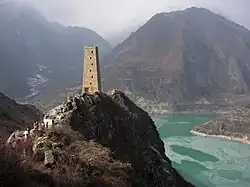

The Qiang were first described as nomadic shepherds living in the region of contemporary Gansu and Qinghai provinces. Unlike other nomads, the Qiang did not shave their heads and wore their hair loose over their face.[64] At some point prior to the modern era they settled and adopted an agricultural way of life.[65] Due to constant conflict between Qiang tribes and other peoples, the Qiang built numerous stone guard towers with small windows and doors, giving them the moniker of the "Stone Tower Culture". These constructs, described as Himalayan Towers, can be found today in eastern Tibet and Sichuan Province.[66]
The 5th-century Liu Song dynasty historian, Fan Ye (398–445) wrote a history of the Western Qiang describing traits such as "disheveled hair", folding their coat from the left side, and marriage customs where a widow would either marry her son or the deceased husband's brother. According to Fan, the Qiang lived in tribes and had no unified ruler.[16]
Qiang society followed matrilineal descent and it was men who integrated into the women's lineage upon their deaths. Others consider Qiang society to be patrilineal but with high status for women. Marriage was monogamous and forbidden within the same family for three generations. A large entourage fetched the bride and delivered her to the groom's house where the wedding ceremony was held, which involved dancing and drinking highland barley wine. After three days, the bride returned to her parents' house and lived there for a year until the birth of the first child. The men traveled to their wives' residences and worked their land for a long period of time as bride service. Despite the centrality of women in Qiang families, Qiang society was neither matriarchal nor egalitarian. Men held all the important political and religious positions, although there is some evidence that female shamans existed at one point. As in most agricultural societies, women were responsible for domestic and agricultural work while men engaged in construction, transport, and plowing.[65][67]
In the Qiang culture, ram's horn flower represents true love. Young men use the flower to express their love for their beloved.[68]
Religion
The Qiang revered the tiger and featured it prominently on their totem poles. White stones (flint stones) were also considered to be sacred and sometimes put on altars or rooftops. Qiang folk religion resembles animism and shamanism. It places spiritual belief in the natural features of the landscape and the ability of shamans to contact spirits.[69] The Qiang believed in the door god, the fireplace god, and the house god. The fireplace god was sacrificed to with food near an iron potholder before each meal. An altar in the corner of the main floor facing the door was considered sacred. It showed the financial status of the household with how ornate it was.[70]
The Qiang celebrated the Qiang New Year on the 24th day of the sixth month of the lunar calendar. Now it is fixed on 1 October. The Mountain Sacrifice Festival is held between second and sixth months of the lunar calendar.[70]
Religious ceremonies were performed by shamans known as duangong or xbi in Qiang. Xbi were responsible for initiation ceremonies for young men who reached 18 years of age. The ceremony, known as "sitting on top of the mountain" in Qiang, involves a family ritual sacrificing a sheep or cow and planting three cypress trees on top of a mountain. These shamans were also responsible for passing down Qiang stories as there was no written Qiang language until recently.[71]
Relation to modern Qiang
In most current scholarship, especially in Chinese, the modern Qiangzu are assumed to be the same as Ancient Qiangzu. However, compared to other Tibeto-Burman speakers, Qiangzu does not have a closer relation to the Ancient Qiang group. Nevertheless they have been designated as Qiangzu by the Chinese government. The arbitrary assignment of Qiang (羌) to a specific ethnic group has created confusion. First, in general, people could hardly avoid making an artificial equivalence between Ancient Qiang and Qiangzu. Since Qiangzu was named in 1950, other Tibeto-Burman speakers or Ancient Qiang descendants show no interest in dating their history back to Ancient Qiang, asking, “How could we (Yi 9,000,000; Tibetan 6,000,000) be descendants of the small Qiangzu?” Moreover, since the assignment of the name Qiangzu, the indigenous culture (Rme/ʐme/ culture) has been strongly shaped by the willing and concomitant necessity of creating a Qiang culture that demonstrates unmerited links to Ancient Qiang. Thirdly, the term Qiang split the Rme people (those using the Rme/ʐme autonym) into two parts. The Rme in Heishui are not considered Qiangzu but Tibetan by the Central Government.[72]
— Maotao Wen
Pre-Tang tribes and chiefs
- Baima (白馬)[73]
- Beinan (卑湳)
- Chendi (沈氐)
- Congzi (葱茈)[73]
- Daya (大雅)
- Fa Qiang (发羌)
- Gongtang (鞏唐)
- Goujiu (句就)
- Dianyu II (184)
- Han (罕)
- Huangniu (黄牛)[73]
- Judong (且凍)
- Lejie (勒姐)
- Lianyu (零吾)
- Maoniu (牦牛)
- Qian (幵)
- Midang'er (60)
- Qianren (虔人)
- Ruoqiang (若羌 or 婼羌)
- Shaodang (燒當; also known as Yan (研))
- Shaodang (40 BCE)
- Dianliang (40)
- Shaohe (燒何)
- Shenlang (參狼)
- Shicheng (石城)
- Tangmao (唐旄)
- Xianlian (先零)
- Yangyu (60)
- Youfei (60)
- Dianlian (r.107–112)
- Lianchang (d.117)
- Langmo (r.112–118)
- Zhong (鍾)
- ?
- Beigong Boyu
- Diaoku
- Dize
- Erku
- Juzhong
- Li Lu
- Liang'er
- Miwang
- Quhu lai Wang
- Ruoling
- Yangdiao
See also
Notes
- ↑ also known as Wudu Qiang; 武都羌
References
- 1 2 3 4 5 Edwin G. Pulleyblank (1983). "Chapter 14 - The Chinese and Their Neighbors in Prehistoric and Early Historic Times". In David Keightley (ed.). The Origins of Chinese Civilization. University of California Press. ISBN 0-520-04229-8.
- ↑ UNESCO (1996-12-31). History of Humanity: From the Seventh Century B.C. to the Seventh Century A.D. UNESCO Publishing. ISBN 978-92-3-102812-0.
- ↑ Chen, Sanping (2012-04-17). Multicultural China in the Early Middle Ages. University of Pennsylvania Press. ISBN 978-0-8122-0628-9.
- ↑ Ebrey, Patricia Buckley (2010-01-25). The Cambridge Illustrated History of China. Cambridge University Press. ISBN 978-0-521-12433-1.
- ↑ Cosmo, Nicola Di; Wyatt, Don J. (2005-08-16). Political Frontiers, Ethnic Boundaries and Human Geographies in Chinese History. Routledge. ISBN 978-1-135-79095-0.
- 1 2 Beckwith, Christopher I. (16 March 2009). Empires of the Silk Road: A History of Central Eurasia from the Bronze Age to the Present. Princeton University Press. pp. 375–376. ISBN 978-14008-29941. Retrieved 30 December 2014.
- ↑ Mayhew, Bradley; Miller, Korina; English, Alex (2002). South-West China. Lonely Planet. ISBN 978-1-86450-370-8.
- ↑ Wicky W. K. Tse (27 June 2018). The Collapse of China's Later Han Dynasty, 25-220 CE: The Northwest Borderlands and the Edge of Empire. Routledge. ISBN 9781315532318.
- 1 2 Shouwen Original text: 羌:西戎牧羊人也。从人从羊,羊亦聲。
- ↑ Baxter, William H. and Laurent Sagart. 2014. Old Chinese: A New Reconstruction. Oxford University Press, ISBN 978-0-19-994537-5.
- ↑ "Wang, Ming-ke, Ph.D., Harvard University, 1992. - The Ch'iang of Ancient China through the Han Dynasty: Ecological Frontiers and Ethnic Boundaries . AAC 9307641". Early China. 18: 283–283. 1993. doi:10.1017/S0362502800001747. ISSN 0362-5028.
- ↑ Song, Mengyuan; Wang, Zefei; Lyu, Qiang; Ying, Jun; Wu, Qian; Jiang, Lanrui; Wang, Fei; Zhou, Yuxiang; Song, Feng; Luo, Haibo; Hou, Yiping; Song, Xingbo; Ying, Binwu (2022-11-01). "Paternal genetic structure of the Qiang ethnic group in China revealed by high-resolution Y-chromosome STRs and SNPs". Forensic Science International: Genetics. 61 102774. doi:10.1016/j.fsigen.2022.102774. ISSN 1872-4973. PMID 36156385. S2CID 252254620.
Furthermore, ancient DNA revealed genetic connections between early Di-Qiang (Di and Qiang were historically combined to be one group) and Han Chinese [5], [6].
- ↑ Li, Jiawei; Zeng, Wen; Zhang, Ye; Ko, Albert Min-Shan; Li, Chunxiang; Zhu, Hong; Fu, Qiaomei; Zhou, Hui (2017-12-04). "Ancient DNA reveals genetic connections between early Di-Qiang and Han Chinese". BMC Evolutionary Biology. 17 (1): 239. Bibcode:2017BMCEE..17..239L. doi:10.1186/s12862-017-1082-0. ISSN 1471-2148. PMC 5716020. PMID 29202706.
We identified Mogou to be the earliest ~4000 yr. BP Di-Qiang population, and genetically related to Taojiazhai in sharing up to 100% paternal (O3a) and ~60% maternal (D4, M10, F, Z) haplogroups.
- ↑ "Qiang among China's ancients". archive.shine.cn. 7 September 2014. Retrieved 2018-11-15.
- 1 2 Wan 2011, p. 20.
- 1 2 3 4 The Creation of the Qiang Ethnicity, its Relation to the Rme People and the Preservation of Rme Language, p.56-63
- ↑ Shi Jing, Sacrificial Odes of Shang, Yin Wu. 《詩經·商頌·殷武》: "昔有成湯,自彼氐羌,莫敢不來享,莫敢不來王"。
- ↑ Shelach, Gideon (1996). "The Qiang and the Question of Human Sacrifice in the Late Shang Period". Asian Perspectives. 35 (1): 1–26. ISSN 0066-8435.
- ↑ 劉新民 (2018). 甲骨刻辭羌人暨相關族群研究 [A Study of the Qiang People and Related Ethnic Groups in Oracle Bone Inscriptions] (in Chinese) (1st ed.). 北京: 中國社會科學出版社. ISBN 9787520325462.
- ↑ 商周至魏晋南北朝羌人问题研究 [A Study of the Qiang Question from Shang-Zhou to Wei-Jin-Northern and Southern Dynasties] (PhD thesis) (in Chinese). East China Normal University. 2011.
- 1 2 Nicola Di Cosmo (13 March 1999). "The Northern Frontier in Pre-Imperial China". In Michael Loewe, Edward L. Shaughness (ed.). The Cambridge History of Ancient China: From the Origins of Civilization to 221 B.C. Cambridge University Press. p. 908. ISBN 0-521-47030-7.
- ↑ Shiji 武王曰:「嗟!我有國冢君,司徒、司馬、司空,亞旅、師氏,千夫長、百夫長,及庸、蜀、羌、髳、微、纑、彭、濮人,稱爾戈,比爾干,立爾矛,予其誓。」
- ↑ Beckwith, Christopher I. (16 March 2009). Empires of the Silk Road: A History of Central Eurasia from the Bronze Age to the Present. Princeton University Press. p. 44. ISBN 978-14008-29941. Retrieved 30 December 2014.
- ↑ Kleeman, Terry F. (1998). Great Perfection: Religion and Ethnicity in a Chinese Millennial Kingdom. University of Hawaii Press. pp. 54–58. ISBN 0824818008. Retrieved 31 December 2014.
- 1 2 3 Wan 2011, p. 13.
- ↑ Wan 2011, p. 15.
- ↑ Wan 2011, p. 22.
- 1 2 3 Wan 2011, p. 14.
- ↑ Joseph P. Yap (2009). "Chapter 9 - War with Qiang". Wars With the Xiongnu: A Translation from Zizhi Tongjian. AuthorHouse. pp. 324–340. ISBN 978-1-4490-0605-1.
- ↑ Zhou, Yiliang (June 1997). 〈北朝的民族問題與民族政策〉. 魏晋南北朝史论集 (in Chinese). Beijing: Beijing University Press. ISBN 9787301031919.
- ↑ Tang, Changru (December 2010). 魏晋杂胡考 二 卢水胡. 魏晋南北朝史论丛 (in Chinese). Commercial Press. ISBN 9787100074513.
- ↑ Whiting 2002, p. 141.
- ↑ Theobald, Ulrich. "Qiang 羌 (www.chinaknowledge.de)". www.chinaknowledge.de. Retrieved 2026-08-19.
- ↑ Whiting 2002, p. 158.
- ↑ Crespigny 1984, pp. 56–57.
- ↑ Whiting 2002, p. 175.
- ↑ Whiting 2002, p. 179.
- ↑ Crespigny 1984, pp. 65–66.
- ↑ Hulsewé, A. F. P. (1979). China in Central Asia: The Early Stage 125 BC – AD 23: an annotated translation of chapters 61 and 96 of the History of the Former Han Dynasty. E. Brill, Leiden. pp. 80–81. ISBN 90-04-05884-2.
- ↑ Crespigny 1984, pp. 67–74.
- ↑ Crespigny 1984, pp. 78–81.
- ↑ Crespigny 2017, p. 90.
- ↑ Twitchett 2008, p. 421.
- ↑ Twitchett 2008, p. 270.
- ↑ Crespigny 2007, p. 445.
- 1 2 3 Cosmo 2009, p. 104.
- ↑ Crespigny 2007, p. 723.
- ↑ Crespigny 2007, p. 663.
- ↑ Crespigny 1984, pp. 119–122.
- ↑ Crespigny 1984, pp. 127–142.
- ↑ Crespigny 2007, p. 248.
- ↑ Crespigny 2007, p. 639.
- 1 2 3 4 "Qiang 羌 (www.chinaknowledge.de)".
- 1 2 "Later Qin Dynasty 後秦(www.chinaknowledge.de)".
- ↑ "Sixteen Barbarian States Event History (www.chinaknowledge.de)".
- ↑ Watt, James C. Y.; Angela Falco Howard, Metropolitan Museum of Art Staff, Metropolitan Museum of Art. New York, NY., Boris Ilʹich Marshak, Su Bai, Zhao Feng, Maxwell K. Hearn, Denise Patry Leidy, Chao-Hui Jenny Lui, Valentina Ivanova Raspopova, Zhixin Sun (2004). China: Dawn of a Golden Age, 200-750 AD (illustrated ed.). Metropolitan Museum of Art. p. 23. ISBN 1588391264.
{{cite book}}: CS1 maint: multiple names: authors list (link) - 1 2 Chen Qingying, Tibetan History, 五洲传播出版社, 2003. page 7.
- ↑ Fei Xiaotong (1999). The Pluralistic and Unified Structure of Chinese Ethnic Groups. The Central Ethnic University Publishing. p. 28.
- ↑ Wagner 2008, p. 322-323.
- ↑ Wagner 2008, p. 322.
- ↑ Kang 2016, p. 63.
- ↑ LaPolla 2003, p. 11.
- ↑ Beaudouin, Mathieu (2023-09-14). "Tangut and Horpa languages: Some shared morphosyntactic features". Language and Linguistics. 24 (4): 611–673. doi:10.1075/lali.00142.bea. ISSN 1606-822X.
- ↑ Twitchett 1994, p. 181-182.
- 1 2 West 2009, p. 681-682.
- ↑ "The inside info on China's ancient watchtowers".
- ↑ LaPolla 2003, p. 12-13.
- ↑ LaPolla 2003, p. 431.
- ↑ West 2009, p. 681.
- 1 2 LaPolla 2003, p. 14.
- ↑ LaPolla 2003, p. 14-15.
- ↑ Wen 2014, pp. 70–71.
- 1 2 3 Annotated translation of the Weilüe by John E. Hill
Sources
- Cosmo, Nicola Di (2002), Ancient China and Its Enemies, Cambridge University Press
- Cosmo, Nicola di (2009), Military Culture in Imperial China, Harvard University Press
- Crespigny, Rafe de (1984), Northern Frontier: The Policies and Strategy of the Later Han Empire, The Australian National University, Faculty of Asian Studies
- Crespigny, Rafe de (2007), A Biographical Dictionary of Later Han to the Three Kingdoms, Brill
- Crespigny, Rafe de (2010), Imperial Warlord, Brill
- Crespigny, Rafe de (2017), Fire Over Luoyang: A History of the Later Han Dynasty, 23-220 AD, Brill
- LaPolla, Randy (2003), A Grammar of Qiang, Mouton Gruyter
- Kang, Xiaofei (2016), Contesting the Yellow Dragon
- Twitchett, Denis (1994), "The Liao", The Cambridge History of China, Volume 6, Alien Regime and Border States, 907-1368, Cambridge: Cambridge University Press, pp. 43–153, ISBN 0521243319
- Twitchett, Denis (2008), The Cambridge History of China: Volume 1, Cambridge University Press
- Wen, Maotao (2014). The Creation of the Qiang Ethnicity, its Relation to the Rme People and the Preservation of Rme Language (Master thesis). Duke University.
- Wagner, Donald B. (2008), Science and Civilization in China Volume 5-11: Ferrous Metallurgy, Cambridge University Press
- West, Barbara A. (2009), Encyclopedia of Peoples of Asia and Oceania, Facts on File
- Whiting, Marvin C. (2002), Imperial Chinese Military History, Writers Club Press
- Wan, Yonglin (2011). 中国古代藏缅语民族源流研究 [A Study on the Ethnic Origins of the Tibeto-Burman Language in Ancient China] (in Chinese). Yunnan: 云南大学出版社 [Yunnan University Press]. ISBN 9787548204503.
Historical non-Han peoples in China | ||||||||||
|---|---|---|---|---|---|---|---|---|---|---|
| Ancient |
|  | ||||||||
| Medieval |
| |||||||||
| Early Modern |
| |||||||||