Pulmonary bay
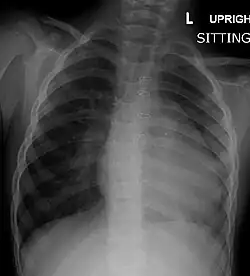
Pulmonary bay is a radiological term which describes an area on the chest radiograph. This is the area just below the aortic knob representing the location of the main pulmonary artery. The pulmonary bay is usually concave, but in cases of diseases which cause enlargement of the pulmonary artery, the pulmonary bay can become convex[1].
Examples of diseases that cause a change in the pulmonary bay are Tetralogy of Fallot and other congenital heart diseases[1][2], and diseases of the heart valves[3].
References
- 1 2 Anand Kumar Mishra, Javid Raja (November 2021). "Aneurysmal right ventricular outflow in an adult patient with unrepaired Tetralogy of Fallot and an absent pulmonary valve". Journal of Cardiac Surgery 37(3). 37 (3).
- ↑ Sharma, S.; Sherwani, P.; Arunachalam, V. S.; Sharma, P. (2021-03-11). "Congenital Cardiovascular Diseases: A Pictorial Review". ECR 2021 EPOS. Retrieved 2026-06-18.
- ↑ "Unusual Survival of Anomalous Left Coronary Artery From the Pulmonary Artery With Severe Rheumatic Mitral Stenosis in Septuagenarian Women: Foes Becoming Friends?". openi.nlm.nih.gov. Retrieved 2026-06-18.
