Puerto Mosquito
| Puerto Mosquito | |
|---|---|
| Bahía Bioluminiscente de Vieques | |
IUCN category V (protected landscape/seascape)[1] | |
 Bioluminescent blue hues at Puerto Mosquito | |
  Location within Puerto Rico | |
| Location | Vieques, Puerto Rico |
| Nearest city | Esperanza, Vieques |
| Coordinates | 18°06′07″N 65°26′45″W / 18.10194°N 65.44583°W |
| Designated | 1980 |
The Puerto Mosquito Bioluminescent Bay (Spanish: Bahía bioluminiscente de Puerto Mosquito), or Mosquito Bio Bay, is a bay in the island of Vieques famous for its bioluminescence produced by the dinoflagellate Pyrodinium bahamense, which glows blue when agitated. This species of phytoplankton is found in bays in the Virgin Islands, Puerto Rico and The Bahamas.[2]
History
According to legend, Puerto Mosquito is named after the Mosquito, the name of one of pirate Roberto Cofresí's ships.[3] The bio bay was proclaimed a National Natural Landmark in 1980.[4]
Ecology
Bioluminescence
Bioluminescence is produced by the dinoflagellate Pyrodinium bahamense, which glows blue when agitated. Although the phytoplankton responsible for the phenomenon of bioluminescence is found throughout the Antilles, Puerto Mosquito is one of the seven year-round bioluminescent bays in the Caribbean.[2] The bioluminescence is the product of a number of factors: the water conditions and ecosystem created by the surrounding mangrove forest (mostly Rhizophora mangle),[5][6] the complete lack of modern development in the lagoon, the temperature of the water and the depth of the bay.[7]
Flora and fauna
Although famous for the red mangrove (Rhizophora mangle), critical in the bioluminescence process of the bay, the reserve is home to all four occurring mangrove species in the archipelago of Puerto Rico: the other three being black (Avicennia germinans), white (Laguncularia racemosa), and buttonwood or button mangrove (Conocarpus erectus).[8]
The reserve, along with the Vieques National Wildlife Refuge, is an internationally recognized Important Bird Area (IBA) and a designated Important Shorebird Site. Some notable bird species found within the reserve include Adelaide's warblers (Setophaga adelaidae), mangrove cuckoos (Coccyzus minor), crested hummingbirds (Orthorhyncus cristatus), snowy egrets (Egretta thula), brown boobies (Sula leucogaster), magnificent frigatebirds (Fregata magnificens), royal terns (Thalasseus maximus) and black-bellied plovers (Pluvialis squatarola), and migratory birds such as semipalmated plovers (Charadrius semipalmatus) and ospreys (Pandion haliaetus).[9]
Recreation
The bright blue hues produced by the microorganisms during nights of very little moonlight or new moon attracts tourists to the bio bay.[10] It is one of the three bio bays in Puerto Rico; the other two are Laguna Grande in Fajardo and La Parguera in Lajas.[11] The bay and its surrounding mangrove forest are protected by the Vieques Bioluminescent Bay Natural Reserve and no swimming is allowed. Guided tours allow visitors to kayak in the bay and observe the bioluminescence.[12] The bio bay is located near the beach community of Esperanza, between the barrios of Puerto Ferro and Puerto Real in Vieques, Puerto Rico.
Gallery
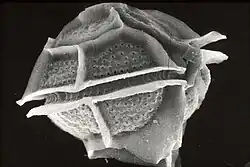 Pyrodinium bahamense is responsible for the bioluminescence.
- Kayaking tour in the Puerto Mosquito Bio Bay
 Aerial view of the bay and nature reserve.
See also
References
- ↑ Protected Planet Website- Retrieved April 13, 2023
- 1 2 Soler-Figueroa, Brenda María; Otero, Ernesto (2015-01-01). "The Influence of Rain Regimes and Nutrient Loading on the Abundance of Two Dinoflagellate Species in a Tropical Bioluminescent Bay, Bahía Fosforescente, La Parguera, Puerto Rico". Estuaries and Coasts. 38 (1): 84–92. doi:10.1007/s12237-014-9827-0. ISSN 1559-2731. S2CID 85305359.
- ↑ University, Georgia State. "5 Facts About Vieques' Bioluminescent Mosquito Bay". Treehugger. Retrieved 2021-12-13.
- ↑ US NPS, NATIONAL NATURAL LANDMARKS PROGRAM (June 2009). "NATIONAL REGISTRY OF NATURAL LANDMARKS" (PDF). npshistory.com.
- ↑ Usup, Gires; Azanza, Rhodora V. (1998). "Physiology and dynamics of the tropical dinoflagellate Pyrodinium bahamense". In Anderson, Donald M.; Cembella, Allan D.; Hallegraeff, Gustaaf M. (eds.). The Physiological Ecology of Harmful Algal Blooms. NATO ASI Series G, Ecological sciences no. 41. Berlin: Springer-Verlag. pp. 81–94. ISBN 978-3-54064-117-9.
- ↑ Phlips, E. J.; Badylak, S.; Bledsoe, E.; Cichra, M. (2006). "Factors affecting the distribution of Pyrodinium bahamense var. bahamense in coastal waters of Florida". Marine Ecology Progress Series. 322: 99–115. Bibcode:2006MEPS..322...99P. doi:10.3354/meps322099.
- ↑ "SEA Launching Second Study on Bioluminescence | St. Croix Source". 2016-03-06. Archived from the original on 2016-03-06. Retrieved 2021-12-13.
- ↑ "Manglares". EcoExploratorio: Museo de Ciencias de Puerto Rico. Retrieved 2026-06-29.
- ↑ Santos, Rommel (2023-06-19). "Vieques designated an Important Shorebird Area". VCHT. Retrieved 2026-06-29.
- ↑ "Mosquito Bioluminescent Bay". Discover Puerto Rico. Retrieved 2021-12-13.
- ↑ "Puerto Rico y sus bahías bioluminiscentes". Para la Naturaleza (in European Spanish). 2018-09-14. Retrieved 2021-12-13.
- ↑ "Mosquito Bioluminescent Bay | Vieques". Retrieved 2021-12-13.