Prunus fremontii
| Prunus fremontii | |
|---|---|
 | |
| Flowers in Palm Springs, California | |
Scientific classification  | |
| Kingdom: | Plantae |
| Clade: | Embryophytes |
| Clade: | Tracheophytes |
| Clade: | Angiosperms |
| Clade: | Eudicots |
| Clade: | Rosids |
| Order: | Rosales |
| Family: | Rosaceae |
| Genus: | Prunus |
| Species: | P. fremontii |
| Binomial name | |
| Prunus fremontii | |
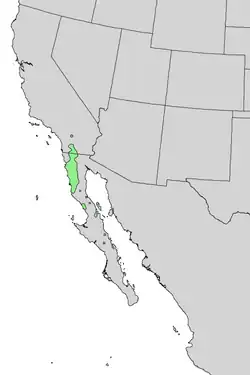 | |
| Natural range of Prunus fremontii | |
| Synonyms[2] | |
| |

Prunus fremontii is a North American species of plants in the rose family, known by the common name desert apricot.[3]
Description
Prunus fremontii is a deciduous shrub or small tree reaching up to 5 metres (16 feet) in height. The flowers are white or pink, blooming about the same time as the leaves unfurl in the spring. The fruits are yellow and egg-shaped.[4]
 P. fremontii in desert chaparral habitat
Taxonomy
The species takes its scientific name from John C. Frémont.[5]
Distribution and habitat
The plant is found in southern California, northern and western Baja California, and northern Baja California Sur.[6][7][8]
Uses
The fruits are an important food for Native American groups, such as the Cahuilla.[9]
References
- ↑ Potter, D. (2021). "Prunus fremontii". IUCN Red List of Threatened Species. 2021 e.T61615642A61615669. doi:10.2305/IUCN.UK.2021-1.RLTS.T61615642A61615669.en. Retrieved 18 November 2021.
- ↑ The Plant List, Prunus fremontii S.Watson
- ↑ NRCS. "Prunus fremontii". PLANTS Database. United States Department of Agriculture (USDA). Retrieved 14 October 2015.
- ↑ Flora of North America, Prunus fremontii S. Watson 1880.Desert apricot
- ↑ Michael L. Charters. "Botanical Names: F". California Plant Names: Latin and Greek Meanings and Derivations. Sierra Madre, CA. Retrieved September 24, 2009.
- ↑ Calflora taxon report, University of California, Prunus fremontii S. Watson desert apricot
- ↑ SEINet, Southwestern Biodiversity, Arizona chapter photos and distribution map
- ↑ Tropicos, Prunus fremontii S. Watson
- ↑ University of Michigan, Ethnobotany
External links
 Media related to Prunus fremontii at Wikimedia Commons
- Jepson Manual treatment for Prunus fremontii
- Interactive Distribution Map of Prunus fremontii
- "Species writeup of Prunus fremontii". Virginia Tech. Department of Forestry. Archived from the original on 2008-04-30.
- "Prunus fremontii". US Forest Service.
- "Prunus fremontii". image gallery from the CalPhotos photo gallery. University of California.
Categories:
- IUCN Red List least concern species
- Prunus
- Flora of California
- Trees of Northern America
- Flora of the Sonoran Deserts
- Natural history of the California chaparral and woodlands
- Natural history of the Colorado Desert
- Natural history of the Peninsular Ranges
- Plants described in 1880
- John C. Frémont
- Taxa named by Sereno Watson
- Plants used in Native American cuisine
- Plants used in traditional Native American medicine
- Trees of Mediterranean climate
- Drought-tolerant trees
- Drought-tolerant plants
- Desert fruits
- Amygdaloideae stubs