Prunus andersonii
| Prunus andersonii | |
|---|---|
 | |
Scientific classification  | |
| Kingdom: | Plantae |
| Clade: | Embryophytes |
| Clade: | Tracheophytes |
| Clade: | Angiosperms |
| Clade: | Eudicots |
| Clade: | Rosids |
| Order: | Rosales |
| Family: | Rosaceae |
| Genus: | Prunus |
| Species: | P. andersonii |
| Binomial name | |
| Prunus andersonii | |
| Synonyms[2] | |
| |

Prunus andersonii is a North American species of shrub in the same genus as the peach, cherry, and almond. Its common names include desert peach and desert almond.
Description
Prunus andersonii is a deciduous shrub or tree up to 3 metres (10 feet) in height, its tangling branches narrowing to spiny-tipped twigs.[3] Serrated, lance-shaped to oval leaves occur in alternate bundles, each leaf measuring up to 3 centimeters (1 in) long.[3] The inflorescence is a solitary flower or cluster of up to five flowers. Each flower has usually five concave pink petals up to 1 cm (3⁄8 in) long,[4] with many whiskerlike stamens at the center. The flowers bloom before or at the same time as the leaves appear.[3]
The fruit is a fuzzy reddish-orange drupe around 1 cm (3⁄8 in) wide. The fruits are fleshy in years with ample moisture and dry in drought years.[3] The seed is a heart-shaped stone.[3] The plant reproduces sexually via germination of the seed and vegetatively by sprouting from its rhizome.[3] One plant may sprout and resprout from its rhizomes to form a very large clone which can spread over several acres.[3][4]
 Habit
 Flower close-up
Taxonomy
It was named after Charles Lewis Anderson by Asa Gray.[5]
Distribution and habitat
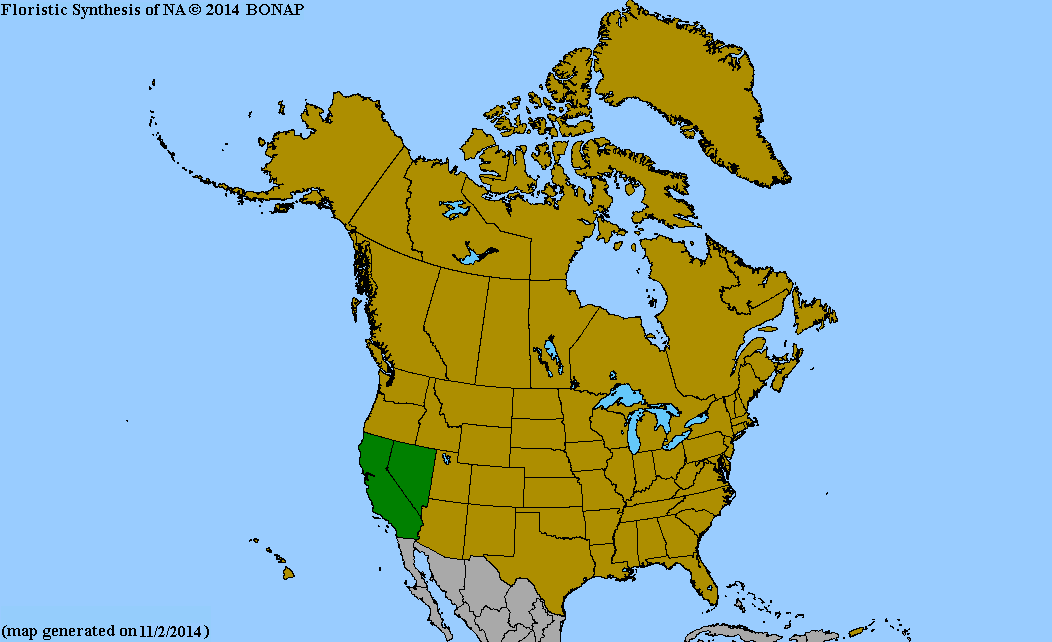
It is native to eastern California and western Nevada, where it grows in forests and scrub in desert and mountains.[6][7]
Ecology
Many animals collect and eat the fruits and cache the seeds.[3]
Uses
The fruit is reportedly edible.[8] Among Native American groups, the Paiute used the plant for making tea and medicinal remedies, and the Cahuilla considered the fruit a delicacy.[9]
References
- ↑ Rhodes, L.; Pollard, R.P. & Maxted, N. (2018). "Amygdalus andersonii". The IUCN Red List of Threatened Species. 208. IUCN. e.T50049394A50626781. doi:10.2305/IUCN.UK.2016-3.RLTS.T50049394A50626781.en.
- ↑ Tropicos, Prunus andersonii A. Gray
- 1 2 3 4 5 6 7 8 "Prunus andersonii". US Forest Service. Archived from the original on 2011-06-05. Retrieved 2026-08-24.
- 1 2 "Prunus andersonii in Flora of North America". efloras.org. Retrieved 2026-08-24.
- ↑ Gray, Asa (1868). "Characters of New Plants of California and Elsewhere . . ". Proc. Amer. Acad. Arts. 7: 337. Retrieved Mar 7, 2020.
- ↑ Biota of North America Program 2014 county distribution map
- ↑ Calflora taxon report, University of California, Prunus andersonii A. Gray desert peach
- ↑ Turner, Mark; Kuhlmann, Ellen (2014). Trees & Shrubs of the Pacific Northwest (1st ed.). Portland, OR: Timber Press. p. 250. ISBN 978-1-60469-263-1.
- ↑ University of Michigan Ethnobotany
External links
 Media related to Prunus andersonii at Wikimedia Commons
- "Prunus andersonii". Plants for a Future.
- Jepson Flora Project: Prunus andersonii
- Calphotos Photo gallery, University of California