Protasio Tagle
Protasio Tagle | |
|---|---|
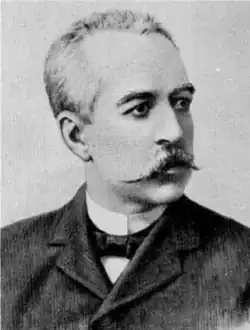 Photograph portrait of Tagle by Agustín Casasola, c. 1890 | |
| Secretary of Justice and Public Instruction | |
| In office 4 June 1877 – 15 November 1879 | |
| President | Porfirio Díaz |
| Preceded by | Ignacio Ramírez |
| Succeeded by | Ignacio Mariscal |
| Secretary of the Interior | |
| In office 28 November 1876 – 23 May 1877 | |
| President |
|
| Preceded by | Juan José Baz |
| Succeeded by | Trinidad García de la Cadena |
| Governor of the Federal District | |
| In office 21 November – 28 November 1876 | |
| Deputy of the Congress of the Union for the 25th district of the State of Mexico | |
| In office 8 December 1867 – 31 April 1871 | |
| Personal details | |
| Born | 1839 |
| Died | 31 July 1903 (aged 63–64) Mexico City, Mexico |
| Resting place | Panteón del Tepeyac |
| Party | Liberal |
Protasio Pérez de Tagle Frago[a] (1839 – 31 July 1903) was a Mexican soldier, politician and lawyer. He served as secretary of the interior from 1876 to 1877 under Presidents Porfirio Díaz and Juan N. Méndez and as secretary of justice and public education from 1877 to 1879 under Díaz. He was previously governor of the Federal District for one week in 1876, and before that was a member of the Chamber of Deputies representing the State of Mexico for two terms.
Biography
Early life
Protasio Pérez de Tagle Frago[a] was born in 1839 in Mexico City.[1][6][7] His father, Mariano Pérez de Tagle[8][9] was a wealthy hacienda owner.[10] His mother was Antonia Frago de Tagle.[9][11] He had a brother, Mariano Pérez de Tagle Frago.[9] Another brother, Ciro, would also serve in the administration of Porfirio Díaz as an ambassador.[12] From his father, Tagle inherited the hacienda of San Bartolomé de los Tepetates near Ciudad Sahagún.[8] Tagle became a lawyer in 1871.[1]
He participated in the Reform War (1857–1861) as a member of the liberal sector, and later led a republican division during the second French intervention in Mexico (1861–1867).
In 1867 Tagle was elected to the Chamber of Deputies for the State of Mexico,[1] and he would continue to serve until 1875.[7] Beginning in 1867, Tagle was part of a group of deputies who proposed the separation of what is now the State of Hidalgo from the State of Mexico, the decree for which would be signed in 1869.[13][14] In October of 1868, Tagle was a member of the Grand Jury of Congress that found General Benigno Canto responsible for the murder of General José María Patoni. On 1 December, he also signed an opinion that accused secretary of war Ignacio Mejía of not respecting the budget of his department.[1]
In 1870 or 1871, he helped found the Asociación Democrática Constitucionalista,[b] which supported General Porfirio Díaz's presidential campaign in the 1871 election.[1][7] Subsequently, Tagle and Justo Benítez supported Díaz's Plan de la Noria.[10] Later, Tagle was one of the biggest congressional opponents of President Sebastián Lerdo de Tejada.[1]
In 1876, Tagle was a co-author of Díaz's Plan of Tuxtepec.[15] Tagle was on the directorate that supported the Tuxtepec uprising from Mexico City, along with Ignacio Vallarta, Pedro Ogazón, and Ireneo Paz.[16] As a result of the uprising, on 20 November, President Lerdo de Tejada fled Mexico City, and Tagle was left in charge of civil governance.[17][18][19] The following day, Tagle became governor of the Federal District and served until 28 November.[7]
Díaz and Méndez administrations
That same day that Tagle's governorship ended, Díaz became president of Mexico and Tagle became secretary of the interior in his cabinet,[6][20] succeeding Juan José Baz.[21] Díaz's cabinet initially consisted of tuxtepecanos (supporterss of the Tuxtepec uprising) including Tagle, Benítez, Ogazón, and Vallarta.[22]
On 6 December, Díaz resigned from the presidency, making Juan N. Méndez provisional president.[23] Tagle retained his post under Méndez.[24] On 15 January 1877, Tagle published a memo that promised to respect religious freedom and the laws of La Reforma. This memo pleased Mexican Catholics and the Vatican, who had been hoping for a shift away from the anti-clerical policies of previous Mexican governments.[25][26][27][28] This and his family background led to accusations of Tagle of having conservative sympathies. The government newspaper Diario Oficial defended Tagle as a liberal, but stated that he had given jobs to "intelligent and honorable" members of the Conservative Party.[29]
Díaz took office again on 17 February, and Tagle remained in his post until 23 May, when he was succeeded by Trinidad García de la Cadena.[30] Tagle was unpopular in the position and was severely criticised for his support of the Federal District's governor over banned forms of gaming.[1]
On 14 May 1877 the Chamber of Deputies elected him to the Supreme Court. On 2 June, he requested a leave of absence from his Supreme Court position, but was denied; upset with the refusal, he presented his resignation, which was accepted on 2 May 1878.[31]
On 24 June 1877, Tagle became Secretary of Justice and Public Instruction, succeeding Ignacio Ramírez.[31][32] On 3 October, Tagle pushed an initiative of reforms to the amparo laws that would begin a process of the strengthening of the executive and the weakening of the judiciary during the Porfiriato.[33] That same year, Tagle banned public and private admonition and expulsions for a day as punishments in schools.[34] He was still an unpopular figure, and when he spoke at Ramírez's funeral on 18 June 1879, the audience reacted negatively.[35] Tagle left the post on 15 November 1879, being succeeded by Juan N. García.[31][32][36] In 1879 there were possibilities for him to be the presidential candidate, but he was defeated by Manuel González and finally retired from political activities. González's ascent marked the final break between Tagle and Díaz.[10][37] By the end of the Díaz administration, the departure of men such as Tagle and Benítez had left none of Díaz's six original cabinet secretaries in power, clearing the way for González's rise.[38]
Later life
Following his retirement from politics, Tagle taught Roman law at the Escuela Nacional de Jurisprudencia.[31][37] He also continued to serve as a lawyer and managed his hacienda, which had a small primary school.[37]
Tagle died in Mexico City on 31 July 1903[3][31][39] of an intestinal illness.[40] He was buried in the Panteón del Tepeyac in Mexico City.[40][41] Tagle was survived by a son, Cornelio Pérez de Tagle.[4]
Legacy
A number of locales in Mexico City bear Tagle's name. These include the street Calle Gob. Protasio Tagle,[42] the park Parque Protasio Tagle,[43] and the primary school Escuela Primaria Lic. Protasio Tagle.[44]
Notes
References
Citations
- 1 2 3 4 5 6 7 8 9 Bravo Rodríguez 1990, p. 1135
- ↑ León 1902, p. 547.
- 1 2 Ortiz Molina 1907, p. 263
- 1 2 Imp. J.C. Padre 1910, p. 42
- ↑ Díaz Zermeño 1979, p. 64.
- 1 2 Quijano Torres 2012, p. 251
- 1 2 3 4 5 Musacchio, Humberto (1990). "Protasio Tagle". Gran Diccionario Enciclopédico de México Visual, Tomo IV (in Spanish). p. 1965. Archived from the original on 12 June 2009. Retrieved 4 August 2026.
- 1 2 Bazart 1979, p. 163
- 1 2 3 Mayagoitia y Hagelstein 1998, p. 392
- 1 2 3 Sierra 1907, p. 64
- ↑ Pimentel 1904, p. 389.
- ↑ Heredia González 2021, p. 119.
- ↑ "150 aniversario de la creación del estado de Hidalgo". Instituto Nacional para el Federalismo y el Desarrollo Municipal (in Spanish). 15 January 2019. Retrieved 16 August 2026.
- ↑ "Aprueba congreso inscripción de letras de oro conmemoriativas a 150 años de erección del Estado de Hidalgo" (PDF). Boletín de Prensa (in Spanish). No. 211. Pachuca, Hidalgo. 8 May 2019. Retrieved 16 August 2026.
- ↑ Bazart 1979, pp. 163–164.
- ↑ Ponce Alcocer 2000, p. 84.
- ↑ Bancroft 1888, pp. 427–428.
- ↑ Galeana 2010, p. 243.
- ↑ Serrano Álvarez 2012, pp. 48–49.
- ↑ Bancroft 1888, pp. 430–431.
- ↑ Quijano Torres 2012, p. 253.
- ↑ Garner 2015, p. 336.
- ↑ Serrano Álvarez 2012, p. 51.
- ↑ Quijano Torres 2012, p. 249.
- ↑ Dublán & Lozano 1886, pp. 134–135.
- ↑ Case 1975, pp. 218, 225.
- ↑ García Ugarte 2014, pp. 25–26.
- ↑ Bar-On & Molas 2021, p. 16.
- ↑ Hale 1989, p. 99.
- ↑ Quijano Torres 2012, p. 245.
- 1 2 3 4 5 Bravo Rodríguez 1990, p. 1136
- 1 2 Quijano Torres 2012, p. 248
- ↑ del Villar 2003, p. 97.
- ↑ Díaz Zermeño 1979, p. 83.
- ↑ Esposito 2005, p. 72.
- ↑ Serrano Álvarez 2012, p. 90.
- 1 2 3 Bazart 1979, p. 164
- ↑ González 1976, p. 201.
- ↑ Garner 2015, p. 343.
- 1 2 "El señor Lic. Don Protasio Tagle". El Mundo Ilustrado (in Spanish). Vol. II, no. 6. 9 August 1903. p. 2.
- ↑ de Mauleón, Héctor (26 May 2014). "El panteón de las celebridades". El Universal (in Spanish). Archived from the original on 4 March 2016. Retrieved 7 August 2026.
- ↑ "Instituto de Especialización para Ejecutivos Plantel CiudadMX, Escuela universitaria en Ciudad de México, Ciudad. de México, México". Escuelas y colegios México (in Spanish). Retrieved 8 August 2026.
- ↑ Poniatowska, Elena (17 September 2023). "Parque Protasio Tagle, en el abandono". La Jornada (in Spanish). Mexico City. Retrieved 3 August 2026.
- ↑ "Escuela Primaria Lic. Protasio Tagle, Escuela primaria en Ciudad de México, Ciudad. de México, México". Escuelas y colegios México (in Spanish). Retrieved 7 August 2026.
Bibliography
- Bancroft, Hubert Howe (1888). History of Mexico: 1861-1887. Vol. VI. San Francisco, California: The History Company.
- Bar-On, Tamir; Molas, Bàrbara (22 November 2021). The Right and Radical Right in the Americas: Ideological Currents from Interwar Canada to Contemporary Chile. Rowman & Littlefield. ISBN 978-1-7936-3583-9.
- Bazart, Jan (July 1979). "La escuela primaria de la hacienda de San Bartolomé Tepetates: Alumnos, maestros, equipo". Historia Mexicana (in Spanish). 29 (1): 163–179. JSTOR 25135682.
- Bravo Rodríguez, Alicia (1990). "Perfil biográfico de los ministros de la Suprema Corte de Justicia de la Nación, cuando fue su presidente Ignacio L. Vallarta (1877-1882)". In Supreme Court of Mexico (ed.). La Suprema Corte de Justicia a principios del porfirismo (PDF) (in Spanish). Mexico City: Poder Judicial de la Federación. pp. 1115–1144. ISBN 968-6145-07-9. Archived from the original (PDF) on 10 February 2005.
- Case, Robert (October 1975). "Resurgimiento de los conservadores en México: 1876-1877". Historia Mexicana (in Spanish). 25 (2): 204–231. JSTOR 25135500.
- del Villar, Samuel I. (2003). "El constitucionalismo estadunidense y el liberalismo mexicano". In Maribe, Bernardo (ed.). México-Estados Unidos-Canadá: 1999-2000 (in Spanish). Mexico City: El Colegio de México. pp. 53–108. ISBN 968-12-1134-0. JSTOR j.ctv3f8q1d.
- Díaz Zermeño, Héctor (July 1979). "La escuela nacional primaria en la ciudad de México: 1876-1910". Historia Mexicana (in Spanish). 29 (1): 59–90. JSTOR 25135679.
- Dublán, Manuel; Lozano, José Maria (1886). Coleccion legislativa completa de la Republica Mexicana con todas las disposiciones expedidas para la Federacion, el Distrito y los territorios federales (in Spanish). Vol. XIII. Eduardo Dublán y Compañía.
- Esposito, Matthew D. (July 2005). "The Politics of Death: State Funerals as Rites of Reconciliation in Porfirian Mexico, 1876-1889". The Americas. 62 (1): 65–94. doi:10.1353/tam.2005.0121. JSTOR 4491023.
- Galeana, Patricia (2010). La disputa por la soberanía (1821-1876). México y el mundo historia de sus relaciones exteriores (in Spanish). Vol. 3. El Colegio de México. ISBN 978-607-462-102-0. JSTOR j.ctv3f8nk7.
- García Ugarte, Marta Eugenia (1 July 2014). "La Iglesia y la formación del Partido Católico Nacional en México: distinción conceptual y práctica entre Católico y Conservador. 1902-1914". Lusitania Sacra (in Spanish) (30). Catholic University of Portugal: 15–52. doi:10.34632/lusitaniasacra.2014.6658.
- Garner, Paul (2015) [2001]. Porfirio Díaz: entre el mito y la historia (PDF) (in Spanish). Translated by Pérez Villanueva, Luis. Editorial Crítica. ISBN 978-607-8406-56-2.
- González, Luis (1976). "El liberalismo triunfante". In Cosío Villegas, Daniel (ed.). Historia general de México: volumen III (in Spanish). El Colegio de México. pp. 163–282. JSTOR j.ctvt1sgxq.5.
- Hale, Charles A. (1989). The Transformation of Liberalism in Late Nineteenth-Century Mexico. Princeton, New Jersey: Princeton University Press. ISBN 0-691-07814-9. JSTOR j.ctt7ztg05.
- Heredia González, Emmanuel (2021). "Una negociación en dos tiempos: John W. Foster y el reconocimiento del gobierno de Porfirio Díaz, 1876–1878". In Lajous, Roberta; Pani, Erika; Riguzzi, Paolo; Toro, María Celia (eds.). Embajadores de Estados Unidos en México: Diplomacia de crisis y oportunidades (in Spanish). Mexico City: El Colegio de México. pp. 111–136. ISBN 978-607-564-302-1. JSTOR j.ctv2kcwnm2.10.
- León, Nicolás (1902). Compendio de la historia general de México desde los tiempos prehistóricos hasta el año de 1900 (in Spanish). Herrero hermanos.
- Mayagoitia y Hagelstein, Alejandro (June 1998). "Fuentes para servir a las biografías de abogados activos en la Ciudad de México durante el siglo XIX: Matrimonios en la Parroquia del Sagrario Metropolitano. Segunda Parte". Ars Iuris (in Spanish) (18). Mexico City: Panamerican University: 339–398. ISSN 0188-5782.
- Ortiz Molina, Luis G. (1907). Prontuario de Acuerdos, Bandos, Circulates, Decretos, Leyes, Reglamentos y demás disposiciones vigentes de la Secretaría de Gobernación y sus dependencias, adicionadas con las de otros Departamentos que por el asunto se relacionan con el ramo (in Spanish). Talleres de Tipografía del Ingeniero Fernando Bustillos.
- Pimentel, Victoriano (1904). Diario de Jurisprudencia del Distrito y Territorios Federales (in Spanish). Vol. II. Secretaría de Justicia é Instrucción Pública.
- Ponce Alcocer, María Eugenia (2000). La elección Presidencial de Manuel González, 1878-1880: Preludio de un presidencialismo. Mexico City: Universidad Iberoamericana. ISBN 968-859-403-2.
- Quijano Torres, Manuel (2012). "Relación de gabinetes, 1821-2012". 200 Años de Administración Pública en México, Tomo III: Los Gabinetes en México, 1824-2012 (PDF) (in Spanish). Instituto Nacional de Administración Pública. pp. 98–364. ISBN 978-607-9026-20-2. Archived (PDF) from the original on 4 July 2024.
- Serrano Álvarez, Pablo (2012). Martínez Ocampo, Lourdes (ed.). Porfirio Díaz y el Porfiriato, Cronología (1830-1915) (PDF) (in Spanish). Instituto Nacional de Estudios Históricos de las Revoluciones de México. ISBN 978-607-7916-66-6. Archived (PDF) from the original on 29 August 2025.
- Sierra, Justo (1907). Descripcion de los 24 Cuadros de Historia Patria (in Spanish). Libreria de la Vda. de Ch. Bouret.
- Testimonio de la escritura constitutiva de la Compañía Expendedora de Pulques, Sociedad Anónima (in Spanish). Imprenta J.C. Padre. 1910.