Hemicordulia affinis
| Western swamp emerald | |
|---|---|
 | |
Scientific classification  | |
| Kingdom: | Animalia |
| Phylum: | Arthropoda |
| Clade: | Pancrustacea |
| Class: | Insecta |
| Order: | Odonata |
| Infraorder: | Anisoptera |
| Superfamily: | Libelluloidea |
| Family: | Corduliidae |
| Genus: | Hemicordulia |
| Species: | H. affinis |
| Binomial name | |
| Hemicordulia affinis | |
 | |
| Synonyms | |
| |

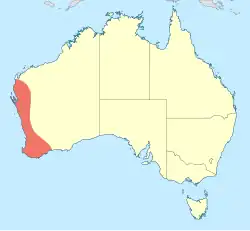
Hemicordulia affinis, commonly known as the western swamp emerald,[4] is a species of dragonfly in the family Corduliidae.[5] It inhabits rivers, pools and lakes in south-western Australia.[6]
Hemicordulia affinis is a small to medium-sized black and orange-yellow dragonfly with a thick, flattened tail.[7]
Taxonomy
Until 2025, Hemicordulia affinis was placed in the genus Procordulia.[3] The IUCN Red List assessment for the species was published under this former name.[1] Following research published in 2025, all species of Procordulia were transferred to Hemicordulia.[8]
Etymology
The genus name Hemicordulia is derived from the Greek ἡμι- (hēmi, "half"), combined with Cordulia, a genus name derived from the Greek κορδύλη (kordylē, "club" or "cudgel"). The name refers to the close relationship of the genus to Cordulia.[9]
The species name affinis is Latin for "related to" or "closely allied", referring to its similarity to Cordulia jacksoniensis.[2][9]
Gallery
 Female wings
 Male wings
 Western swamp emerald on grass blade
See also
References
- 1 2 Dow, R.A. (2017). "Procordulia affinis". IUCN Red List of Threatened Species. 2017 e.T163571A87529256. doi:10.2305/IUCN.UK.2017-1.RLTS.T163571A87529256.en. Retrieved 20 November 2021.
- 1 2 Selys-Longchamps, Edmond (1871). "Synopsis des Cordulines". Bulletin de la Classe des Science, Académie Royale de Belgique. 2 (in French). 31: 238–316, 519–565 [260] – via Biodiversity Heritage Library.
- 1 2 "Species Procordulia affinis (Selys, 1871)". Australian Faunal Directory. Australian Biological Resources Study. 2012. Retrieved 7 February 2017.
- ↑ Theischinger, Günther; Hawking, John (2006). The Complete Field Guide to Dragonflies of Australia. Collingwood, Victoria, Australia: CSIRO Publishing. p. 250. ISBN 978-0-64309-073-6.
- ↑ Paulson, D.; Schorr, M.; Abbott, J.; Bota-Sierra, C.; Deliry, C.; Dijkstra, K.-D.; Lozano, F. "World Odonata List". OdonataCentral. University of Alabama.
- ↑ Theischinger, Günther; Endersby, Ian (2009). Identification Guide to the Australian Odonata. Department of Environment, Climate Change and Water NSW. p. 233. ISBN 978-1-74232-475-3.
- ↑ Watson, J.A.L.; Theischinger, G.; Abbey, H.M. (1991). The Australian Dragonflies: A Guide to the Identification, Distributions and Habitats of Australian Odonata. Melbourne: CSIRO. ISBN 0-643-05136-8.
- ↑ Goodman, Aaron; Abbott, John C.; Bybee, Seth; Ehlert, Juliana; Frandsen, Paul B.; Guralnick, Rob; Kalkman, Vincent J.; Newton, Lacie; Parise Pinto, Ângelo; Ware, Jessica L. (2025-10-09). Christopher Owen (ed.). "Systematic and taxonomic revision of emerald and tigertail dragonflies (Anisoptera: Synthemistidae and Corduliidae)". Systematic Entomology. doi:10.1111/syen.70000.
- 1 2 Endersby, Ian; Fliedner, Heinrich (2015). The Naming of Australia's Dragonflies. Eltham, Victoria, Australia: Busybird Publishing. ISBN 9781925260625.
