Florence Ada Fuller (1867 – 17 July 1946) was a South African-born Australian artist. Originally from
Port Elizabeth, Fuller migrated as a child to
Melbourne with her family. There she trained with her uncle
Robert Hawker Dowling and teacher
Jane Sutherland and took classes at the
National Gallery of Victoria Art School, becoming a professional artist in the late 1880s. In 1892 she left Australia, travelling first to South Africa, where she met and painted for
Cecil Rhodes, and then on to Europe. She lived and studied there for the subsequent decade, except for a return to South Africa in 1899 to paint a portrait of Rhodes. Between 1895 and 1904 her works were exhibited at the
Paris Salon and London's
Royal Academy.
In 1904, Fuller returned to Australia, living in Perth. She became active in the Theosophical Society and painted some of her best-known work, including A Golden Hour, described by the National Gallery of Australia as a "masterpiece"[1] when it acquired the work in 2013. Beginning in 1908, Fuller travelled extensively, living in India and England before ultimately settling in Sydney. There, she was the inaugural teacher of life drawing at the School of Fine and Applied Arts, established in 1920 by the New South Wales Society of Women Painters. She died in 1946.
Highly regarded during her active career as a portrait and landscape painter, by 1914 Fuller was represented in four public galleries—three in Australia and one in South Africa—a record for a woman who was an Australian painter at that time. In 1927 she began almost twenty years of institutionalization in a mental asylum, however, and her death went without notice. After her death, information about her was frequently omitted from reference books about Australian painters and knowledge of her work became obscure despite her paintings being held in public art collections including the Art Gallery of South Australia, the Art Gallery of Western Australia, the National Gallery of Australia, the National Gallery of Victoria, the Art Gallery of New South Wales and Australia's National Portrait Gallery.
Portal:Visual arts/Selected biography/16
Maria Dulębianka (21 October 1861 – 7 March 1919) was a
Polish artist and activist. Born into a family of landed gentry, she attended finishing school in
Kraków and then studied art in
Warsaw and in
Vienna and
Paris. Her work was recognized in the
1900 Paris Exposition and her
Studium dziewczyny (Girls' Studio) was purchased by the
National Museum in Kraków. After 1889, the majority of her paintings were of her companion
Maria Konopnicka.
Dulębianka was active in the women's movement pressing for women to be admitted to the Kraków Academy of Fine Arts and for the establishment of a gymnasium in Lviv for girls to gain access to higher education. She published articles and gave lectures on women's issues. Active in the fight for women's suffrage, she ran as a candidate in the 1908 election for the Parliament of Galicia, but was rejected because she was a woman. Undiscouraged, she continued to strive for social equality, Polish independence, and cooperation between Poles and Ukrainians.
Dulębianka founded the Women's Electoral Committee to press for women's inclusion in the Lviv City Council, the Union of Women's Rights, the Men's League for the Defense of Women's Rights and the Women's Civic Work Committee. As the leader of the Civic Work Committee, she established kitchens for the poor, children's nurseries, and a club to care for street children and orphans. Under the occupation of Lviv by the Imperial Russian Army and during the Polish–Ukrainian War, she organized humanitarian aid. She contracted typhus while assisting prisoners of war and died in 1919. Dulębianka is remembered as a pioneer of women's rights in Poland.
Portal:Visual arts/Selected biography/15
Emily Sartain (March 17, 1841 – June 17, 1927) was an American painter and engraver. She was the first woman in Europe and the United States to practice the art of
mezzotint engraving, and the only woman to win a gold medal at the
1876 World Fair in Philadelphia. Sartain became a nationally recognized art educator and was the director of the
Philadelphia School of Design for Women from 1866 to 1920.
[2] Her father,
John Sartain, and three of her brothers,
William, Henry and Samuel were artists. Before she entered the
Pennsylvania Academy of the Fine Arts and studied abroad, her father took her on a
Grand Tour of Europe. She helped found the
New Century Club for working and professional women, and the professional women's art clubs,
The Plastic Club and The Three Arts Club.
Portal:Visual arts/Selected biography/14
Eleanor Norcross, born
Ella Augusta Norcross (1854–1923), was an American painter who studied under
William Merritt Chase and
Alfred Stevens. She lived the majority of her adult life in
Paris, France as an artist and collector and spent the summers in her hometown of
Fitchburg, Massachusetts. Norcross painted
Impressionist portraits and still lifes, and is better known for her paintings of
genteel interiors.
Her father provided her a comfortable living, under the proviso that she would not sell her paintings. With a life mission to provide people from her hometown the ability to view great works of art, Norcross collected art, made copies of paintings of Old Masters, and systematically documented decorative arts from the 12th through the 19th century. Her funding and art collection were used to establish the Fitchburg Art Museum.
In 1924, her works were shown posthumously in Paris at the Louvre and Salon d'Automne, where Norcross was the first American to have had a retrospective. Her works were also shown the following year at the Museum of Fine Arts, Boston.
Portal:Visual arts/Selected biography/13
Xue Susu (
Chinese: 薛素素; also known as
Xue Wu,
Xuesu,
Sunjung among other pen names) (
c.1564
–1650? C.E.) was a Chinese
courtesan. Known as one of the "Eight Great Courtesans of the
Ming Dynasty", she was an accomplished painter and poet, and was noted for her skill at mounted archery. She was particularly noted for her figure paintings, which included many Buddhist subjects. Her works are held in a number of museums both in China and elsewhere. Her archery was commented upon by a number of contemporary writers, as were her masculine, martial tendencies; these were regarded as an attractive feature by the literati of the period.
She lived in Eastern China, residing for most of her life in the Zhejiang and Jiangsu districts. After a career as a celebrated courtesan in Nanjing, Xue married several times, but none of these unions lasted. During her later life, she eventually opted for the life of a Buddhist recluse.
Portal:Visual arts/Selected biography/12
Isobel "Iso" Rae (18 August 1860
– 16 March 1940) was an Australian
impressionist painter. After training at Melbourne's
National Gallery of Victoria Art School, where she studied alongside
Frederick McCubbin and
Jane Sutherland, Rae travelled to France in 1887 with her family, and spent most of the rest of her life there. A longstanding member of the
Étaples art colony, Rae lived in or near the village of
Étaples from the 1890s until the 1930s. During that period, Rae exhibited her paintings at the
Royal Society of British Artists, the
Society of Oil Painters, and the
Paris Salon. During World War I, she was a member of the
Voluntary Aid Detachment and worked throughout the war in Étaples Army Base Camp. She and
Jessie Traill were the only Australian women to live and paint in France during the war, however they were not included in their country's first group of
official war artists. Following Hitler's rise to power, Rae moved to south-eastern England, where she died in 1940.
Portal:Visual arts/Selected biography/11
Auguste Rodin was a French artist, generally considered the progenitor of modern
sculpture. He was the preeminent French sculptor of his time, possessing a unique ability to model a complex, turbulent, deeply pocketed surface in
clay. Many of Rodin's most notable sculptures were roundly criticized during his lifetime. They clashed with the predominant figure sculpture tradition, in which works were decorative, formulaic, or highly thematic. Rodin's most original work departed from traditional themes of
mythology and
allegory, modeled the human body with high realism, and celebrated individual character and physicality. Rodin was sensitive to the controversy about his work, but did not change his style, and successive works brought increasing favor from the government and the artistic community. By 1900, he was a world-renowned artist. Wealthy private clients sought Rodin's work after his
World's Fair exhibit, and he kept company with a variety of high-profile intellectuals and artists. His sculpture suffered a decline in popularity after his death in 1917, but within a few decades his legacy solidified.
Portal:Visual arts/Selected biography/10
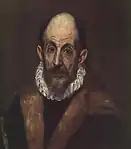
El Greco was a prominent
painter,
sculptor and
architect of the
Spanish Renaissance. El Greco was born in
Crete, which was at that time part of the
Republic of Venice, and at 26 travelled to
Venice to study. In 1570 he moved to Rome, where he opened a workshop and executed a series of works. During his stay in
Italy, El Greco enriched his style with elements of
Mannerism and of the
Venetian Renaissance. In 1577 he emigrated to
Toledo,
Spain, where he lived and worked until his death. In Toledo El Greco received several major commissions and produced his best known paintings. El Greco's dramatic and expressionistic style was met with puzzlement by his contemporaries but found appreciation in the
20th century. El Greco is regarded as a precursor of both
Expressionism and
Cubism, while his personality and works were a source of inspiration for poets and writers such as
Rainer Maria Rilke and
Nikos Kazantzakis. El Greco has been characterized by modern scholars as an artist so individual that he belongs to no conventional school. He is best known for tortuously elongated figures and often fantastic or phantasmagorical
pigmentation, marrying
Byzantine traditions with those of
Western civilization.
Portal:Visual arts/Selected biography/9
Roman Vishniac was a renowned Russian-American
photographer, best known for capturing on film the culture of
Jews in
Eastern Europe before the
Holocaust. He was, however, an extremely diverse photographer, an accomplished
biologist and a knowledgeable student and teacher of
art history. Throughout his life, he made significant scientific contributions to the fields of
photomicroscopy and
time-lapse photography. He later became a teacher and collector of historic art and artifacts. Vishniac was very interested in history, especially that of his ancestors. In turn, he was strongly tied to his Jewish roots and was a
Zionist later in life. Roman Vishniac won international acclaim for his photography: his pictures from the
shtetlach and Jewish ghettos, celebrity portraits, and images of microscopic biology. He is known for his book
A Vanished World, published in 1947, which was one of the first such pictorial documentations of Jewish culture in Eastern Europe from that period. He is known also for his extreme humanism and respect and awe for life, sentiments that can be seen in all aspects of his work.
Portal:Visual arts/Selected biography/8
Henry Moore was a
British artist and
sculptor. Born into a poor mining family in the
Yorkshire town of
Castleford, he became well-known for his large-scale
abstract cast bronze and carved marble sculptures; substantially supported by the British art establishment, Moore helped to introduce a particular form of
modernism into Britain. His ability to satisfy large-scale
commissions made him exceptionally wealthy towards the end of his life. However, he lived frugally and most of his wealth went to endow the
Henry Moore Foundation, which continues to support education and promotion of the arts. His signature form is a pierced reclining figure, first influenced by a
Toltec-
Maya sculpture known as "
Chac Mool", which he had seen as a
plaster cast in
Paris in
1925. Early versions are pierced conventionally as a bent arm reconnects with the body. Later, more abstract versions, are pierced directly through the body in order to explore the concave and convex shapes. These more extreme piercings developed in parallel with
Barbara Hepworth's sculptures. Hepworth first pierced a torso after misreading a review of one of Henry Moore's early shows.
Portal:Visual arts/Selected biography/7
Salvador Dalí was a
Catalan-
Spanish artist who became one of the most important
painters of the twentieth century. A skilled draftsman, he is best known for his
surrealist work identified by its striking, bizarre,
dreamlike images. His
painterly skills are often attributed to the influence of
Renaissance masters. His best known work,
The Persistence of Memory, was completed in 1931. In addition to painting, his artistic repertoire included film, sculpture, photography, and an
Academy Award-nominated short cartoon, "
Destino," on which he collaborated with
Walt Disney; it was released posthumously in 2003. An artist of great imagination, Dalí had an affinity for doing unusual things to draw attention to himself. This sometimes irked those who loved his art as much as it annoyed his critics, since his
eccentric manner sometimes drew more public attention than his artwork.
Portal:Visual arts/Selected biography/6
El Lissitzky was a
Russian artist,
designer,
photographer,
teacher,
typographer, and
architect. He was one of the most important figures of the
Russian avant-garde, helping develop
suprematism with his friend and mentor,
Kazimir Malevich, and designed numerous
exhibition displays and
propaganda works for the former
Soviet Union. His work greatly influenced the
Bauhaus,
Constructivist, and
De Stijl movements and experimented with production techniques and stylistic devices that would go on to dominate
20th century graphic design. Lissitzky's entire career was laced with the belief that the artist could be an agent for change, later summarised with his edict,
"das zielbewußte Schaffen" (The task-oriented creation). In
1941 he produced one of his last known works
— a Soviet propaganda poster rallying the people to construct more tanks for the fight against
Nazi Germany.
Portal:Visual arts/Selected biography/5
Paul Kane (September 3, 1810
– February 20, 1871) was an
Irish-
Canadian painter, famous for his paintings of
First Nations peoples in the Canadian West and other
Native Americans in the
Oregon Country.
A largely self-educated artist, Kane grew up in Toronto (then known as York) and trained himself by copying European masters on a study trip through Europe. He undertook two voyages through the wild Canadian northwest in 1845 and from 1846 to 1848. The first trip took him from Toronto to Sault Ste. Marie and back. Having secured the support of the Hudson's Bay Company, he set out on a second, much longer voyage from Toronto across the Rocky Mountains to Fort Vancouver and Fort Victoria in the Columbia District, as the Canadians called the Oregon Country.
On both trips Kane sketched and painted Aboriginal peoples and documented their lives. Upon his return to Toronto, he produced more than one hundred oil paintings from these sketches. Kane's work, particularly his field sketches, are still a valuable resource for ethnologists. The oil paintings he completed in his studio are considered a part of the Canadian heritage, although he often embellished them considerably, departing from the accuracy of his field sketches in favour of more dramatic scenes.
Portal:Visual arts/Selected biography/4
Adolfo Farsari (11 February 1841
– 7 February 1898) was an
Italian photographer based in
Yokohama,
Japan. Following a brief military career, including service in the
American Civil War, he became a successful
entrepreneur and commercial photographer. His photographic work was highly regarded, particularly his
hand-coloured portraits and landscapes, which he sold mostly to foreign residents and visitors to the country. Farsari's images were widely distributed, presented or mentioned in books and periodicals, and sometimes recreated by artists in other media; they shaped foreign perceptions of the people and places of Japan and to some degree affected how Japanese saw themselves and their country. His
studio – the last notable foreign-owned studio in Japan
– was one of the country's largest and most prolific commercial photographic firms. Largely due to Farsari's exacting technical standards and his entrepreneurial abilities it had a significant influence on the development of photography in Japan.
Portal:Visual arts/Selected biography/3
Pierre Joseph Rossier (born 16 July 1829, died between 1883 and 1898) was a pioneering Swiss photographer whose
albumen photographs, which include
stereographs and
cartes-de-visite, comprise portraits, cityscapes and landscapes. He was commissioned by the London firm of
Negretti and Zambra to travel to Asia and document the progress of the Anglo-French troops in the
Second Opium War and, although he failed to join that military expedition, he remained in Asia for several years, producing the first commercial photographs of
China, the
Philippines,
Japan and Siam (now
Thailand). He was the first professional photographer in Japan, where he trained
Ueno Hikoma,
Maeda Genzō,
Horie Kuwajirō, as well as lesser known members of the first generation of Japanese photographers. In Switzerland he established
photographic studios in
Fribourg and
Einsiedeln, and he also produced images elsewhere in the country. Rossier is an important figure in the early history of photography not only because of his own images, but also because of the critical impact of his teaching in the early days of Japanese photography.
Portal:Visual arts/Selected biography/2
Michelangelo Merisi da Caravaggio was an Italian artist active in Rome,
Naples,
Malta and
Sicily between 1593 and 1610. He is commonly placed in the
Baroque school, on which he had a formative influence.
Even in his own lifetime Caravaggio was enigmatic, fascinating, and dangerous. He burst upon the Rome art scene in 1600, and never afterwards lacked commissions or patrons, yet handled his success atrociously. In 1606 he killed a young man in a brawl and fled Rome with a price on his head. In Malta in 1608 he was involved in another brawl, and yet another in Naples in 1609, possibly a deliberate attempt on his life by unidentified enemies. By the next year, after a career of little more than a decade, he was dead.
Famous while he lived, Caravaggio was almost completely forgotten in the centuries after his death, and it was only in the last few decades of the 20th century that he has been rediscovered. Yet despite this his influence on the common style which eventually emerged from the ruins of Mannerism, the Baroque, was profound. Andre Berne-Joffroy, Paul Valéry’s secretary, said of him: "What begins in the work of Caravaggio is, quite simply, modern painting."
Portal:Visual arts/Selected biography/1




 Done. Added to the Selected biography section (diff). North America1000 09:10, 15 July 2020 (UTC)