Portal:Viruses

The Viruses Portal
Welcome!

Viruses are small infectious agents that can replicate only inside the living cells of an organism. Viruses infect all forms of life, including animals, plants, fungi, bacteria and archaea. They are found in almost every ecosystem on Earth and are the most abundant type of biological entity, with millions of different types, although only about 6,000 viruses have been described in detail. Some viruses cause disease in humans, and others are responsible for economically important diseases of livestock and crops.
Virus particles (known as virions) consist of genetic material, which can be either DNA or RNA, wrapped in a protein coat called the capsid; some viruses also have an outer lipid envelope. The capsid can take simple helical or icosahedral forms, or more complex structures. The average virus is about 1/100 the size of the average bacterium, and most are too small to be seen directly with an optical microscope.
The origins of viruses are unclear: some may have evolved from plasmids, others from bacteria. Viruses are sometimes considered to be a life form, because they carry genetic material, reproduce and evolve through natural selection. However they lack key characteristics (such as cell structure) that are generally considered necessary to count as life. Because they possess some but not all such qualities, viruses have been described as organisms at the edge of life.
Selected disease

Influenza, or flu, is an infectious disease caused by some orthomyxoviruses, that affects birds and some mammals including humans, horses and pigs. Influenza is predominantly transmitted through the air by coughs or sneezes, creating aerosols containing the virus. It can also be transmitted by contact with bird droppings or nasal secretions, or by touching contaminated surfaces. As the virus can be inactivated by soap, frequent hand washing reduces the risk of infection. Around a third of cases show no symptoms. The most common symptoms include fever, runny nose, sore throat, muscle pains, headache, cough and fatigue. Influenza is occasionally associated with nausea and vomiting, particularly in children. Pneumonia is a rare complication which can be life-threatening.
Influenza spreads around the world in seasonal epidemics, resulting in about 3–5 million cases of severe illness annually, and about 250,000–500,000 deaths, mainly in the young, the old and those with other health problems. Annual influenza vaccinations are recommended for those at high risk. Sporadic influenza pandemics have been recorded since at least the 16th century. The Spanish flu pandemic of 1918–20 is estimated to have killed 50–100 million people.
Selected image

The striping caused by tulip breaking virus, first described in 1576 by Carolus Clusius, was the second plant virus disease to be documented. The effects were much prized by 17th-century tulip growers.
Credit: Unknown (before 1640)
In the news
Portal:Viruses/News
Selected article
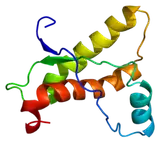
A prion is an infectious agent hypothesised to consist of protein. This is in contrast to viruses and other known infectious agents, which all contain one or both of the nucleic acids, DNA and RNA. Prions propagate by transmitting a misfolded protein state. The prion induces existing, properly folded proteins in the host to convert into the misfolded prion form. Abnormal protein aggregates called amyloids accumulate in infected tissue and are associated with tissue damage and cell death.
Prion variants of PrP are associated with the transmissible spongiform encephalopathies in mammals. Human prion diseases include Creutzfeldt–Jakob disease, Gerstmann–Sträussler–Scheinker syndrome, fatal familial insomnia, kuru and variably protease-sensitive prionopathy. Prion diseases of other mammals include bovine spongiform encephalopathy ("mad cow disease") in cattle, scrapie in sheep, and chronic wasting disease in deer. All known mammalian prion diseases affect the structure of the brain or other neural tissue. All are progressive, lack an effective treatment and are inevitably fatal. Proteins showing prion-type behaviour are also found in some fungi. Fungal prions do not appear to cause disease in their hosts.
Selected outbreak

The 2009 flu pandemic was an influenza pandemic first recognised in Mexico City in March 2009 and declared over in August 2010. It involved a novel strain of H1N1 influenza virus with genes from five different viruses, which resulted when a previous triple reassortment of avian, swine and human influenza viruses further combined with a Eurasian swine influenza virus, leading to the term "swine flu" being used for the pandemic. It was the second pandemic to involve an H1N1 strain, the first being the 1918 "Spanish flu" pandemic.
The global infection rate was estimated as 11–21%. This pandemic strain was less lethal than previous ones, killing about 0.01–0.03% of those infected, compared with 2–3% for Spanish flu. Most experts agree that at least 284,500 people died, mainly in Africa and Southeast Asia – comparable with the normal seasonal influenza fatalities of 290,000–650,000 – leading to claims that the World Health Organization had exaggerated the danger.
Selected quotation
| “ | We are part virus. This bizarre yet inescapable fact has been revealed over the past 30 years, as scientists have spelunked their way through the human genome and encountered stretches of DNA with the telltale chemical signatures of viruses. | ” |
Recommended articles
Viruses & Subviral agents: bat virome • elephant endotheliotropic herpesvirus • HIV • introduction to viruses • Playa de Oro virus • poliovirus • prion • rotavirus • virus
Diseases: colony collapse disorder • common cold • croup • dengue fever • gastroenteritis • Guillain–Barré syndrome • hepatitis B • hepatitis C • hepatitis E • herpes simplex • HIV/AIDS • influenza • meningitis • myxomatosis • polio • pneumonia • shingles • smallpox
Epidemiology & Interventions: 2007 Bernard Matthews H5N1 outbreak • Coalition for Epidemic Preparedness Innovations • Disease X • 2009 flu pandemic • HIV/AIDS in Malawi • polio vaccine • Spanish flu • West African Ebola virus epidemic
Virus–Host interactions: antibody • host • immune system • parasitism • RNA interference
Methodology: metagenomics
Social & Media: And the Band Played On • Contagion • "Flu Season" • Frank's Cock • Race Against Time: Searching for Hope in AIDS-Ravaged Africa • social history of viruses • "Steve Burdick" • "The Time Is Now" • "What Lies Below"
People: Brownie Mary • Macfarlane Burnet • Bobbi Campbell • Aniru Conteh • people with hepatitis C • HIV-positive people • Bette Korber • Henrietta Lacks • Linda Laubenstein • Barbara McClintock • poliomyelitis survivors • Joseph Sonnabend • Eli Todd • Ryan White
Selected virus
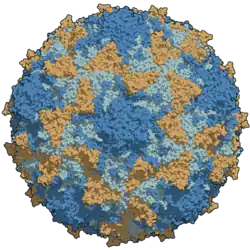
Poliovirus is an enterovirus, an RNA virus in the Picornaviridae family, associated with the paralytic disease polio. The icosahedral virus particle is about 30 nanometres in diameter and lacks an envelope. It contains a relatively short, single-stranded positive RNA genome of around 7500 nucleotides, which encodes about ten viral products. The virus has a fairly high mutation rate even for an RNA virus. Historically there were three serotypes, each with a slightly different capsid protein; PV1 is the most common, and PV2 was declared eradicated in 2015.
The virus only naturally infects humans, although some monkeys can be infected experimentally; 95% of infections are asymptomatic. Infection occurs via the faecal–oral route and viral replication occurs in the alimentary tract. The virus enters the host cell by binding to an immunoglobulin-like receptor, CD155. Fully assembled poliovirus leaves the cell 4–6 hours after initiation of infection. Poliovirus was first isolated in 1909 by Karl Landsteiner and Erwin Popper. Its genome was sequenced in 1981. Among the simplest clinically significant viruses, poliovirus is one of the best-characterised viruses, and has become a useful model for studying RNA viruses.
Did you know?

- ...that modified mRNA (mRNA translation depicted) is a key technology in the Moderna and BioNTech/Pfizer vaccines against COVID-19?
- ...that Derrick Tovey recognised early cases of smallpox during an outbreak in Bradford in 1962?
- ...that Nkosi's Haven is a South African care centre created to address HIV-related discrimination, including the separation of infected mothers from their children?
- ...that American physician Max C. Starkloff used social distancing to fight the 1918 flu pandemic in St. Louis?
- ...that following his research for Epidemiology in Country Practice, William Pickles observed that "studies in epidemiology sometimes reveal romances"?
Selected biography

Françoise Barré-Sinoussi (born 30 July 1947) is a French virologist, known for being one of the researchers who discovered HIV.
Barré-Sinoussi researched retroviruses in Luc Montagnier's group at the Institut Pasteur in Paris. In 1982, she and her co-workers started to analyse samples from people with a new disease, then referred to as "gay-related immune deficiency". They found a novel retrovirus in lymph node tissue, which they called "lymphadenopathy-associated virus". Their results were published simultaneously with those of Robert Gallo's group in the USA, who had independently discovered the virus under the name "human T-lymphotropic virus type III". The virus, renamed "human immunodeficiency virus", was later shown to cause AIDS. Barré-Sinoussi continued to research HIV until her retirement in 2015, studying how the virus is transmitted from mother to child, the immune response to HIV, and how a small proportion of infected individuals, termed "long-term nonprogressors", can limit HIV replication without treatment. In 2008, she was awarded the Nobel Prize, with Montagnier, for the discovery of HIV.
In this month

1 August 1971: The term viroid was coined by Theodor Diener to describe the agent of potato spindle tuber disease
6 August 2007: Maraviroc, first CCR5 receptor antagonist, approved for HIV/AIDS
8 August 2011: UN declared rinderpest eradicated
8 August 2014: WHO declared the Ebola outbreak in West Africa (virus pictured), the most widespread so far, an international public health emergency
18 August 1990: Ryan White Care Act enacted, the largest American federally funded programme for people living with HIV/AIDS
20 August 1780: Start of an outbreak of dengue fever in Philadelphia, USA, which led Benjamin Rush to describe the disease in 1789
26 August 1976: First case of Ebola virus, now the Zaire form
26 August 1998: Fomivirsen, first antisense drug, approved for cytomegalovirus retinitis
Selected intervention

Several human papillomavirus (HPV) vaccines, including Cervarix and Gardasil, have been approved to protect against infections with particular types of HPV, associated with cervical and other cancers. All vaccines protect against the high-risk HPV types 16 and 18. Gardasil is a quadrivalent vaccine that additionally protects against low-risk HPV-6 and -11, which are associated with most cases of genital warts. A second-generation nine-valent Gardasil vaccine protects against five additional high-risk HPV types. It is estimated that the vaccines may prevent 70% of cervical cancer, 80% of anal cancer, 60% of vaginal cancer, 40% of vulvar cancer and possibly some oropharyngeal cancers. Protection lasts for at least 8–9 years. Some advocate giving Gardasil to men and boys with the primary aim of protecting their female sexual partners; others consider vaccinating only women and girls to be more cost effective. The licensed vaccines are subunit vaccines, containing only the L1 capsid protein of the virus, which self-assembles into virus-like particles. They are not effective in people already infected with HPV. Research is ongoing into therapeutic HPV vaccines including the viral oncoproteins, E6 and E7, but none has yet been licensed.
Subcategories
Subcategories of virology:
Topics
Things to do
- Comment on what you like and dislike about this portal
- Join the Viruses WikiProject
- Tag articles on viruses and virology with the project banner by adding {{WikiProject Viruses}} to the talk page
- Assess unassessed articles against the project standards
- Create requested pages: red-linked viruses | red-linked virus genera
- Expand a virus stub into a full article, adding images, citations, references and taxoboxes, following the project guidelines
- Create a new article (or expand an old one 5-fold) and nominate it for the main page Did You Know? section
- Improve a B-class article and nominate it for Good Article
 or Featured Article status
- Suggest articles, pictures, interesting facts, events and news to be featured here on the portal
WikiProjects & Portals
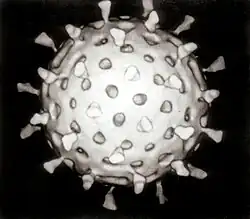 WikiProject Viruses
Related WikiProjects
Medicine • Microbiology • Molecular & Cellular Biology • Veterinary Medicine
Related PortalsAssociated Wikimedia
The following Wikimedia Foundation sister projects provide more on this subject:
-
 Commons
Free media repository -
 Wikidata
Free knowledge base -
 Wikiquote
Collection of quotations -
 Wikisource
Free-content library -
 Wikispecies
Directory of species -
 Wikiversity
Free learning tools -
 Wiktionary
Dictionary and thesaurus