Portal:United States/Selected biography
Selected society biographies list
1–25
Portal:United States/Selected biography/1
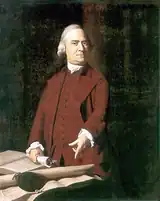
Born in Boston, Massachusetts, Adams was brought up in a religious and politically active family. After being educated at Boston Latin School and Harvard College, Adams became a mercantile businessman, but this proved not to be his vocation and he soon turned to politics, and became an influential political writer and theorist. Adams established himself as one of the voices of opposition to British control in the colonies; he argued that the colonies should withdraw from Great Britain and form a new government. Adams called for the colonists to defend their rights and liberties, and led town meetings in which he drafted written protests against Parliament's colonial tax measures such as the Stamp Act of 1765. Adams played a prominent role during protests against the Stamp Act, and in the events of the Boston Tea Party in 1773. He participated in the Continental Congress. He also advocated the adoption of the Declaration of Independence at the Second Continental Congress.
Portal:United States/Selected biography/2

In many ways Coolidge's style of governance was a throwback to the passive presidency of the nineteenth century. He restored public confidence in the White House after the scandals of his predecessor's administration, and left office with considerable popularity. As his biographer later put it, "he embodied the spirit and hopes of the middle class, could interpret their longings and express their opinions. That he did represent the genius of the average is the most convincing proof of his strength."
Portal:United States/Selected biography/3
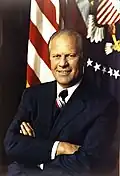
As president, Ford signed the Helsinki Accords, marking a move toward détente in the Cold War, even as South Vietnam, a former ally, was invaded and conquered by North Vietnam. Ford did not intervene in Vietnamese affairs, but did help extract friends of the U.S. Domestically, the economy suffered from inflation and a recession under President Ford. One of his more controversial decisions was granting a presidential pardon to President Richard Nixon for his role in the Watergate scandal. In 1976, Ford narrowly defeated Ronald Reagan for the Republican nomination, but ultimately lost the presidential election to Democrat Jimmy Carter.
Portal:United States/Selected biography/4

A native of Honolulu, Hawaii, Obama is a graduate of Columbia University and Harvard Law School, where he was the president of the Harvard Law Review. He was a community organizer in Chicago before earning his law degree. He worked as a civil rights attorney in Chicago and taught constitutional law at the University of Chicago Law School from 1992 to 2004.
As president, Obama signed economic stimulus legislation in the form of the American Recovery and Reinvestment Act in February 2009 and the Tax Relief, Unemployment Insurance Reauthorization, and Job Creation Act of 2010 in December 2010. Other domestic policy initiatives include the Patient Protection and Affordable Care Act, the Dodd–Frank Wall Street Reform and Consumer Protection Act and the Don't Ask, Don't Tell Repeal Act of 2010. In foreign policy, Obama gradually withdrew combat troops from Iraq, increased troop levels in Afghanistan, and signed an arms control treaty with Russia. In October 2009, Obama was named the 2009 Nobel Peace Prize laureate.
Portal:United States/Selected biography/5
Rosa Parks (February 4, 1913 – October 24, 2005) was an African American civil rights activist whom the U.S. Congress later called "Mother of the Modern-Day Civil Rights Movement".
On December 1, 1955, Parks became famous for refusing to obey bus driver James Blake's order that she give up her seat to make room for a white passenger. This action of civil disobedience started the Montgomery bus boycott, which is one of the largest movements against racial segregation. In addition, this launched Martin Luther King Jr., who was involved with the boycott, to prominence in the civil rights movement. She has had a lasting legacy worldwide.
Although Parks' autobiography recounts that some of her earliest memories are of the kindness of white strangers, her situation made it impossible to ignore racism. When the Ku Klux Klan marched down the street in front of her house, Parks recalls her grandfather guarding the front door with a shotgun. The Montgomery Industrial School, founded and staffed by white northerners for black children, was burned twice by arsonists, and its faculty was ostracized by the white community.
Parks received most of her national accolades very late in life, with relatively few awards and honors being given to her until many decades after the Montgomery bus boycott. For example, the Rosa Parks Congressional Gold Medal bears the legend "Mother of the Modern Day Civil Rights Movement".
Portal:United States/Selected biography/6
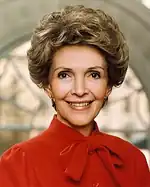
She became the First Lady of the United States in January 1981 following her husband's victory, but experienced criticism early in his first term largely due to her decision to replenish the White House china. Nancy restored a Kennedy-esque glamor to the White House following years of lax formality, and her interest in high-end fashion garnered much attention as well as criticism for accepting unreported loans and gifts from fashion designers. She championed recreational drug prevention causes by founding the "Just Say No" drug awareness campaign, which was considered her major initiative as First Lady. More controversy ensued when it was revealed in 1988 that she had consulted an astrologer to assist in planning the president's schedule after the 1981 assassination attempt on her husband's life.
Portal:United States/Selected biography/7
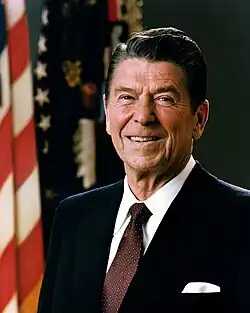
As president, Reagan implemented new political initiatives as well as economic policies, advocating a laissez-faire philosophy, but the extent to which these ideas were implemented is debatable. The supply-side economic policies, dubbed "Reaganomics", included substantial tax cuts implemented in 1981. After surviving an assassination attempt and ordering controversial military actions in Grenada, he was re-elected in a landslide victory in 1984.
Portal:United States/Selected biography/8
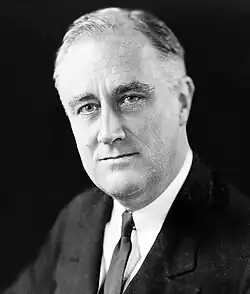
During the Great Depression of the 1930s, Roosevelt created the New Deal to provide relief for the unemployed, recovery of the economy, and reform of the economic and banking systems. Although recovery of the economy was incomplete until almost 1940, many programs initiated continue to have instrumental roles in the nation's commerce, such as the FDIC, TVA, and the SEC. One of his most important legacies is the Social Security system.
Roosevelt won four presidential elections in a row, causing a realignment political scientists call the Fifth Party System. His aggressive use of the federal government re-energized the Democratic Party, creating a New Deal Coalition which dominated American politics until the late 1960s. He and his wife, Eleanor Roosevelt, remain touchstones for modern American liberalism. Conservatives vehemently fought back, but Roosevelt usually prevailed until he tried to pack the Supreme Court in 1937. Thereafter, the new Conservative coalition successfully ended New Deal expansion; during the war it closed most relief programs like the WPA and Civilian Conservation Corps, arguing unemployment had disappeared.
Portal:United States/Selected biography/9

As Assistant Secretary of the Navy, Roosevelt prepared for and advocated war with Spain in 1898. He organized and helped command the 1st U.S. Volunteer Cavalry Regiment, the Rough Riders, during the Spanish–American War. Returning to New York as a war hero, he was elected Republican governor in 1899. He was a professional historian, a lawyer, a naturalist and explorer of the Amazon basin; his 35 books include works on outdoor life, natural history, the American frontier, political history, naval history, and his autobiography.
Portal:United States/Selected biography/10
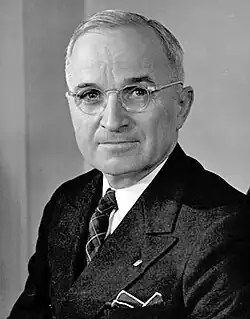
During World War I he served as an artillery officer. After the war he became part of the political machine of Tom Pendergast and was elected a county judge in Missouri and eventually a United States Senator. In 1945, Roosevelt replaced Henry A. Wallace as vice president with Truman for Roosevelt's fourth term.
As president, Truman faced challenge after challenge in domestic affairs. The tumultuous reconversion of the economy of the United States was marked by severe shortages, numerous strikes, and the passage of the Taft–Hartley Act over his veto. He confounded all predictions to win re-election in 1948, largely due to his famous Whistle Stop Tour of rural America. After his re-election he was able to pass only one of the proposals in his Fair Deal program. He used executive orders to begin desegregation of the U.S. armed forces and to launch a system of loyalty checks to remove thousands of communist sympathizers from government office, even though he strongly opposed mandatory loyalty oaths for governmental employees, a stance that led to charges that his administration was soft on communism. Truman's presidency was also eventful in foreign affairs, with the end of World War II and his decision to use nuclear weapons in combat, the founding of the United Nations, the Marshall Plan to rebuild Europe, the Truman Doctrine to contain communism, the beginning of the Cold War, the creation of NATO, and the Korean War. Corruption in Truman's administration reached the cabinet and senior White House staff. Republicans made corruption a central issue in the 1952 campaign.
Portal:United States/Selected biography/11
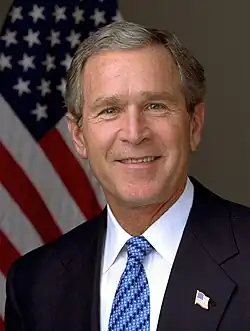
Born into the prominent Bush family in New Haven, Connecticut, Bush flew warplanes in the Texas Air National Guard in his twenties. After graduating from Harvard Business School in 1975, he worked in the oil industry. He later co-owned the Major League Baseball team Texas Rangers before being elected governor of Texas in 1994. As governor, Bush successfully sponsored legislation for tort reform, increased education funding, set higher standards for schools, and reformed the criminal justice system. He also helped make Texas the leading producer of wind-generated electricity in the United States. In the 2000 presidential election, he defeated Democratic incumbent vice president Al Gore while losing the popular vote after a narrow and contested United States Electoral College win, which involved the Supreme Court decision Bush v. Gore to stop a recount in Florida. (Full article...)
Portal:United States/Selected biography/12

Born and raised in Chicago, Rodham graduated from Wellesley College in 1969 and from Yale Law School in 1973. After serving as a congressional legal counsel, she moved to Arkansas and, in 1975, married Bill Clinton, initially keeping her maiden name. In 1977, Rodham co-founded Arkansas Advocates for Children and Families, and two years later became the first woman partner at Little Rock's Rose Law Firm. She was the first lady of Arkansas from 1979 to 1981 and again from 1983 to 1992, at which time she began going by "Hillary Rodham Clinton". As the first lady of the U.S., Clinton advocated for healthcare reform. In 1994, her health care plan failed to gain approval from Congress. In 1997 and 1999, Clinton played a leading role in promoting the creation of the State Children's Health Insurance Program, the Adoption and Safe Families Act, and the Foster Care Independence Act. In 1998, Clinton's marital relationship came under public scrutiny during the Clinton–Lewinsky scandal, which led her to publicly reaffirm her commitment to the marriage. (Full article...)
Portal:United States/Selected biography/13
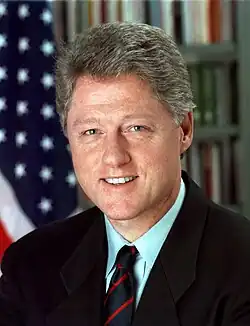
Born and raised in Arkansas, Clinton graduated from Georgetown University in 1968, and later from Yale Law School, where he met his future wife, Hillary Rodham. After graduating from law school, Clinton returned to Arkansas and won election as state attorney general, followed by two non-consecutive tenures as Arkansas governor. As governor, he overhauled the state's education system and served as chairman of the National Governors Association. Running as a "New Democrat", Clinton was elected president in the 1992 election, defeating the incumbent Republican president George H. W. Bush, and the independent businessman Ross Perot. He became the first president to be born in the Baby Boomer generation and the youngest to serve two full terms. (Full article...)
Portal:United States/Selected biography/14
Portal:United States/Selected biography/15
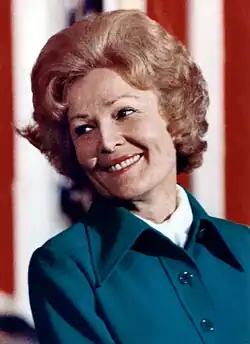
As First Lady, Pat Nixon promoted a number of charitable causes including volunteerism and oversaw the collection of more than 600 examples of historic art and furnishings for the White House, an acquisition larger than that of any other administration. She also encouraged women to run for political offices and became the most traveled First Lady in U.S. history up to that time, visiting about eighty nations; she was the first First Lady to visit a combat zone. Pat's tenure ended when, after being re-elected in the landslide victory of 1972, President Nixon resigned two years later amidst the Watergate scandal.
Pat's public appearances became rarer in her later life. She suffered two strokes within ten years of returning to California and was later diagnosed with lung cancer. She died in 1993.
Portal:United States/Selected biography/16
Born in Chicago and raised on the South Side of the city, Obama is a graduate of Princeton University and Harvard Law School. In her early legal career, she worked at the law firm Sidley Austin where she met her future husband. She subsequently worked in nonprofits and as the associate dean of student services at the University of Chicago. Later, she served as vice president for community and external affairs of the University of Chicago Medical Center. Michelle married Barack in 1992, and they have two daughters. (Full article...)
Portal:United States/Selected biography/17

Washington was chosen to be the commander-in-chief of the American revolutionary forces in 1775. The following year, he forced the British out of Boston, but was defeated when he lost New York City later that year. He revived the patriot cause, however, by crossing the Delaware River in New Jersey and defeating the surprised enemy units. As a result of his strategy, Revolutionary forces captured the two main British combat armies — Saratoga and Yorktown. Negotiating with Congress, the colonial states, and French allies, he held together a tenuous army and a fragile nation amid the threats of disintegration and failure. Following the end of the American Revolution in 1783, Washington retired to his plantation on Mount Vernon.
Portal:United States/Selected biography/18

Born into the prominent McCain family in the Panama Canal Zone, McCain graduated from the U.S. Naval Academy in 1958 and received a commission in the U.S. Navy. He became a naval aviator and flew ground-attack aircraft from aircraft carriers. During the Vietnam War, he almost died in the 1967 USS Forrestal fire. While on a bombing mission during Operation Rolling Thunder over Hanoi in October 1967, McCain was shot down, seriously injured, and captured by the North Vietnamese. He was a prisoner of war until 1973. McCain experienced episodes of torture and refused an out-of-sequence early release. He sustained wounds that left him with lifelong physical disabilities. McCain retired from the Navy as a captain in 1981 and moved to Arizona. (Full article...)
Portal:United States/Selected biography/19

Boone was a militia officer during the American Revolutionary War, which in Kentucky was fought primarily between settlers and British-allied American Indians. Boone was captured by Shawnees in 1778 and adopted into the tribe, but he escaped and continued to help defend the Kentucky settlements. He was elected to the first of his three terms in the Virginia General Assembly during the war, and fought in the Battle of Blue Licks in 1782, one of the last battles of the American Revolution. Boone worked as a surveyor and merchant after the war, but he went deep into debt as a Kentucky land speculator. Frustrated with legal problems resulting from his land claims, in 1799 Boone resettled in Missouri, where he spent his final years.
Portal:United States/Selected biography/20
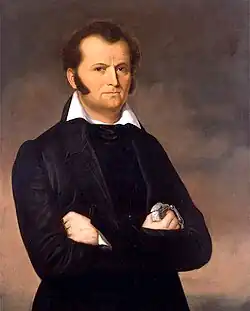
His rise to fame began in 1827 on reports of the Sandbar Fight. What began as a duel between two other men deteriorated into a melee in which Bowie, having been shot and stabbed, killed the sheriff of Rapides Parish with a large knife. This and other stories of Bowie's prowess with the knife led to the widespread popularity of the Bowie knife.
Bowie's reputation was cemented by his role in the Texas Revolution. After moving to Texas in 1830, Bowie became a Mexican citizen and married the daughter of the vice governor of the province. At the outbreak of the Texas Revolution, Bowie joined the Texas militia, leading forces at the Battle of Concepcion and the Grass Fight. In January 1836, he arrived at the Alamo, where he commanded the volunteer forces until an illness left him bedridden. Bowie died with the other Alamo defenders on March 6. Despite conflicting accounts of the manner of his death, the "most popular, and probably the most accurate" accounts maintain that he died in his bed after emptying his pistols into several Mexican soldiers.
Portal:United States/Selected biography/21
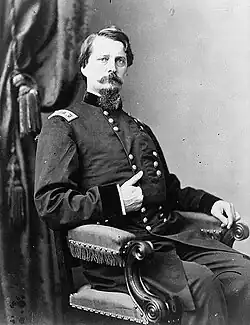
After the Civil War, Hancock's reputation as a soldier and his dedication to conservative constitutional principles made him a quadrennial Presidential possibility. His noted integrity was a counterpoint to the corruption of the era. This nationwide popularity led the Democrats to nominate him for President in 1880. Although he ran a strong campaign, Hancock was defeated by Republican James Garfield by the closest popular vote margin in American history.
Portal:United States/Selected biography/22
During the 1940s and 1950s, McClintock discovered transposons and used it to demonstrate that genes are responsible for turning physical characteristics on and off. She developed theories to explain the suppression and expression of genetic information from one generation of maize plants to the next. Due to skepticism of her research and its implications, she stopped publishing her data in 1953. (Full article...)
Portal:United States/Selected biography/23
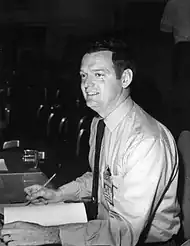
Lunney was a pivotal figure in America's manned space program from Project Mercury through the coming of the Space Shuttle. He has received numerous awards for his work, including the National Space Trophy, which he was given by the Rotary Club in 2005. Chris Kraft, NASA's first flight director, described Lunney as "a true hero of the space age", saying that he was "one of the outstanding contributors to the exploration of space of the last four decades".
Portal:United States/Selected biography/24

Surrounded by Boston's literary elite—which included friends such as Ralph Waldo Emerson, Henry Wadsworth Longfellow, and James Russell Lowell—Holmes made an indelible imprint on the literary world of the 19th century. Many of his works were published in The Atlantic Monthly, a magazine that he named. For his literary achievements and other accomplishments, he was awarded numerous honorary degrees from universities around the world. Holmes's writing often commemorated his native Boston area, and much of it was meant to be humorous or conversational. Some of his medical writings, notably his 1843 essay regarding the contagiousness of puerperal fever, were considered innovative for their time. He was often called upon to issue occasional poetry, or poems written specifically for an event, including many occasions at Harvard. Holmes also popularized several terms, including "Boston Brahmin" and "anesthesia".
Portal:United States/Selected biography/25
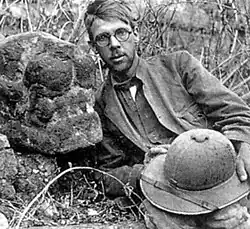
To his contemporaries, "Vay" Morley was one of the leading Mesoamerican archaeologists of his day. Although more recent developments in the field have resulted in a re-evaluation of his theories and works, his publications, particularly on calendric inscriptions, are still cited. In his role as director of various projects sponsored by the Carnegie Institution, he oversaw and encouraged many others who later established notable careers in their own right. His commitment and enthusiasm for Maya studies helped inspire the necessary sponsorship for projects that would ultimately reveal much about ancient Maya civilization.
Morley also conducted espionage in Mexico on behalf of the United States during World War I, but the scope of those activities only came to light well after his death. His archaeological field work in Mexico and Central America provided suitable cover for his work with the United States' Office of Naval Intelligence investigating German activities and anti-American activity. (Full article...)
26–40
Portal:United States/Selected biography/26

In his later years he became especially known for his advocacy of controversial technological solutions to both military and civilian problems, including a plan to excavate an artificial harbor in Alaska using thermonuclear explosives. He was a vigorous advocate of Ronald Reagan's Strategic Defense Initiative, perhaps overselling the feasibility of the program. Over the course of his life, Teller was known both for his scientific ability and his difficult interpersonal relations and volatile personality, and is considered one of the inspirations for the character Dr. Strangelove in the 1964 movie of the same name.
Portal:United States/Selected biography/27

Sherman served under General Ulysses S. Grant in 1862 and 1863. In 1864, Sherman succeeded Grant as the Union commander in the western theater of the war. He proceeded to lead his troops to the capture of the city of Atlanta, a military success that contributed decisively to the re-election of President Abraham Lincoln. Sherman's subsequent march through Georgia and the Carolinas further undermined the Confederacy's ability to continue fighting.
After the Civil War, Sherman became Commanding General of the Army (1869–83). As such, he was responsible for the conduct of the Indian Wars in the western United States. He steadfastly refused to be drawn into politics and in 1875 published his Memoirs, one of the best-known firsthand accounts of the Civil War.
Portal:United States/Selected biography/28
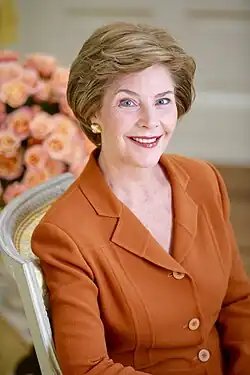
Born in Midland, Texas, Bush graduated from Southern Methodist University in 1968 with a bachelor's degree in education, and took a job as a second grade teacher. After attaining her master's degree in library science at the University of Texas at Austin, she was employed as a librarian. Bush met her future husband, George W. Bush, in 1977, and they were married later that year. The couple had twin daughters, Barbara and Jenna in 1981. Bush's political involvement began during her marriage. She campaigned with her husband during his unsuccessful 1978 run for the United States Congress, and later for his successful Texas gubernatorial campaign.
As First Lady of Texas, Bush implemented many initiatives focused on health, education, and literacy. From 1999 to 2000, she aided her husband in campaigning for the presidency in a number of ways, such as delivering a prominent address at the 2000 Republican National Convention, which gained her national attention. She became first lady after her husband was inaugurated as president on January 20, 2001.
Polled by the Gallup Organization as one of the most popular first ladies, Bush was involved in national and global concerns during her tenure. She continued to advance her trademark interests of education and literacy by establishing the annual National Book Festival in 2001. She encouraged education on a worldwide scale. She also advanced women's causes through the Heart Truth and Susan G. Komen for the Cure organizations. She represented the United States during her foreign trips, which tended to focus on HIV/AIDS and malaria awareness. (Full article...)
Portal:United States/Selected biography/29

Born in Milton, Massachusetts, to an old-money family with a tradition of public service, Bush was raised in Greenwich, Connecticut, and attended Phillips Academy in Andover, Massachusetts. He enlisted in the U.S. Navy Reserve on his 18th birthday, flying 58 combat missions during World War II and earning the Distinguished Flying Cross. Following an unsuccessful run for the U.S. Senate in 1964, Bush was elected to represent Texas in the U.S. House of Representatives in 1966. He held a variety of ambassadorial, federal, and party positions in the administrations of Richard Nixon and Gerald Ford from 1971 to 1977.
Bush lost the 1980 Republican Party primaries to Ronald Reagan, who later picked him as his running mate. Bush ran again in 1988 and won against Democratic nominee Michael Dukakis. Foreign policy drove Bush's presidency as he navigated the final years of the Cold War and played a key role in the reunification of Germany. He presided over the U.S. invasion of Panama and the Gulf War, ending the Iraqi occupation of Kuwait in the latter conflict. Though the agreement was not ratified until after he left office, Bush negotiated and signed the North American Free Trade Agreement, which created a trade bloc consisting of the United States, Canada and Mexico. Domestically, Bush reneged on a 1988 campaign promise by enacting legislation to raise taxes that he justified as necessary to reducing the budget deficit. He championed and signed three pieces of bipartisan legislation in 1990, the Americans with Disabilities Act, the Immigration Act and the Clean Air Act Amendments. He also appointed David Souter and Clarence Thomas to the Supreme Court. Bush lost the 1992 presidential election to Democrat Bill Clinton following an economic recession, his turnaround on his tax promise, and the decreased emphasis of foreign policy in a post–Cold War political climate. (Full article...)
Portal:United States/Selected biography/30

Burnham had little formal education, attending high school but never graduating. He began his career at 14 in the American Southwest as a scout and tracker for the U.S. Army in the Apache Wars and Cheyenne Wars. Sensing the Old West was getting too tame, as an adult Burnham went to Africa where this background proved useful. He soon became an officer in the British Army, serving in several battles there. During this time, Burnham became friends with Baden-Powell, and passed on to him both his outdoor skills and his spirit for what would later become known as Scouting.
Burnham eventually moved on to become involved in espionage, oil, conservation, writing and business. His descendants are still active in Scouting.
Portal:United States/Selected biography/31
Portal:United States/Selected biography/32
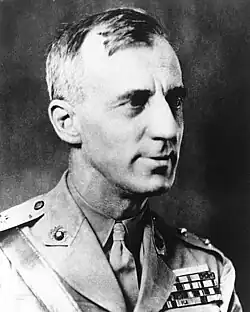
Butler continued his speaking engagements in an extended tour but in June 1940 checked himself into a naval hospital, dying a few weeks later from what was believed to be cancer. He was buried at Oaklands Cemetery in West Chester, Pennsylvania; his home has been maintained as a memorial and contains memorabilia collected during his various careers.
Portal:United States/Selected biography/33
Frank Woodruff Buckles (born Wood Buckles; February 1, 1901 – February 27, 2011) was a United States Army corporal and the last surviving American veteran of World War I. He enlisted in the U.S. Army in 1917 at age 16 and served with the 1st Fort Riley Casual Detachment in Europe, where he worked as an ambulance driver and later helped escort prisoners of war.
During World War II, Buckles was working as a civilian in the shipping business in the Philippines when Japanese forces captured him. He spent more than three years as a civilian prisoner of war, including captivity at the University of Santo Tomas internment camp and Los Baños. (Full article...)
Portal:United States/Selected biography/34
Portal:United States/Selected biography/35
Portal:United States/Selected biography/36
Portal:United States/Selected biography/37
Portal:United States/Selected biography/38
Portal:United States/Selected biography/39

Portal:United States/Selected biography/40

Portal:United States/Selected biography/41 Portal:United States/Selected biography/41
Portal:United States/Selected biography/42 Portal:United States/Selected biography/42
Portal:United States/Selected biography/43 Portal:United States/Selected biography/43
Portal:United States/Selected biography/44 Portal:United States/Selected biography/44
Portal:United States/Selected biography/45 Portal:United States/Selected biography/45
Portal:United States/Selected biography/46 Portal:United States/Selected biography/46
Portal:United States/Selected biography/47 Portal:United States/Selected biography/47
Portal:United States/Selected biography/48 Portal:United States/Selected biography/48
Portal:United States/Selected biography/49 Portal:United States/Selected biography/49
Portal:United States/Selected biography/50 Portal:United States/Selected biography/50
Instructions
- Use template {{Portal:United States/Selected biography/Layout}}.
- Add a new Selected biography to the next available subpage.
Nominations
Feel free to add FA-Class United States articles, A-Class United States articles, FA-Class biography articles and A-Class biography articles of Americans to the above list. Other United States-related biographies may be nominated here.
United States popular pages by WikiProject
The following United States WikiProjects include lists of popular pages - the top pages ordered by number of views in the scope of each WikiProject.
| National | United States | Roads | Superfunds |
| States | Alabama | Alaska | Arizona | Arkansas | California | Colorado | Connecticut | Delaware | Florida | Georgia | Hawaii | Idaho | Illinois | Indiana | Iowa | Kansas | Kentucky | Louisiana | Maine | Maryland | Massachusetts | Michigan | Minnesota | Mississippi | Missouri | Montana | Nebraska | Nevada | New Hampshire | New Jersey | New Mexico | New York | North Carolina | North Dakota | Ohio | Oklahoma | Oregon | Pennsylvania | Rhode Island | South Carolina | South Dakota | Tennessee | Texas | Utah | Vermont | Virginia | Washington | West Virginia | Wisconsin | Wyoming |
| Borders | Canada | Mexico |
| Government | Government | Congress | Supreme Court cases |
| Culture | Military history | National Register of Historic Places |
| Society | African diaspora | Asian Americans | Indigenous peoples of North America |
FA-Class society biography articles about Americans
 = Article added to portal.
Military
- Daniel Boone
- James Bowie
- Simon Bolivar Buckner
- Henry Cornelius Burnett
- Frederick Russell Burnham
- Wesley Clark
- Brian Eaton
- Gerald Ford
- Winfield Scott Hancock
- Benjamin Harrison
- William Henry Harrison
- Rutherford B. Hayes
- Thomas C. Hindman
- Thomas C. Kinkaid
- Eli Lilly
- John McCain
- George B. McClellan
- Fred Moosally
- Sylvanus Morley
- Edwin Taylor Pollock
- Ronald Reagan
- Uriel Sebree
- Lawrence Sullivan Ross
- Isaac Shelby
- William Tecumseh Sherman
- Myles Standish
- Edward Teller
- Benjamin Franklin Tilley
- Stephen Trigg
- Harriet Tubman
Politics and government
- Samuel Adams
- J. C. W. Beckham
- Daniel Boone
- William O'Connell Bradley
- Simon Bolivar Buckner
- Henry Cornelius Burnett
- Charles Carroll the Settler
- Murray Chotiner
- Wesley Clark
- Grover Cleveland
- Calvin Coolidge
- Richard Cordray
- John J. Crittenden
- Gerald Ford
- Wendell Ford
- William Goebel
- Emma Goldman
- John W. Johnston
- Franklin Knight Lane
- John McCain
- George B. McClellan
- Bob McEwen
- Thomas R. Marshall
- Harvey Milk
- Edwin P. Morrow
- Pat Nixon
- Barack Obama
- Rosa Parks
- Paul E. Patton
- Edwin Taylor Pollock
- Nancy Reagan
- Ronald Reagan
- Theodore Roosevelt
- Lawrence Sullivan Ross
- Terry Sanford
- Antonin Scalia
- Solomon P. Sharp
- Isaac Shelby
- Augustus Owsley Stanley
- Stephen Trigg
- Jerry Voorhis
- Daniel Webster
- Franklin D. Roosevelt (C-Class)
- Harry S. Truman (B-Class)
Science and academia
Core
- Franklin D. Roosevelt (C-Class)