Selected pictures list
Template:POTD/2004-07-24
Photo credit: Eric Pierce
Template:POTD/2004-07-25
Photo credit: Eric Pierce The
pin tumbler lock is a
lock mechanism that utilizes a group of pins of varying lengths to prevent opening the lock without the correct
key. Pin tumblers are most commonly employed in
cylinder locks, but may also be found in tubular or radial locks.
When the correct key is inserted, the gaps between the key pins (red) and driver pins (blue) align with the edge of the plug (yellow).
Template:POTD/2004-08-30
Photo credit: Michael Reeve Pitstone Windmill, believed to be the oldest windmill in the British Isles
A
windmill is an
engine powered by
wind energy. In
Europe, windmills have been used since the
Middle Ages. They were developed from the 12th century, apparently from technology gained by crusaders who came into contact with windmills in the
Middle East.
Persian sources indicate windmill use as early as the
7th century BC. In the
United States, the development of water-pumping windmills was a major factor in allowing the farming of vast areas of North America.
Template:POTD/2007-02-27
Photo credit: Willi Heidelbach
Template:POTD/2007-03-10
Image credit: Joaquim Alves Gaspar An
animation showing how to use a vernier
caliper, which is a caliper that uses a
vernier scale to interpolate linear measurements. Vernier calipers can measure internal and external
dimensions using, respectively, the uppermost and lower jaws, and also depths, using the depth probe (located at the right end). In this example, the first two digits (2.4) are decided by the location of the zero of the vernier scale in the centimeter scale, and the last digit (0.07), by the first line of the vernier scale that exactly matches a line of the centimeter scale above.
Template:POTD/2007-03-20
A test firing of twin linear XRS-2200
aerospike engines, originally built for the
Lockheed Martin X-33, a next-generation, commercially operated
reusable launch vehicle. The aerospike engine is a type of
rocket engine that maintains its efficiency across a wide range of altitudes through the use of an aerospike nozzle. A vehicle with an aerospike engine uses 25-30% less fuel at low
altitudes, where most missions have the greatest need for
thrust.
Template:POTD/2007-06-18
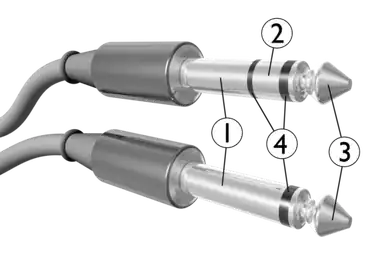
Two
TRS connectors (also known as
jack plugs or
phone plugs), a common
audio connector. They are
cylindrical in shape, with two or more contacts. Originally invented for use in
telephone switchboards, jack plugs are still widely used, both in the original ¼-inch (6.3
mm) size and in miniaturized versions. The top plug in this image is for
stereo connections, while the bottom is for
mono.
Template:POTD/2007-08-04
Photo credit: L Cpl. Samantha L. Jones, USMC
Template:POTD/2007-11-25
Photo credit: Gretar Ívarsson
Template:POTD/2007-12-17
Image credit: WikipedianProlific An animated cut-away diagram of a typical
fuel injector, which is used to spray controlled amounts of
petrol (gasoline) into an
internal combustion engine. A
solenoid is activated when fuel is intended to be delivered to the engine, causing the plunger to become pulled toward the solenoid by
magnetic force. This uncovers the valve opening, allowing fuel to flow into the
atomiser and out the spray tip. The route of fuel is shown in orange; grey/blue indicates no fuel present.
Template:POTD/2008-03-23
Image credit: Al2/Lycaon/Jeff Dahl A diagram showing the parts of a
tugboat, a
boat used to maneuver large
ships in
harbours, over the open sea, or through
rivers and
canals. They also tow
barges, disabled ships, and
oil rigs. Equipped with powerful engines producing thousands of horsepower, extensive rigging equipment, and a fender of tires for protection, tugboats can push or tow large vessels with high precision and speed.
Template:POTD/2008-04-29
Photo credit: Christian Kuhna The rotor of a modern
steam turbine , which converts
steam (heat)
energy into
kinetic (mechanical) energy. The steam path is from the smallest blade, expanding through progressively larger blade elements. Steam turbines are used in
power plants to extract
mechanical work from
pressurized steam and benefit from their high efficiency and high power-to-weight ratio compared to other technologies, leading to their widespread deployment from
electricity generation to
marine propulsion.
Template:POTD/2008-07-06
Template:POTD/2008-08-30
Photo credit: Alfred T. Palmer "Big Pete" Ramagos,
rigger at work on
Douglas Dam,
Tennessee, June 1942. A rigger is a person or company which specializes in the lifting and/or moving of extremely large and/or heavy objects. Riggers use equipment expressly designed for moving and lifting objects where ordinary
material handling equipment cannot go.
Template:POTD/2008-10-04
Daguerreotype credit: Unknown
Template:POTD/2008-10-17
Image credit: Prolineserver/Tomia This diagram of four
pulley systems illustrates how increasing the number of pulleys increases the
mechanical advantage, making the load easier to lift. MA is the factor by which a mechanism multiplies the
force put into it. In this diagram, 100
newtons is required to lift the weight off the ground. Each additional pulley increases the MA such that the four-pulley system only needs 25 newtons to accomplish the same task, but the rope must be pulled four times as far.
Template:POTD/2008-10-21
Photo credit: Richard Bartz
Template:POTD/2009-05-01
A structural worker bolts beams on the framework during the construction of the
Empire State Building in
New York City. The 1,250-foot (380
m) building opened on May 1, 1931, at the time the
tallest building in the world, overtaking the
Chrysler Building (seen to the right), which had just been completed the year before. The addition of a pinnacle and antennas later increased its overall height to 1,472 feet (449
m).
Template:POTD/2009-07-10
Template:POTD/2009-07-20
Template:POTD/2009-07-30
Image credit: Fastfission
Template:POTD/2010-01-10
Photo credit: UpstateNYer
Template:POTD/2010-02-01
A portrait of
George Washington Carver, American
scientist,
botanist,
educator and
inventor, from 1942. Much of Carver's fame is based on his research into and promotion of alternative
crops to
cotton, such as
peanuts and
sweet potatoes. In addition to his work on agricultural extension education for purposes of advocacy of
sustainable agriculture and appreciation of plants and nature, Carver's important accomplishments also included improvement of
racial relations,
mentoring children,
poetry,
painting, and
religion. One of his most important roles was in undermining, through the fame of his achievements and many talents, the widespread
stereotype of the time that the
black race was intellectually inferior to the
white race.
Template:POTD/2010-02-11
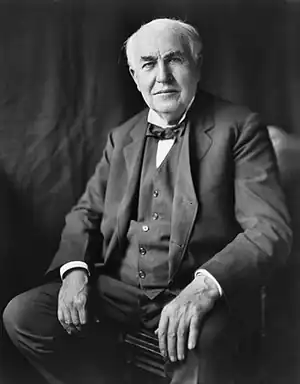
Thomas Edison (1847–1931) was an American
inventor,
scientist and
businessman who developed many devices that greatly influenced life around the world, including the
phonograph, the
motion picture camera, and a long-lasting, practical electric
light bulb. Dubbed "The Wizard of Menlo Park" (now
Edison, New Jersey) by a newspaper reporter, he was one of the first inventors to apply the principles of
mass production and large teamwork to the process of invention, and therefore is often credited with the creation of the first industrial
research laboratory. Edison is considered one of the most
prolific inventors in history, holding 1,093
U.S. patents in his name, as well as many patents in the United Kingdom, France and Germany.
Template:POTD/2010-04-02
Photo credit: Hans Hillewaert
Template:POTD/2010-09-12
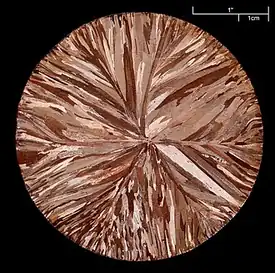
A disc of
copper made by
continuous casting, the process whereby
molten metal is solidified into a "semifinished" state for subsequent
rolling in the finishing mills. Continuous casting replaced the creation of
ingots using stationary
moulds. The process allows lower-cost production of metal sections with better quality, due to the inherently lower costs of continuous,
standardised production of a product, as well as providing increased control over the process through
automation. After casting, this disc was then
etched to achieve its final state.
Template:POTD/2010-11-20
Template:POTD/2010-12-19
Template:POTD/2011-03-18
Template:POTD/2011-03-31
Template:POTD/2011-05-06
The
Let L-410 Turbolet is a twin-engined short-range transport aircraft, manufactured by the
Czech aircraft manufacturer
LET, mostly used for passenger transport. The L-410 first flew in 1969, and with more than 1100 produced, is the most popular 19-seat plane in history.
Template:POTD/2011-05-14
Template:POTD/2012-05-17
Template:POTD/2012-12-19
Template:POTD/2013-03-25
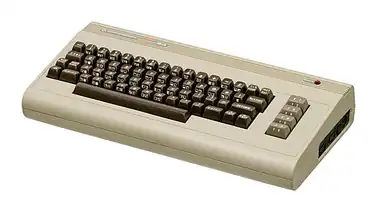
The
Commodore 64 is an
8-bit home computer introduced in 1982 by
Commodore International. Its low retail price and easy availability led to the system becoming the market leader for three years. It remains the best-selling single personal computer model of all time.
Template:POTD/2013-04-05
Rail transport is a means of
conveyance of passengers and goods by way of wheeled vehicles running on rail tracks. The oldest, man-hauled railways date to the 6th century B.C.; the method grew more popular after the introduction of steam locomotives in the 19th
century. Here we can see four
BNSF GE C44-9W diesel locomotives hauling a mixed freight train along the
Columbia River in the US.
Template:POTD/2013-06-19
Picture: Unknown; restoration: Mmxx
Template:POTD/2013-07-07
Template:POTD/2013-10-15
Photo: Drew Jacksich; edit: Bruce1ee
Template:POTD/2014-03-20
Template:POTD/2014-03-26
Template:POTD/2014-05-17
A self-portrait by the
Mars rover
Curiosity on October 31, 2012. The mosaic is stitched from a set of 55 images taken by the
Mars Hand Lens Imager at "Rocknest," the spot in
Gale crater where
the mission's first scoop sampling took place. Self-portraits such as this help
NASA document the state of the rover and track changes, such as dust accumulation and wheel wear.
Template:POTD/2014-06-18
Template:POTD/2014-08-11
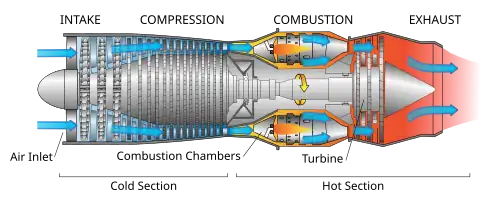
A diagram of a typical
turbojet engine.
Air is compressed as it enters the
engine, and is mixed with
fuel that burns in the
combustion section. Released through the exhaust, the resulting hot gases
provide forward
thrust and turn the
turbines that drive the fan blades of the compressor.
Template:POTD/2014-11-12
Template:POTD/2014-11-27
Photograph: Peter Trimming The
Mark IV tank was introduced by the British in May 1917 to fight in
World War I. The "
female" version, as pictured here, was armed with five machine guns. Production of the Mark IV ceased at the end of the War in 1918. A small number served briefly with other combatants afterwards.
This Mark IV tank, on display in
Ashford, Kent, was presented to the town after the end of World War I. The engine was removed to install an electricity substation inside it, though this substation was subsequently removed; the tank's interior is now empty.
Template:POTD/2015-03-20
Photograph: Christoph Braun
Template:POTD/2015-06-03
The
Geneva drive is a
gear mechanism that translates a continuous
rotation into an intermittent rotary motion. The rotating drive wheel has a pin that reaches into a slot of the driven wheel advancing it by one step. The drive wheel also has a raised circular blocking disc that locks the driven wheel in position between steps. Such a mechanism is used in film projectors, watches, and
indexing tables, among others.
Template:POTD/2015-07-14
Photograph: Raimond Spekking
Template:POTD/2015-08-11
An interior view of
Stockwell Garage, a large bus garage in
Stockwell, London, designed by Adie, Button and Partners and opened in 1952. The 393-foot-long (120
m) roof structure, seen here, is supported by ten very shallow "two-hinged" arched ribs, between which are cantilevered barrel vaults topped by large skylights. The garage, which could originally hold 200 buses, has been a
Grade II* Listed Building since 1988.
Template:POTD/2015-09-17
Photograph: David Shankbone
Template:POTD/2015-09-26
Template:POTD/2015-12-05
Two
Jet Propulsion Laboratory engineers stand with three vehicles, providing a size comparison of three generations of
Mars rovers. Front and center is the flight spare for the first Mars rover,
Sojourner, which landed on Mars in 1997 as part of the Mars Pathfinder Project. On the left is a
Mars Exploration Rover test vehicle, a working sibling to
Spirit and
Opportunity, which landed on Mars in 2004. On the right is a test rover for the Mars Science Laboratory, which landed
Curiosity on Mars in 2012.
Template:POTD/2016-02-06
Template:POTD/2016-06-13
Template:POTD/2016-07-15
The
Wiesen Viaduct is a single-track railway
viaduct (concrete blocks with
dimension stone coverage) which spans the
Landwasser southwest of the hamlet of
Wiesen, Switzerland. Designed by Henning Friedrich, then the chief engineer of the
Rhaetian Railway, it was built between 1906 and 1909 by the contractor G. Marasi (Westermann & Cie, Zürich) under the supervision of P. Salaz and Hans Studer (RhB). The Rhaetian Railway still owns and uses the viaduct today for regular service with 29 passenger trains per day. An important element of the
Davos–Filisur railway, the viaduct is 88.9 metres (292
ft) high, 210 metres (690
ft) long, and has a main span of 55 metres (180
ft). In 1926, the viaduct was the inspiration for
Ernst Ludwig Kirchner's painting
Brücke bei Wiesen.
Template:POTD/2016-08-22
The
Trojan Room coffee pot was the inspiration for the world's first
webcam. The
coffee pot was located in the corridor just outside the so-called Trojan Room within the old
Computer Laboratory of the
University of Cambridge. The webcam was created in 1991 to help people working in other parts of the building avoid pointless trips to the coffee pot by providing, on the user's desktop computer, a live 128×128 pixel
greyscale picture of the state of the coffee pot. The webcam was shut down on 22 August 2001, following the Computer Laboratory's move to the
William Gates Building.
Template:POTD/2017-03-10
A
micrometer is a device incorporating a calibrated
screw, widely used for precise measurement of components in
mechanical engineering and
machining. Micrometers are usually, but not always, in the form of
calipers (opposing ends joined by a frame). The spindle is a very accurately machined screw and the object to be measured is placed between the spindle and the anvil. The spindle is moved by turning the ratchet knob or thimble until the object to be measured is lightly touched by both the spindle and the anvil.
Template:POTD/2018-02-11
Template:POTD/2018-03-08
Template:POTD/2018-04-23
The
Apple Bandai Pippin is a multimedia technology console designed by
Apple Computer based on the
Apple Pippin platform, and produced by
Bandai. Only 100,000 of the consoles were produced between its 1996 release and 1997 discontinuation. The Bandai Pippin was intended to create an inexpensive computer aimed mostly at playing CD-based multimedia software, especially games, but also functioning as a
thin client.
Template:POTD/2018-05-17
Template:POTD/2018-07-16
Diagram: H Padleckas and Ju gatsu mikka A diagram showing a side and underside view of an 18-wheeler
semi-trailer truck with an enclosed cargo space. The underside view shows the arrangement of the wheels, and in blue, the axles, drive shaft, and differentials.
The numbered parts are:
- tractor unit
- semi-trailer (detachable)
- engine compartment
- cabin
- sleeper (not present in all trucks)
- air dam
- fuel tanks
- fifth-wheel coupling
- enclosed cargo space
- landing gear (legs for when semi-trailer is detached)
- tandem axles
Template:POTD/2018-08-14
A
filling station in
Sabah, Malaysia, operated by
Royal Dutch Shell. Filling stations, also known under a wide variety of names, are facilities that sell fuel and engine lubricants for motor vehicles. They include one or more
fuel dispensers, which distribute fuels such as
gasoline and
diesel into the tanks within vehicles and calculate the financial cost of the fuel transferred. Filling stations may also include air compressors and electricity sockets, which may inflate tyres or offer
charging stations. Many filling stations also incorporate a
convenience store, where customers can purchase snacks and other goods.
Template:POTD/2018-11-18
Photograph: National Photo Company, Restoration: Adam Cuerden
Template:POTD/2019-05-27
Photograph credit: Unknown; restored by Adam Cuerden George Washington Carver (1860s–1943) was an American agricultural scientist and inventor. Born into slavery in
Diamond, Missouri, he was raised by his master
Moses Carver after being emancipated, having been separated from his parents as an infant during a kidnapping incident. After college, Carver became a professor at
Tuskegee Institute, where he developed techniques to improve soils depleted by repeated plantings of cotton. He wanted poor farmers to grow alternative crops, such as peanuts and sweet potatoes, as a source of their own food and to improve their quality of life. Carver spent years developing and promoting products made from peanuts, although none became commercially successful. Apart from his work to improve the lives of farmers, he was also a leader in promoting
environmentalism. Carver received numerous honors for his work, including the
NAACP's
Spingarn Medal. In an era of very high racial polarization, his fame reached beyond the black community; he was widely recognized and praised in the white community for his many achievements and talents. In 1941,
Time magazine dubbed Carver a "black
Leonardo".
This picture of Carver was taken around 1910 and is in the collection of the Tuskegee University archives.
Template:POTD/2019-07-22

Mary Jackson (1921–2005) was an African American mathematician and
aerospace engineer at the
National Advisory Committee for Aeronautics, which was succeeded by
NASA in 1958. For most of her career, she worked at
Langley Research Center in
Hampton, Virginia; starting as a
computer at the segregated
West Area Computing division, she later took advanced engineering classes and, in 1958, became NASA's first black female engineer.
After 34
years at NASA, Jackson had earned the most senior engineering title available. Realizing that she could not earn further promotions without becoming a supervisor, she accepted a demotion to become a manager of the Federal Women's Program in the NASA Office of Equal Opportunity Programs, as well as of the Affirmative Action Program. In this role, she worked to influence both the hiring and promotion of women in NASA's science, engineering and mathematics careers. She was portrayed by
Janelle Monáe as a lead character in the 2016 film
Hidden Figures. This picture, taken in 1980, shows Jackson working at NASA Langley.
Template:POTD/2019-08-13
The
BMW S1000RR is a
sport bike made by
BMW Motorrad. It was introduced in 2008, initially for competition in the 2009
Superbike World Championship, and has been in commercial production since then. Powered by a 999
cc (61.0
cu
in)
four-cylinder engine,
redlined at 14,200
rpm, it delivers 133.6
kW (179.2
hp; 181.6
PS) to the rear wheel, making it the most powerful motorcycle in the class.
Rubén Xaus and
Troy Corser rode the bike for its inaugural Superbike World Championship in 2009, gaining highest finishes of fifth and seventh respectively, but it achieved greater success in the
2010 FIM Superstock 1000 championship season, with rider
Ayrton Badovini winning every single race but one on the S1000RR.
Template:POTD/2020-02-05
Photograph credit: John Masterson, CSIRO; restored by Bammesk
Template:POTD/2020-05-31
Photograph credit: Matt Steiner and Kees08 A
hybrid-propellant rocket is a rocket with an engine that uses
propellants in two different phases, one solid and the other gaseous or liquid. The concept can be traced back to at least the 1930s.
This picture shows a transparent 3D-printed hybrid-rocket fuel grain with dual helical fuel ports, a post-combustion chamber, and a
de Laval nozzle, photographed prior to the hot-fire test. The motor used
nitrous oxide as the oxidizer and
Pyrodex pellets for the igniter.
Template:POTD/2021-01-14
Photograph credit: Petar Milošević A
thermoplastic-sheathed cable consists of a toughened outer
thermoplastic sheath of
polyvinyl chloride, covering one or more individual
annealed copper conductors. Each of the current-carrying conductors in the "core" is insulated by an individual thermoplastic sheath, coloured to indicate the purpose of the conductor concerned. The protective
earth conductor may also be covered with insulation, although, in some countries, this conductor may be left as bare copper. The type of thermoplastic, the dimensions of the conductors and the colour of their individual insulation are specified by the regulatory bodies in the various countries concerned.
Template:POTD/2021-03-31
Photograph credit: Michael Mainiero The
SOCATA TBM (now Daher TBM) is a family of high-performance single-engine turboprop business and utility light aircraft manufactured by
Daher. This SOCATA TBM
900 was photographed in flight during the 2015
EAA AirVenture Oshkosh airshow in the U.S. state of Wisconsin. The aircraft features a
Pratt & Whitney Canada PT6A-64 engine, and a five-blade
carbon-fiber propeller, which increases performance and decreases cabin noise. In a passenger configuration, the pressurized cabin is typically fitted with highly finished interiors, featuring luxury materials such as leather and wood veneers.
Template:POTD/2021-07-07
Diagram credit: AstroBidules The
Soyuz MS is the latest revision of the Russian spacecraft series
Soyuz. It is an evolution of the
Soyuz TMA-M, with modernization mostly concentrated on its communications and navigation subsystems. The spacecraft is used by
Roscosmos for human spaceflight. The Soyuz
MS has minimal external changes with respect to the Soyuz
TMA-M, mostly limited to antennas and sensors, as well as the thruster placement. The first launch,
Soyuz MS-01, took place on 7
July
2016 aboard a
Soyuz-FG launch vehicle towards the
International Space Station. This
exploded-view diagram illustrates and labels various components of the Soyuz
MS spacecraft and the
Soyuz-FG rocket.
Template:POTD/2021-10-13
Template:POTD/2021-11-29
Photograph credit: Diego Delso
Portal:Technology/Selected pictures/1
An
escalator is a moving staircase for carrying people between floors of a building. The device consists of a
motor-driven chain of individual, linked steps that move up or down on tracks, allowing the step treads to remain horizontal.
Portal:Technology/Selected pictures/2
Portal:Technology/Selected pictures/3
Portal:Technology/Selected pictures/4
Portal:Technology/Selected pictures/5