Portal:South Australia/Selected article
 | This Wikipedia page has been superseded by Portal:South Australia and is retained primarily for historical reference. |
 | Note: Article entries are now being transcluded directly on the main portal page. However, this page should be retained for historical reference. |
Usage
The layout design for these subpages is at Portal:South Australia/Selected article/Layout.
- Add a new selected article to the next available subpage.
- Update "max=" to new total for its {{Random portal component}} on the main page.
Selected articles
Selected article 1
Portal:South Australia/Selected article/1

Selected article 2
Portal:South Australia/Selected article/2 Waterfall Gully is a small suburb in the South Australian city of Adelaide. It is located in the foothills of the Mount Lofty Ranges around five kilometres east of Adelaide's central business district (CBD). For the most part, the suburb encompasses one long gully with First Creek at its centre and Waterfall Gully Road adjacent to the creek. At one end of the gully is the waterfall for which the suburb was named. Part of the Burnside Council, it is bounded to the north by the suburb of Burnside, to the north-east by Greenhill, to the south-east by Cleland Conservation Park, to the south-west by Leawood Gardens and to the north-west by Mount Osmond. Waterfall Gully is rich in history and has been a popular attraction since Adelaide's early colonists discovered the area in the nineteenth century. Home to a number of residents and increasingly frequented by tourists, Waterfall Gully has undergone extensive developments in recent years.
Selected article 3
Portal:South Australia/Selected article/3

Selected article 4
Portal:South Australia/Selected article/4

Selected article 5
Portal:South Australia/Selected article/5 Don Dunstan (21 September 1926 – 6 February 1999) was an Australian politician. He was Labor Premier of South Australia between 1 June 1967 and 17 April 1968, and subsequently between 2 June 1970 and 15 February 1979. A reformist, Dunstan brought profound change to South Australian society: his progressive reign saw Aboriginal land rights recognised, homosexuality decriminalised, the first female judge appointed and anti-discrimination legislation introduced. He is recognised for his role in reinvigorating the social, artistic and cultural life of South Australia during his nine years in office, remembered as the Dunstan Decade. Entering politics as the Member for Norwood in 1953, he became infamous in Parliament for his vigorous debating skills and for his unique flair. Dunstan rose through the Labor Party to become leader of the opposition, and then, in 1967 and after elections in 1970, premier.
Selected article 6
Portal:South Australia/Selected article/6

Selected article 7
Portal:South Australia/Selected article/7 Sir Thomas Playford (July 5, 1896 – 16 June 1981) was a prominent South Australian politician and farmer. He served continuously as Premier of South Australia from 5 November 1938 to 10 March 1965, the longest term of any democratically elected leader in the history of the Commonwealth of Nations. His tenure as premier was marked by a period of population and economic growth unmatched by any other Australian state. Born into an old political family, he grew up on the family farm in Norton Summit before enlisting in the Australian Imperial Force in World War I, fighting in Gallipoli and Western Europe. In office, Playford used his negotiating skills to encourage industry to relocate to South Australia during World War II, and built upon this in the post-war boom years. Playford took a unique, strong and direct approach to the premiership and personally oversaw his industrial initiatives. His string of election wins were assisted by a system of electoral malapportionment that bore his name, the 'Playmander'. However, Playford and his party failed to adapt to changing social mores and eventually lost office in the 1965 election.
Selected article 8
Portal:South Australia/Selected article/8
Selected article 9
Portal:South Australia/Selected article/9
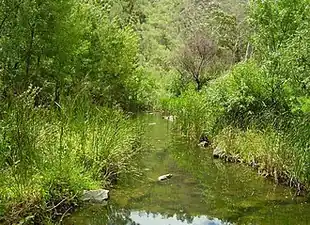
The river's flora and fauna have been both deliberately and accidentally impacted since settlement. Native forests have been cleared, gravel removed for construction and many foreign species introduced. With construction of the linear parks, many species native to the river have been replanted and introduced species controlled as weeds. Since European settlement the river has been a frequently touted tourist attraction. It has also acted as the city’s primary water source, and main sewer leading to outbreaks of typhus and cholera.
Selected article 10
Portal:South Australia/Selected article/10

The suburb is at a high elevation in the Mount Lofty Ranges, and provides views over Adelaide as well as containing a renowned golf course and Country Club. Mining operations in the 19th century gave the area notoriety, but it has since developed slowly into a small, quiet and secluded suburb.
Selected article 11
Portal:South Australia/Selected article/11

Beaumont House was constructed on land initially owned by Sir Samuel Davenport, a wealthy Adelaide landlord. Following Short's move back to England, Davenport purchased the house—the second of five eventual owners. Following three sales between 1907 and 1911, the house was then transferred to the National Trust of South Australia during 1968.
Selected article 12
Portal:South Australia/Selected article/12

The inhabited section of the suburb occupies less than 100 hectares along the seafront, with the remainder used for salt lagoons and also settlement ponds of nearby Bolivar sewage treatment works.
What was originally a seaside town was named by John Harvey, the founder of nearby Salisbury, as it reminded him of St Kilda in the Outer Hebrides of Scotland with its similar abundance of birdlife. St Kilda is an internationally recognised bird watching area with over 100 species of birds feeding in and around the mudflats, salt Lagoons, mangroves and seagrass beds.
Selected article 13
Portal:South Australia/Selected article/13
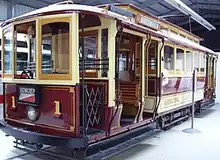
The early use of trams was for recreation as well as daily travel, by entire families and tourists. Until the 1950s, trams were used for family outings to the extent that the Municipal Tramways Trust (MTT) constructed gardens in the suburb of Kensington Gardens, extending the Kensington line to attract customers. By 1945 the MTT was collecting fares for 95 million trips annually—295 trips per head of population.
After the Great Depression, the maintenance of the tramway system and the purchase of new trams suffered. Competition from private buses, the MTT's own bus fleet and the growth of private car ownership all took patrons from the tram network. By the 1950s, the tram network was losing money and being replaced by an electric and petrol-driven bus fleet. Adelaide's tram history is preserved by a volunteer run museum and tramway at St Kilda, and the continuing use of 1929 H Class trams on the remaining Glenelg tram line.
Selected article 14
Portal:South Australia/Selected article/14

The site was contaminated with radioactive materials and an initial cleanup was attempted in 1967. The McClelland Royal Commission into the tests delivered its report in 1985, and found that significant radiation hazards still existed at many of the Maralinga test areas. It recommended another cleanup, which was completed in 2000 at a cost of $108 million. Debate continued over the safety of the site and the long-term health effects on the traditional Aboriginal owners of the land and former personnel. In 1994, the Australian Government paid compensation amounting to $13.5 million to the local Maralinga Tjarutja people.
Selected article 15
Portal:South Australia/Selected article/15

Wind power became a significant energy source within South Australia over the first two decades of the 21st century. In 2015, there was an installed capacity of 1,475 MW, which accounted for 34% of electricity production in the state. This accounted for 35% of Australia's installed wind power capacity. In 2021, there was an installed capacity of 2052.95 MW, which accounted for 42.1% of the electricity production in the state in 2020.
The development of wind power capacity in South Australia has been encouraged by a number of factors. These include the Australian Government's Renewable Energy Target, which requires electricity retailers to source a proportion of energy from renewable sources, incentives from the South Australian Government including a supportive regulatory regime and a payroll tax rebate scheme for large scale renewable energy developments. Also, the state's proximity to the Roaring forties means there are high-quality wind resources for wind farms to exploit. In mid-2009, RenewablesSA was established by the South Australian Government to encourage further investment in renewable energy in the state.
The load factor (or capacity factor) for South Australian wind farms is usually in the range of 32–38%. This means that a wind farm could typically produce between 32 and 38% of its nameplate capacity averaged over a year. (Full article...)
Selected article 16
Portal:South Australia/Selected article/16

He played his first first-class cricket match for South Australia while still a schoolboy, aged sixteen. By the time he was nineteen, he had been included in the Australian team touring England in 1896, where he made his Test match début. At the Melbourne Cricket Ground two years later, Hill scored 188; his maiden Test century and still the highest score in Ashes Tests by a player under twenty-one. He was named one of Wisden Cricketers of the Year in 1899, despite missing half the English season due to illness. In the 1901–02 season, Hill was dismissed in consecutive innings for 99, 98 and 97. In total he was dismissed in the nineties five times. In 1903–04, Hill was at the centre of a riot at the Sydney Cricket Ground when he was given out run out in a Test match against England. With Roger Hartigan he still holds the Australian Test record partnership for the eighth wicket – 243, made against England at the Gabba in Brisbane in 1907–08.
Selected article 17
Portal:South Australia/Selected article/17

Along with his teaching and professional duties, Laybourne Smith was a member of the South Australian Institute of Architects, the Federal Council of the Australian Institute of Architects, and the Australian Institute of Architects, as well as being on numerous committees and advising the State Government in the formation of both the State Building Act of 1923 and the 1939 Architects Act. Today, the architectural school which he founded (now part of the University of South Australia) bears his name—the Louis Laybourne Smith School of Architecture.