Selected biographies list
Portal:Schools/Selected biography/1
John Baldwin (October 13, 1799
– December 28, 1884) was an
American educator, and the founder of Baldwin Institute (later Baldwin University) in
Berea, Ohio, which would eventually merge into
Baldwin-Wallace College. He was also the founder of
Baker University and
Baldwin City, Kansas, and contributed money to start schools in
Bangalore, India that are today called
Baldwin Boys High School and
Baldwin Girls High School. Baldwin originally began teaching in Maryland and Connecticut before moving to Ohio. He opened up Baldwin Institute in 1846. He moved to Kansas afterwards, laying the foundation for Baker University. He made contributions to education in India late in his life.
Portal:Schools/Selected biography/2
Mary Jane McLeod Bethune (July 10, 1875--May 18, 1955) was an educator and civil rights leader best known for starting a school for black students that eventually became
Bethune–Cookman University. Born in
South Carolina to parents who had been slaves, she took an early interest in her own education. With the help of benefactors, Bethune attended college hoping to become a
missionary in Africa. When that did not materialize, she started a school for black girls in Daytona Beach. From six students it grew and merged with an institute for black boys and eventually became the Bethune-Cookman School. Bethune worked tirelessly to ensure funding for the school, and used it to exhibit what educated black people could do.
Portal:Schools/Selected biography/3
Marion Luther Brittain, Sr. (November 11, 1866
– July 13, 1953 was an
American academic administrator and
president of the
Georgia Institute of Technology from 1922 to 1944. Brittain was born in
Georgia and, aside from a brief stint at the
University of Chicago for
graduate school, spent most of his life serving the educational community there. After receiving a
Bachelor of Arts degree from
Emory College in 1886, Brittain worked his way up the ranks from
principal of an
Atlanta high school to
superintendent of education for the entire state of Georgia. In 1922, Brittain accepted the position of president of the Georgia Institute of Technology, then called the Georgia School of Technology, an office he would hold until his retirement in 1944.
Portal:Schools/Selected biography/4
Nathan Covington Brooks (August 12, 1809 – October 6, 1898) was an
educator,
historian, and
poet born in West Nottingham,
Cecil County, Maryland,
U.S. He began his education at the West Nottingham Academy, and upon graduating enrolled at
St. John's College in
Annapolis, Maryland. Brooks was the first principal of
Baltimore City College, the third oldest public high school in the United States, and the only president of the Baltimore Female College, the first institution of higher education for women in
Maryland. He also was the owner of the
The American Museum, a literary magazine, in which he published several works of the famed poet
Edgar Allan Poe, and the author of several textbooks on classical literature. Brooks died in
Philadelphia,
Pennsylvania.
Portal:Schools/Selected biography/5
Reverend Canon Percy Umfreville Henn (b. 21 January 1865 in
Manchester,
England; d. 25 February 1955 in
Perth, Western Australia) was a clergyman and teacher in
England and later
Western Australia. He is best known for his time as Headmaster at
Guildford Grammar School and later for the building of the
Chapel of SS. Mary and George. Henn gained his
BA in 1887 and
MA in 1890 from
Worcester College at
Oxford University. He taught at various schools until 1900, when he became a missionary in
Western Australia in country towns. After further religious work in regional WA, he moved to
Guildford, Western Australia and became a leading force behind
Guildford Grammar School's
chapel and preparatory school. He died in 1955 at age 90.
Portal:Schools/Selected biography/6
Herbert Armitage James,
C.H. (3 August 1844
– 15 November 1931) was a
Welsh cleric and
headmaster of three leading
public schools, who ended his "remarkable scholastic career", as it was later described by
Austen Chamberlain, by becoming President of
St John's College, Oxford. After an
Oxford education and early teaching career at
Marlborough College, he was headmaster of
Rossall School from 1875 to 1886. It was said that he raised the school "to a pitch of all-round excellence which it had not known before". After suffering from health problems at Rossall, he served as
Dean of
St Asaph from 1886 to 1889. He returned to teaching in 1889, becoming headmaster of
Cheltenham College and remaining in this post until 1895.
Portal:Schools/Selected biography/7
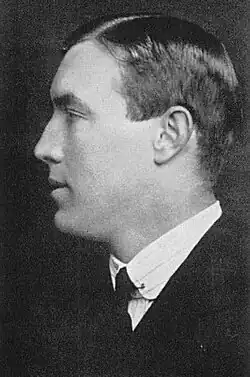
James Morris III (
(1752-01-19)January 19, 1752 –
(1820-04-20)April 20, 1820) was a
Continental Army officer from
Connecticut during the
American Revolutionary War and founder of the Morris Academy, a pioneer in
coeducation. Born in
Litchfield County, Connecticut, Morris spent his early life training to be minister. However, after graduating from
Yale College, Morris accepted a commission from the
Continental Army and joined the fight for
American Independence. Morris was captured during the
Battle of Germantown. Upon his release, Morris was promoted to the rank of
Captain and supported
Alexander Hamilton in the
Siege of Yorktown. When he returned from the war, Morris began and ran an
academy which taught both boys and girls together, a rarity at the time.
Portal:Schools/Selected biography/8
Maria Montessori (August 31, 1870
– May 6, 1952) was an
Italian physician, educator, philosopher, humanitarian and devout
Catholic; she is best known for her philosophy and the
Montessori method of education of children from birth to adolescence. Her educational method is in use today in a number of public as well as private schools throughout the world. Maria Montessori was born in
Chiaravalle (
Ancona),
Italy. Montessori was the first woman to graduate from the
University of Rome La Sapienza Medical School. She became intrigued with trying to educate the "
intellectually disabled" and the "uneducable" in
Rome. The first "defective" children she taught not only passed state examinations for reading and writing, but had above-average scores.
Portal:Schools/Selected biography/9
John Dewey (October 20, 1859
– June 1, 1952) was an
American philosopher,
psychologist, and
educational reformer, whose thoughts and ideas have been greatly influential in the
United States and around the world. He, along with
Charles Sanders Peirce and
William James, is recognized as one of the founders of the philosophical school of
Pragmatism. He is also known as the father of
functional psychology and was a leading representative of the
progressive movement in U.S. schooling during the first half of the 20th century. Dewey founded the
University of Chicago Laboratory Schools where he was able to actualize his pedagogical beliefs which provided material for his first major work on education,
The School and Society (1899).
Portal:Schools/Selected biography/10
Erin Gruwell (born 15 August 1969) is an
American teacher. Gruwell began
student teaching in 1994 at
Woodrow Wilson High School in
Long Beach, California. As a student teacher, she was assigned the lowest-performing students in the school. One student, a boy she referred to as "Sharaud", seemed determined to make her life miserable. However, a few months into the school year one of her other students passed a note depicting Sharaud (an
African American) with extremely large lips. Infuriated, Gruwell told the class that that was the type of caricature that the
Nazis had used during the
Holocaust. When only one of the students knew what the Holocaust was, Gruwell changed the theme of her curriculum to tolerance.
Portal:Schools/Selected biography/11
Francis "Frank" McCourt (born August 19, 1930) is an Irish-American
teacher and
Pulitzer Prize-winning
author. After returning from
World War II, he used the
GI Bill to enroll in
New York University. He received a Masters degree from
Brooklyn College in 1958, and taught
English at McKee High School and
Stuyvesant High School in New York City (where he joined the
American Federation of Teachers). At first he had trouble teaching, because his students were unruly and disobedient. But eventually McCourt became a very experienced teacher. He ending his teaching career after 30 years. McCourt received the
Pulitzer Prize (1997) for his
memoir Angela's Ashes (1996), which details his childhood as a poor
Irish Catholic in
Limerick.
Portal:Schools/Selected biography/12
Charles Manning Hope Clark AC (3 March 1915 – 23 May 1991), Australian historian, was the author of the best-known general history of Australia, his six-volume History of Australia, published between 1962 and 1987. He has been described as "Australia's most famous historian," but his work has been the target of much criticism, particularly from conservatives. Clark was born in Sydney in 1915. When World War II broke out in September 1939, Clark was exempted from military service on the grounds of his mild epilepsy. He supported himself while finishing his thesis by teaching history and coaching cricket teams at Blundell's School, a minor public school at Tiverton in Devonshire, England.
Portal:Schools/Selected biography/13
Frances Mary Buss (16 August, 1827
–24 December, 1894) was a
headmistress and an
English pioneer of women's education. At age sixteen, she was teaching and occasionally left in charge of her school in
Hampstead,
London. To help the family finances her mother set up a private school in
Kentish Town in 1845, at which Frances assisted. The Buss's school was renamed the
North London Collegiate School and moved to larger premises in 1850. Buss was its first Principal and remained so for the rest of her life. Under her headship, the school became a model for
girls' education. Buss was at the forefront of campaigns for the endowment of girls' schools, and for girls to be allowed to sit public examinations and to enter universities.
Portal:Schools/Selected biography/14
Gabriela Mistral (April 7, 1889—January 10, 1957) was the
pseudonym of
Lucila de María del Perpetuo Socorro Godoy Alcayaga, a
Chilean poet, educator, diplomat, and
feminist who was the first
Latin American to win the
Nobel Prize in Literature, in 1945. She was able to get work as a teacher thanks to her older sister, Emelina, who had likewise begun as a teacher's aide, and was responsible for much of the poet's early education. In 1918
Pedro Aguirre Cerda, then Minister of Education and a future President of Chile, appointed her to direct a Liceo, or high school in
Punta Arenas. In 1921, she was named director of the newest and most prestigious girls' school in Chile. By 1922, she had moved to
Mexico where she helped reform libraries and schools.
Portal:Schools/Selected biography/15
Johann Heinrich Pestalozzi (January 12, 1746
– February 17, 1827) was a
Swiss pedagogue and educational reformer. He was born on January 12, 1746 in
Zürich,
Switzerland. During the French invasion of Switzerland in 1798, a number of orphaned children had been left without food or shelter in the Canton
Unterwalden. Pestalozzi took some of them under his charge, and he converted a deserted convent into a school for them. In 1801 Pestalozzi gave an exposition of his ideas on education in the book
How Gertrude Teaches Her Children. His method is to proceed from the easier to the more difficult. To begin with observation, to pass from observation to consciousness, and then from consciousness to speech.
Portal:Schools/Selected biography/16
Kinglsey Ogilvie Fairbridge (5 May 1885 – 19 July 1924) was the founder of a child emigration scheme to
British colonies and the
Fairbridge Schools. His life work was the founding of the "Society for the Furtherance of Child Emigration to the Colonies", which was afterwards incorporated as the "Child Emigration Society" and ultimately the "Fairbridge Society". At the time of his death, 200 children were attending his school near
Pinjarra, Western Australia. After his death a total of six other schools were established by the Child Emigration Society including the Prince of Wales Fairbridge Farm School at Cowichan Station, near
Duncan on
Vancouver Island,
Canada in 1935 as well as schools in Australia at
Bacchus Marsh, Victoria, and
Molong, New South Wales in 1937.
Portal:Schools/Selected biography/17
Percy Shaw Jeffrey (March 14, 1862 - February 22, 1952) was a respected schoolmaster and author of several books on a range of topics, including significant contributions towards the teaching of
phonetics in schools. Born in
Cheltenham,
Gloucestershire to Thomas Ashby Jeffrey, a chemist, and Mary Helen Jeffrey (née Sparrow), he taught at a variety of schools before spending sixteen years as headmaster at
Colchester Royal Grammar School. Shaw Jeffrey was particularly at home with modern languages, and lectured on the topic and how it should be taught. Later on, he authored more works relating to education. With his wife Alice, he retired to the town of Whitby in 1916, where he spent his time between numerous trips to countries around the world.