If you wish to add an article for rotation within this portal, please
- Check its unofficial rating by a WikiProject; it must be B-class or higher to qualify
- Add the article in to a subpage of this portal, such as Portal:Connecticut/Selected article/#, replacing the "#" with the number above the current highest. For example, if 21 articles are in roation, you would make the number of the article you are creating 22.
- Update the article maximum paramater on the main Portal
- If possible, please accompany the article with a freely-licensed image (such as images released under the GNUFDL, Public Domain.) Fair use images are not permitted, per Wikipedia:Non-free content criteria.
- Update this list accordingly.
Portal:Rhode Island/Selected article/1 Providence is the
capital and the most populous city of the U.S. state of
Rhode Island and one of the first cities established in the United States, located in
Providence County. It is the estimated third-largest city in the
New England region. It has an estimated population of 172,459 as of 2007—yet it anchors the
36th-largest
metropolitan population in the country due to its reaching into southern
Massachusetts, with an estimated
MSA population of 1,600,856, exceeding that of Rhode Island by about 60%. The city is situated at the mouth of the
Providence River and the head of
Narragansett Bay. Its small area is crisscrossed by erratic streets and contains a rapidly changing demographic. It was founded in 1636 by
Roger Williams, a religious exile from the
Massachusetts Bay Colony who named the area in honor of
"God's merciful Providence", which he believed was responsible for revealing such a haven for him and his followers to settle. Providence was one of the first cities in the country to industrialize and became noted for its
jewelry and
silverware industry.
Portal:Rhode Island/Selected article/2 Rhode Island has the second lowest number of counties of any U.S. state; only
Delaware has fewer, with three counties. Rhode Island does not have any local government at the county level; instead, local government is provided by the
eight cities and
thirty-one towns. The
Colony of Rhode Island and Providence Plantations was established in the 17th century and was the first of the
thirteen original American colonies to
declare independence from British rule in 1776, signaling the start of the
American Revolution. The counties were all established before the Declaration of Independence. The
Federal Information Processing Standard (FIPS) is used by the United States government to uniquely identify states and counties. Rhode Island's code is 44, which would be written as 44XXX when combined with any county code.
Portal:Rhode Island/Selected article/3 Gilbert Charles Stuart (born
Stewart) (December 3, 1755
– July 9, 1828) was an American
painter from
Rhode Island who is widely considered to be one of America's foremost
portraitists. His best known work is the unfinished portrait of
George Washington which is sometimes referred to as
The Athenaeum; it was begun in 1796 and left incomplete at the time of Stuart's death in 1828. The image of George Washington featured in the painting has appeared on the United States
one-dollar bill for more than a century. Throughout his career, Gilbert Stuart produced portraits of more than 1,000 people, including the first six
Presidents of the United States. His work can be found today at art museums throughout the United States and the United Kingdom, most notably the
Metropolitan Museum of Art and
Frick Collection in New York City, the
National Gallery of Art in Washington, D.C., the
National Portrait Gallery in London, and the
Museum of Fine Arts in
Boston. Gilbert Stuart was born in
Saunderstown, Rhode Island on December 3, 1755 and baptized at
Old Narragansett Church.
Portal:Rhode Island/Selected article/4 The
First Baptist Church in America is the oldest
Baptist church
congregation in the
United States, founded by
Roger Williams in
Providence, Rhode Island in 1638. Williams held religious services in his home after founding Providence Plantation in 1636 before he converted his congregation into a Baptist church. For the next sixty years, the congregation met outside in nice weather or in congregants' homes. Baptists in Rhode Island through most of the 17th century declined to erect meetinghouses because they felt that buildings reflected vanity. Eventually, however, they came to see the utility of some gathering place, and they erected severely plain-style meetinghouses like the Quakers. The present church building was erected in 1774–75 and held its first meetings in May 1775. When it was built, it represented a dramatic departure from the traditional Baptist meetinghouse style. It was the first Baptist meetinghouse to have a
steeple and bell, making it more like Anglican and Congregational church buildings. It is located at 75 North Main Street in Providence's
College Hill neighborhood and is a
National Historic Landmark.
Portal:Rhode Island/Selected article/5 The state of Rhode Island remained loyal to the
Union during the American Civil War, as did all of the other
New England states. Rhode Island furnished 25,236 fighting men to the
Union Army, of whom 1,685 died. The state used its industrial capacity to supply the Union Army with the materials that it needed to win the war, along with the other
northern states. Rhode Island's continued growth and modernization led to the creation of an urban mass transit system, and improved health and sanitation programs. During the Civil War,
Fort Adams near
Newport was used temporarily as the
United States Naval Academy. In May 1861, the Academy was moved to Newport from
Annapolis, Maryland due to concerns about the political sympathies of the Marylanders, many of whom were suspected of being supporters of the
Confederate States of America. In September, the Academy moved to the Atlantic House hotel in Newport and remained there for the rest of the war. In 1862, Fort Adams became the headquarters and recruit depot for the
15th U.S. Infantry Regiment.
Portal:Rhode Island/Selected article/6 Woonsocket is a
city in
Providence County,
Rhode Island,
United States. The population was 43,224 at the
2000 census, making it the sixth largest city in the state. Woonsocket lies directly south of the
Massachusetts border. The city is the corporate headquarters of
CVS Caremark, a leading integrated pharmacy services provider. It is also home to Landmark Medical Center,
St John the Baptist Union, the
Museum of Work and Culture, and the
American-French Genealogical Society. Local Hip-Hop radio station
WWKX 106.3
"Hot 106" is licensed to broadcast from Woonsocket. Radio Station
WNRI, established in 1954, broadcasts 24 hours daily from its Diamond Hill Road studios. According to the
United States Census Bureau, the city has a total area of 8.0
square miles (20.6
km²), of which 7.7
square miles (20.0
km²) is land and 0.2
square miles (0.6
km², 3.14%) is water. Woonsocket is located at
42°0′6″N 71°30′26″W / 42.00167°N 71.50722°W / 42.00167; -71.50722, approximately 15 miles north of Providence. Adjacent communities include
Blackstone,
Bellingham,
Cumberland, and
North Smithfield.
Portal:Rhode Island/Selected article/7 The Breakers is a
Vanderbilt mansion located on Ochre Point Avenue,
Newport, Rhode Island,
United States on the
Atlantic Ocean (
41°28′11″N 71°17′55″W / 41.46972°N 71.29861°W / 41.46972; -71.29861). It is a
National Historic Landmark and a
contributing property to the
Bellevue Avenue Historic District, owned and operated by the
Preservation Society of Newport County. The 70-room mansion was built as the Newport summer home of
Cornelius Vanderbilt II, a member of the wealthy United States
Vanderbilt family. It was designed by renowned
architect Richard Morris Hunt, with interior decoration by
Jules Allard and Sons and
Ogden Codman, Jr., and it boasts approximately 65,000
sq
ft (6,000
m
2) of living space. The home was constructed between 1893 and 1895 at a cost of more than $7 million (approximately $150 million in today's dollars adjusted for inflation). The Ochre Point Avenue entrance is marked by sculpted iron gates, and 30-foot (9.1
m) high walkway gates are part of a 12-foot high limestone and iron fence which borders the property on all sides except the ocean side.
Portal:Rhode Island/Selected article/8
The Station nightclub fire began at 11:07 PM EST on February 20, 2003 at The Station, a glam metal- and rock n roll-themed nightclub located in West Warwick, Rhode Island, United States. It is considered to be the fourth-deadliest nightclub fire in United States history, killing 100 people, four of whom died at local hospitals. Pyrotechnic sparks were set off by the tour manager of the evening's headlining band Great White, which ignited flammable sound insulation foam in the walls and ceilings around the stage and created a flash fire that engulfed the club in 5 1/2 minutes. In addition to those who died, 230 people were injured and 132 escaped uninjured. Video footage of the fire depicts the rapidity of its initial growth and the ensuing pandemonium, as the front entrance is blocked by stampeding patrons frantically attempting to exit the building. Several bystanders tried desperately to help people escape the building by whatever means possible.
Portal:Rhode Island/Selected article/9 H. P. Lovecraft (August 20, 1890–March 15, 1937) was an American author who achieved posthumous fame through his influential works of
horror fiction. He was virtually unknown and published only in
pulp magazines before he died in poverty, but he is now regarded as one of the most significant 20th-century authors in his genre. He was born in
Providence, Rhode Island where he spent most of his life. Among his most celebrated tales are "
The Call of Cthulhu" and "
The Shadow over Innsmouth," both canonical to the
Cthulhu Mythos. Lovecraft was never able to support himself from earnings as author and editor. He subsisted in progressively straitened circumstances in his last years; an inheritance was completely spent by the time that he died at age 46. According to
Joyce Carol Oates, Lovecraft exerted "an incalculable influence on succeeding generations of writers of horror fiction."
Stephen King called him "the twentieth century's greatest practitioner of the classic horror tale," and lists him as having the largest influence in his fiction writing.
Portal:Rhode Island/Selected article/10 Brown University is a
private university located in
Providence, Rhode Island, and a member of the
Ivy League. It was founded in 1764 as the College of Rhode Island; it is the third-oldest institution of higher education in
New England and
seventh-oldest in the United States. Brown was the first college in the nation to accept students without regard for their religious affiliations. Academically, Brown consists of
The College,
Graduate School, and
Alpert Medical School. The New Curriculum was instituted in 1969, eliminating distribution requirements and allowing any course to be taken on a satisfactory/no credit basis. In addition, there are no pluses or minuses in the letter grading system. The school has the oldest undergraduate
engineering program in the Ivy League (1847).
Pembroke College, Brown's women's college, merged with the university in 1971.
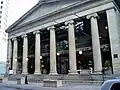
Portal:Rhode Island/Selected article/11 Westminster Arcade is a historic shopping center in
Providence,
Rhode Island built in 1828. It is notable as the first enclosed
shopping mall in the United States and has been lauded as a fine example of commercial Greek Revival architecture. It served as a shopping center for many years before falling into decline in the late 20th century. It has since been closed for renovation and rehabilitation several times, and most recently reopened its doors in October 2013 as a residential and commercial mixed-use building. At the time of the Arcade's opening, there were few retail stores on the west side of the
Providence River; most shopping was located on the east side or Cheapside district. It was slow to attract customers and was known as "Butler's Folly" for many years because of its distance from the retail districts. This changed when a fashionable hat shop opened next door which attracted wealthy female customers to the neighborhood. After that, Westminster Street and downtown developed into a major shopping area. The Arcade was listed on the
National Register of Historic Places in 1971 and declared a
National Historic Landmark in 1976, and is located at 130 Westminster Street and 65 Weybosset Street in downtown Providence.
Portal:Rhode Island/Selected article/12 Newport is a city on
Aquidneck Island in
Newport County,
Rhode Island,
United States, about 30 miles (48 km) south of
Providence. It is famous as a New England summer resort and renowned for its Newport Mansions. It is also the home of
Salve Regina University and
Naval Station Newport, which houses the United States
Naval War College, the
Naval Undersea Warfare Center, and a major
United States Navy training center. The city is the county seat of
Newport County, a county that no longer has any governmental functions. Newport was known for being the home of the
Summer White Houses during the administrations of
Presidents Dwight D. Eisenhower and
John F. Kennedy. The population was 26,475 at the
2000 census. Newport was founded in 1639; its eight founders and first officers were
Nicholas Easton,
William Coddington,
John Clarke,
John Coggeshall, William Brenton, Jeremy Clark, Thomas Hazard, and Henry Bull, who left
Portsmouth, Rhode Island after a political fallout with
Anne Hutchinson and her followers.
Portal:Rhode Island/Selected article/13 There are currently 14
colleges and
universities operating in Rhode Island, as listed by the
Rhode Island Board of Governors for Higher Education. This includes nine universities, two
associates colleges, and three special-focus institutions. The state's three public institutions are administered by the Rhode Island Board of Governors for Higher Education. The state operates two public universities, the
University of Rhode Island and
Rhode Island College, as well as the
Community College of Rhode Island, which offers degrees at six locations. The
Naval War College is operated by the
United States Navy and is located in
Newport. The oldest school in the state is
Brown University, a member of the
Ivy League and the only Rhode Island institution founded before the
American Revolution. The newest is the Community College of Rhode Island, founded in 1964 in
Providence as Rhode Island Junior College.
Portal:Rhode Island/Selected article/14 Coffee milk is a
drink similar to
chocolate milk which uses
coffee syrup instead of chocolate syrup. It is the official state drink of
Rhode Island in the
United States of America. Coffee milk was introduced to Rhode Island sometime in the early 1930s. It came about from diner and drugstore operators trying to attract new customers with creative drinks. One of these now-anonymous operators sweetened leftover coffee grounds with milk and sugar. This created a
molasses-like extract that became popular. Coffee milk became a favorite among Rhode Islanders and created a demand for this coffee syrup. The demand was so great that it beat out
Del's Lemonade in 1993 as the official drink of Rhode Island. In southeastern
New England, it can be found in the
dairy case of stores right next to other flavored milks such as
chocolate,
strawberry, and
vanilla, and is often found on the
beverage menus of
diners throughout the state.
Portal:Rhode Island/Selected article/15 Roger Williams (c. 21 December 1603 – between 27 January and 15 March 1683) was a
Puritan, an English
Reformed theologian, and later a
Reformed Baptist. He was expelled by the Puritan leaders from the colony of
Massachusetts because they thought that he was spreading "new and dangerous ideas" to his congregants. He eventually was forced to flee the Massachusetts colony under the threat of impending arrest and being shipped across the Atlantic to an English prison, walking more than 50 miles in deep snow. He purchased land from several Indian tribes and began the settlement of
Providence Plantation in 1636 as a refuge offering freedom of conscience. Providence Plantation eventually merged with several other colonies to become the
Colony of Rhode Island and Providence Plantations, and eventually the
State of Rhode Island. Williams was also a student of
Native American languages, an early advocate for fair dealings with
American Indians, and one of the first
abolitionists in North America, organizing the first attempt to prohibit slavery in any of the British American colonies. He is best remembered as the originator of the principle of separation of church and state.
Portal:Rhode Island/Selected article/16 Hurricane Carol was among the worst tropical cyclones to affect
New England,
United States. It developed from a
tropical wave near the
Bahamas on August 25, 1954, and gradually strengthened as it moved northwestward. On August 27, Carol intensified to reach winds of 105
mph (169
km/h), but weakened as its motion turned to a northwest drift. The hurricane made landfall on
Long Island and
Connecticut on August 30 near peak intensity, and quickly became extratropical over land. Carol was similar to the
New England Hurricane of 1938; both struck New England as fast-moving hurricanes. The storm produced a record-high wind gust of 135
mph (215
km/h) at
Block Island, and sustained winds peaked at 90
mph (145
km/h) in
Warwick with gusts to 105
mph (170
km/h). Entire coastal communities were nearly destroyed, and the winds destroyed the roofs of hundreds of buildings, forcing many to evacuate to shelters.
Portal:Rhode Island/Selected article/17 Route 4 (also known as the Colonel Rodman Highway) is a numbered
state highway located in
Washington County and southern
Kent County, Rhode Island,
United States. The route is a major north–south
freeway in the southern
Providence metropolitan area, directly linking
Providence with eastern Washington County. Route 4 is used for access to the beaches of
Narragansett and
South Kingstown, and also serves as a major connection between Providence and
Newport. The 9.8-mile (15.8
km) route begins as a two-lane
divided highway at an intersection with
U.S. Route 1 in the town of
North Kingstown, becoming a
limited-access freeway shortly after an intersection with Oak Hill Road. Route 4 has four numbered interchanges before terminating in
Warwick, where the northbound lanes merge into
Interstate 95. All but the southernmost 1.2 miles (1.9
km) of Route 4 is a freeway. The southern portion of the route has three at-grade intersections with three northbound and two southbound traffic signals.
Portal:Rhode Island/Selected article/18 Belcourt Castle is the former summer cottage of
Oliver Hazard Perry Belmont located on
Bellevue Avenue in
Newport, Rhode Island. Construction was begun in 1891 and completed in 1894, and it was intended to be used for six to eight weeks of the year. The mansion was designed in a multitude of European styles and periods, with heavy emphasis on French Renaissance and Gothic decor and further borrowings from German, English, and Italian design. In the
Gilded Age, the castle was noted for its extensive stables and carriage areas, which were incorporated into the main structure located at 659 Bellevue Avenue. Belcourt was designed by
Richard Morris Hunt for the heir of
August Belmont, a
Hessian Jew who came to the United States in 1837 as an agent for the Rothschilds and accumulated enormous personal wealth as a banker. When construction finished in 1894, the entire first floor was composed of carriage space and a multitude of stables for Belmont's prized horses.
Portal:Rhode Island/Selected article/19 Ninigret is a coastal
lagoon in
Charlestown,
Washington County, Rhode Island, United States, located at
41°22′45″N 71°38′43″W / 41.3792677°N 71.6453401°W / 41.3792677; -71.6453401. It is the largest of nine such lagoons (often referred to as "salt ponds") in southern Rhode Island. It is utilized for recreational actives, as well as oyster and
quahog harvesting. The pond is situated on low-lying ground and, as such, it is considered particularly vulnerable to
storm surge flooding. It is connected to Green Hill Pond via a small channel. According to information compiled by the Rhode Island Sea Grant program, Ninigret Pond's watershed covers 7,645.65
acres (3,094.08
ha), of which 5,820.79 acres (2,355.59
ha) is occupied by water. The pond itself has a surface area of 1,580.38 acres (639.56
ha), while other, smaller bodies of water account for the other 244.48 acres (98.94
ha). Ninigret Pond has a salinity level of 24
parts per thousand and averages 4.3
ft (1.3
m) deep.
Portal:Rhode Island/Selected article/20 The Flying Horse Carousel is a historic
carousel in
Watch Hill, Rhode Island, the principal summer resort area of the town of
Westerly. It is the oldest operating carousel in the United States in which the horses are suspended from chains, and one of two in the state designated as
National Historic Landmarks. It is believed to have been built around 1876 by the Charles W. Dare Company of
New York. The bodies of the horses are believed to have been carved from single blocks of wood, with the legs carved separately and attached. The horses still have their original agate eyes, while other trappings have been replaced. When the carousel rotates,
centrifugal force drives the horses outward, giving rise to the name "flying horses." The carousel was originally part of a traveling
carnival until 1879, when the carnival was forced to abandon it in Watch Hill. It was extensively damaged by the
New England Hurricane of 1938 which devastated Watch Hill; however, its horses were recovered from the sand dunes and the carousel was restored to operation.
Portal:Rhode Island/Selected article/21 Rhode Island Route 403 (also known as the
Quonset Freeway) is a numbered
state highway located in
Washington County and
Kent County, Rhode Island,
United States. The route is a nominally east–west
limited-access freeway for its entire length, a
spur of
Rhode Island Route 4. Route 403 serves
Davisville and the
Quonset Business Park, providing freeway access to
Interstate 95 and the northern
Providence metropolitan area from the industrial zone. The western terminus of the freeway is at a
trumpet interchange with Route 4 in
East Greenwich. The route has three unnumbered interchanges along its 4.5-mile (7.2
km) length, including a junction with
U.S. Route 1 in
North Kingstown, before terminating at an
at-grade intersection with Roger Williams Way and Commerce Park Road in
Quonset. Route 403 is the highest
numbered route in Rhode Island. Prior to 2006, it was a narrow, two-lane road through Davisville. The western terminus of the route was at an interchange with Route 4 and
Rhode Island Route 402 in East Greenwich, and the eastern terminus was at U.S. Route 1 in North Kingstown.
Portal:Rhode Island/Selected article/22 Anne Hutchinson, born
Anne Marbury (1591–1643), was a
Puritan woman, spiritual adviser, mother of 15, and important participant in the
Antinomian Controversy that shook the infant
Massachusetts Bay Colony from 1636 to 1638. Her strong religious convictions were at odds with the established Puritan clergy in the
Boston area, and her popularity and charisma helped create a theological schism that threatened to destroy the Puritans' religious experiment in New England. She was eventually tried and convicted, then banished from the colony with many of her supporters. She and many of her supporters had encouragement from
Providence founder
Roger Williams and established the settlement of
Portsmouth in what became the
Colony of Rhode Island and Providence Plantations. After her husband's death, she moved to
New Netherland near an ancient landmark called
Split Rock in what later became
The Bronx in
New York City. Here all but one of the 16 members of her household were massacred by
Siwanoy Indians, the only survivor being her nine-year old daughter
Susanna, who was taken captive. Her well-publicized trials and the accusations against her make Hutchinson the most famous—or infamous—English woman in colonial American history.
Portal:Rhode Island/Selected article/23
Stephen Hopkins (1707–1785) was a governor of the Colony of Rhode Island and Providence Plantations, a Chief Justice on the Rhode Island Supreme Court, and a signer of the Declaration of Independence. He began his public service at age 23 as a justice of the peace in the newly established town of Scituate, Rhode Island. He soon became a justice of the Inferior Court of Common Pleas, while also serving at times as the Speaker of the House of Deputies and President of the Scituate Town Council. In May 1747, Hopkins was appointed as a justice of the Rhode Island Supreme Court, and he became the third Chief Justice of this body in 1751. In 1755, he was elected to his first term as governor of the colony and served a total of nine of the next 15 years in this capacity. Hopkins had become well known in the Thirteen Colonies when he published a pamphlet entitled "The Rights of Colonies Examined," which was critical of British Parliament and its taxation policies. Hopkins signed the Declaration of Independence in the summer of 1776, with palsy in his hands; he held his right hand with his left, saying, "my hand trembles, but my heart does not." He died in Providence in 1785 at age 78 and is buried in the North Burial Ground there. He has been called Rhode Island's greatest statesman.
Portal:Rhode Island/Selected article/24 Benedict Arnold (1615 – 1678) was president and then governor of the
Colony of Rhode Island and Providence Plantations, serving for a total of 11 years in these roles. He learned the Indian languages at an early age and became one of the two leading
interpreters in the Rhode Island colony,
Roger Williams being the other. In 1651, he began his public service which lasted continuously until his death. He became a Commissioner and Assistant, and succeeded Roger Williams as President of the colony in 1657, serving for three years. In 1662, he was once again elected President; the
Royal Charter of 1663 was delivered from England during the second year of this term, naming him as the first governor of the colony. Arnold was a bold and decisive leader; he was elected for two additional terms as governor, the last time following the devastation of
King Philip's War. He died on 19 June 1678 while still in office and was buried in the
Arnold Burying Ground, located on Pelham Street in Newport. In his will, he left his
"stone built wind mill" to his wife, which still stands as an important Newport landmark. His many descendants include General
Benedict Arnold, best known for his treason during the
American Revolutionary War, and Senator
Stephen Arnold Douglas, who debated
Abraham Lincoln in 1858 and lost to him during the
1860 presidential election.