Selected pictures list
Template:POTD/2007-02-01
A
map of
Network of National Highways in
India, including
NHDP projects up to phase IIIB, which is due to be completed by December 2012. The National Highways are the main long-distance roadways and constitute a total of about 58,000 km (36,250 mi), of which 4,885 km (3,053 mi) are central-separated
expressways. Highways in India are around 2% of the total road network in India, but carry nearly 40% of the total road traffic.
Template:POTD/2008-08-26
Pigments for sale at a market stall in
Goa,
India. Many pigments used in manufacturing and the visual arts are dry
colourants, ground into a fine powder. This powder is then added to a vehicle or matrix, a relatively neutral or colorless material that acts as a
binder, before it is applied. Unlike a
dye, a pigment generally is
insoluble.
Template:POTD/2008-11-28
The
national flower of
India,
Nelumbo nucifera is known by a number of common names, including Indian lotus, sacred lotus, bean of India, and sacred water-lily. This plant is an
aquatic perennial, though under favorable conditions its seeds may remain viable for many years.
Template:POTD/2009-04-19
Photo credit: Luc Viatour A fire breather in the "Jaipur Maharaja Brass Band" of
India.
Fire breathing, which is said to have originated in India, is the act of creating a large
flame by spraying, with one's mouth, a
flammable liquid upon an open flame. A number of
legendary creatures are said to possess innate capabilities for fire breathing, most notably
dragons.
Template:POTD/2010-03-04
Image credit: Vaikunda Raja The Lotus-Namam is the symbol of
Ayyavazhi, a
Dharmic belief system that originated in
South India in the 19th century. The
lotus represents the 1,008-petalled
Sahasrara and the flame-shaped white
Namam represents the
Aanma Jyothi or
ātman, sometimes translated as 'soul' or 'self'. The number of practitioners is estimated to be between 700,000 and 8,000,000, although the exact number is unknown, since Ayyavazhis are reported as
Hindus during censuses.
Template:POTD/2011-10-07
Photo: Muhammad Mahdi Karim
Template:POTD/2011-11-04
Photo: Muhammad Mahdi Karim Bangalore Town Hall is a
neoclassical municipal building in
Bangalore, India. It is sometimes known, after a former president of Bangalore, as the
Sir K. P. Puttanna Chetty Town Hall. Built by
Mirza Ismail in 1935, it underwent renovations in 1990 at a cost of
₹6.5 million (US$371,400 at the time).
Template:POTD/2012-05-03
Template:POTD/2012-11-05
A statue of the
Hindu god
Shiva as
Nataraja, the Lord of Dance. In this form, Shiva performs his divine dance to destroy a weary universe and make preparations for the god
Brahma to start the process of creation. A
Telugu and
Tamil concept, Shiva was first depicted as Nataraja in the famous
Chola bronzes and sculptures of
Chidambaram. The form is present in most Shiva temples in South India, and is the main deity in
Chidambaram Temple, the foremost
Shaivist temple.
Template:POTD/2013-02-09
Photograph: Muhammad Mahdi Karim
Template:POTD/2013-03-04
Photograph: Muhammad Mahdi Karim
Template:POTD/2013-03-26
Unripe drupes of
black pepper (
Piper nigrum) at
Trivandrum,
Kerala, India. The drupes are cooked briefly in hot water. The heat ruptures cell walls in the pepper, speeding the work of browning enzymes during drying. The drupes are dried for several days, during which the pepper around the seed shrinks and darkens into a thin, wrinkled black layer. Once dried, the spice is called black peppercorn.
Template:POTD/2013-06-03
Murugan, also known as
Kartikeya, is the
Hindu war god, worshiped particularly by
Tamil Hindus. Murugan has a peacock as a
mount and is often depicted with six heads and twelve arms holding a variety of weapons. His consorts, pictured here, are
Valli and
Deivayanai.
Template:POTD/2013-07-29
A mating pair of
Papilio demoleus, a common and widespread
Swallowtail butterfly, photographed at
Kadavoor, Kerala, India. After successful mating the female goes from plant to plant, laying a single egg at a time on top of a leaf, and flies off as soon as the egg is laid.
Template:POTD/2013-11-04
Template:POTD/2013-12-22
A
potter at work in Jaura,
Madhya Pradesh, India. Pottery, defined by
ASTM International as "all fired ceramic wares that contain clay when formed, except technical, structural, and refractory products", originated during the
Neolithic period.
Template:POTD/2014-01-17
Photograph: Muhammad Mahdi Karim
Template:POTD/2014-01-24
Template:POTD/2014-04-22
Photograph: Muhammad Mahdi Karim
Template:POTD/2014-07-15
Template:POTD/2014-08-23
Al-Ameen College of Pharmacy
Photo: Muhammad Mahdi KarimAl-Ameen College of Pharmacy is a pharmacy college in
Bangalore, India. Established in 1983, it is under the purview of the Al-Ameen Educational Society.
Template:POTD/2014-08-28
Photo: Muhammad Mahdi Karim The
mosque at the
Taj Mahal complex in
Agra, India. This red sandstone building, on the western side of the complex, faces the west side of the mausoleum. In the forefront is a
howz, meant for ablution. On the eastern side of the complex is the
jawab ("answer"), a mirror image of the mosque except for the missing
mihrab and different floor pattern; this
jawab was mainly intended for architectural balance. Both were constructed in 1643.
Template:POTD/2014-11-24
Photograph: Augustus Binu Arundhati Roy (b. 1961) is an Indian author and political activist who won the 1997
Man Booker Prize with her debut novel
The God of Small Things. Born in
Shillong,
Meghalaya, Roy wrote several screenplays in the late 1980s after meeting (and later marrying) director
Pradip Krishen. She wrote
The God of Small Things over a four-year period ending in 1996; it was published the following year and received positive international reviews, although in India the work was controversial. She has continued to write essays and articles, but has yet to publish another novel.
Template:POTD/2015-04-10
Template:POTD/2015-05-10
Photograph: Augustus Binu
Template:POTD/2016-01-12
Photograph: Muhammad Mahdi Karim
Template:POTD/2016-04-13
Template:POTD/2016-08-13
Photograph: Arthur Chapman; edit: Papa Lima Whiskey and Ryan Kaldari
Template:POTD/2016-10-10
Photograph: Augustus Binu Odissi is an ancient
classical dance that originated in the
Hindu temples of
Odisha, India. Historically, it has been performed predominantly by women, and expressed religious stories and spiritual ideas, particularly of
Vaishnavism (Vishnu as
Jagannath), but also of other traditions such as those related to Hindu gods
Shiva and
Surya, as well as Hindu goddesses (
Shaktism). Modern Odissi productions by Indian artists have presented a diverse range of experimental ideas, culture fusion, themes and plays.
Odissi is learnt and performed as a composite of a basic dance motif called the
Bhangas (symmetric body bends, stance). It involves the lower, mid, and upper body as three sources of perfecting expression and audience engagement with geometric symmetry and rhythmic musical resonance.
Template:POTD/2016-11-16
Photograph: Muhammad Mahdi Karim Bangles on display in
Bangalore, India. These rigid
bracelets are usually made from metal, wood, or plastic and are traditionally worn by women in India, Nepal, Pakistan, and Bangladesh. In India, it is a common tradition to see a new bride wearing glass bangles at her
wedding and the honeymoon will end when the last bangle breaks.
Template:POTD/2017-01-15
Photograph: Yann; edit: Jim Carter A view of the
Taj Mahal from the south, featuring the
Charbagh garden. The mausoleum complex also includes subsidiary tombs, waterworks infrastructure, the small town of Taj Ganji, and a "moonlight garden".
Its origins and architecture have been extensively documented, covering both the circumstances of its commission and the cultural and historical influence of the Islamic
Mughal Empire in India.
Template:POTD/2017-01-28
Photograph: Muhammad Mahdi Karim
Template:POTD/2017-04-27
Template:POTD/2017-08-04
Template:POTD/2018-07-24
An Indian merchant holding green
chickpeas (
Cicer arietinum). One of the earliest cultivated
legumes, chickpeas are ingredients in
a number of dishes around the world. India is the largest producer of this nutrient-dense food, accounting for 64% of global production in 2016.
Template:POTD/2018-10-19
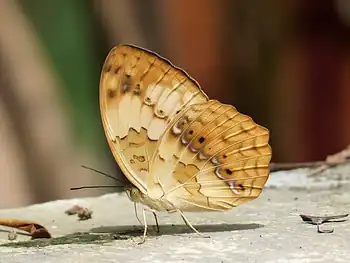
Danaus genutia, also known as the common tiger or striped tiger, is a species of butterfly found throughout India as well as Sri Lanka, Myanmar, South-East Asia and Australia. It is a member of the
Danainae group of
brush-footed butterflies. Both sexes have tawny wings with veins marked with broad black bands, and the male has a pouch on its hindwing. The butterfly is found in scrub jungles, fallow land adjacent to habitation, and deciduous forests, preferring areas of moderate to heavy rainfall. Its most common food plants in peninsular India are small herbs, twiners and creepers from the family
Asclepiadaceae. The caterpillar of
D. genutia obtains poison by eating poisonous plants, which make the caterpillar and butterfly taste unpleasant to predators. It has some 16
subspecies and although its evolutionary relationships are not completely resolved, it appears to be most closely related to the
Malay tiger (
D. affinis) and the white tiger.
Template:POTD/2019-08-14
Photograph credit: Jeevan Jose Lyriothemis acigastra is a species of
dragonfly in the family
Libellulidae, found in India. Until 2013, it was thought to be restricted to the northeastern states of
Assam and
West Bengal, but it has now also been recorded in the southern state of
Kerala. It is a small dragonfly with brown-capped greenish-yellow eyes and a blackish-brown thorax marked with yellow. Laterally, there are three stripes. Its wings are transparent, palely tinted with yellow at the base. The female is similar to the male, but the abdomen is cylindrical instead of tapered from base to end and reddish yellow instead of blood red. This picture shows a male
L. acigastra individual.
Template:POTD/2019-11-02
Photograph credit: Charles J. Sharp The
nilgai or blue bull (
Boselaphus tragocamelus) is the largest Asian
antelope and is
endemic to the Indian subcontinent. The sole member of the genus
Boselaphus, the species was
described and given its binomial name by German zoologist
Peter Simon Pallas in 1766. The nilgai stands 1–1.5 metres (3.3–4.9
ft) at the shoulder; males weigh 109–288 kilograms (240–635
lb), and the lighter females 100–213 kilograms (220–470
lb). A sturdy thin-legged antelope, the nilgai is characterised by a sloping back, a deep neck with a white patch on the throat, a short crest of hair along the neck terminating in a tuft, and white facial spots. A column of pendant coarse hair hangs from the dewlap ridge below the white patch.
Sexual dimorphism is prominent
– while females and juveniles are orange to tawny, adult males have a bluish-grey
coat. Only males possess
horns, which are 15–24 centimetres (5.9–9.4
in) in length.
This picture shows a male nilgai in a potato field at Jamtra, in the Indian state of
Madhya Pradesh.
Template:POTD/2019-11-26
Photograph credit: Charles J. Sharp The
Indian roller (
Coracias benghalensis) is a member of the bird family Coraciidae, the
rollers. It occurs widely from the Arabian Peninsula to the Indian subcontinent and is designated as
Least Concern on the
IUCN Red List. The bird is best known for the aerobatic displays of males during the breeding season. It is commonly found in open grassland and scrub forest habitats, and is often seen perched on roadside bare trees and wires, which give it a good view of the ground below where it finds its prey. Its diet consists mainly of insects such as beetles and grasshoppers, but also includes spiders, scorpions, amphibians and small reptiles. The largest population occurs in India, and several states in India have chosen it as their state bird.
This picture shows an Indian roller of the
benghalensis subspecies, photographed in
Kanha Tiger Reserve in the Indian state of
Madhya Pradesh.
Template:POTD/2020-02-16
Photograph credit: Muhammad Mahdi Karim The
Dharmaraya Swamy Temple is one of the oldest temples in
Bangalore, India. It is thought to be more than 800 years old and is built in the
Dravidian style, with a
gopuram, an ornate monumental entrance tower. Gods worshipped here include
Dharmaraya,
Krishna,
Arjuna,
Draupadi and
Bhima.
The
Karaga festival starts from the temple each year; the festival is dedicated to Draupadi, the most important female character in the Hindu epic, the
Mahabharata. Starting at midnight, a priest dressed as a woman carries an earthen pot filled with water and adorned with decorations several feet high on his head in procession through the town, preceded by hundreds of bare-chested, dhoti-clad, turbaned
Veerakumaras bearing unsheathed swords.
Template:POTD/2020-06-01
Photograph credit: Charles J. Sharp The
southern plains gray langur (
Semnopithecus dussumieri) is a species of
Old World monkey native to the Indian subcontinent. It is about 62
cm (24
in) tall and lives in groups in various forest habitats, feeding mainly on leaves, fruit and flowers in the
canopy, supplementing these with insects, gum, grasses, herbs and roots. The monkeys are considered sacred in India, and some are used by Hindu priests for religious purposes. They have adapted to living in close proximity to humans in urban settings; they are often fed by humans and accept cakes, millet, and other foods. The species is protected by law in India, but some are still persecuted for damaging crops, hunted for food and captured for pets.
This photograph of a female southern plains gray langur was taken in
Kanha Tiger Reserve, in the Indian state of
Madhya Pradesh. The park was created on 1
June
1955 and was designated a
tiger reserve in 1973.
Template:POTD/2020-08-29
Photograph credit: Subhrajyoti Saha
Template:POTD/2020-08-31
Photograph credit: Charles J. Sharp The
bank myna (
Acridotheres ginginianus) is a
passerine bird found in flocks on the plains of northern and central India. Its usual habitat is cultivated farmland, usually in the vicinity of open water, but flocks will often live within cities, in markets and railway stations. Its common name comes from its propensity to nest in large colonies in holes excavated in the banks of rivers, although other sites are sometimes chosen. It feeds on grain, insects and fruits, and sometimes follows grazing animals, picking up disturbed insects or even ticks off the animals' backs. In towns, it makes use of food dropped by humans, even following catering vehicles at airports. This bank myna was photographed in the Indian state of
Uttar Pradesh.
Template:POTD/2020-09-15
Photograph credit: Prathyush Thomas Macrotyloma uniflorum, commonly known as horse gram, is a
legume native to tropical southern Asia. The plant grows from a rhizome, sending up annual shoots to a height of 60
cm (24
in). The flowers are cream, yellow or pale green and are followed by short pods. The seeds, pictured here, have been consumed in India for at least 4,000 years and are used both for animal feed and human consumption, including
Ayurvedic cuisine. In other tropical countries in southeastern Asia, and in northern Australia, the plant is grown mainly as a
fodder crop and for use as
green manure. It is a drought-tolerant plant, largely cultivated in areas with low rainfall.
Template:POTD/2020-09-27
Photograph credit: Augustus Binu Pomegranate juice is a beverage made from the fruit of the
pomegranate. It is used in cooking both as a fresh juice and as a concentrated syrup. The fruit originated in the region extending from Iran to northern India and has been cultivated since ancient times. The fruit has a hard outer husk and a spongy
mesocarp in which the seeds in their
fleshy seedcoats are embedded. Pomegranate juice can be sweet or sour, but most fruits are moderate in taste. The juice has long been a popular drink in Europe and the Middle East, and is now widely distributed in the United States and Canada.
Template:POTD/2020-11-13
The
round ribbontail ray (
Taeniura meyeni) is a species of stingray in the family
Dasyatidae, found throughout the nearshore waters of the tropical
Indo-Pacific region. Reaching 1.8
m (6
ft) across, this large ray is characterized by a thick, rounded pectoral fin disc covered by small
tubercles on top, and a relatively short tail bearing a single venomous spine. The ray is well-camouflaged when lying on the seabed; it is largely nocturnal, and preys on
molluscs,
crustaceans and
bony fish. Mature females bear litters of up to seven pups, which are fed during gestation on "uterine milk", a product secreted by the walls of the
oviduct. This round ribbontail ray was photographed in
Lakshadweep, India.
Template:POTD/2020-12-13
The
mohur is a gold coin that was formerly minted by several governments, including those of British India. It was usually equivalent in value to fifteen silver
rupees. Gold mohurs issued by the British
East India Company or the Crown are valuable collectors' items, and sell in auctions for high prices. The double mohur (minted between 1835 and 1918), with a value of thirty rupees, is the highest-denomination circulating coin ever issued in India. The 1835 two-mohur coin above was minted in the reign of King
William IV, while the 1862 one-mohur coin below was minted in the reign of Queen
Victoria; both are now part of the
National Numismatic Collection at the
National Museum of American History.
Template:POTD/2021-01-30
Photograph credit: Augustus Binu K. T. Thomas (born 30
January
1937) is a former judge of the
Supreme Court of India, known for his strong opinions on Indian socio-political matters. He was selected as a district and sessions judge in 1977, and became a judge of the
Kerala High Court in 1985. A decade later, he was appointed a judge of the Supreme Court, on which he served until retiring in 2002. He was awarded the
Padma Bhushan by the Indian government in 2007 for services in the field of social affairs.
Template:POTD/2021-02-08
Template:POTD/2021-04-07
Photograph credit: Charles James Sharp Danaus genutia, the common tiger or striped tiger, is a species of
brush-footed butterfly found in Sri Lanka, India, Myanmar, south-eastern Asia and Australia. It prefers areas of moderate to heavy rainfall, and typical habitats include scrubby jungle, deciduous forests and fallow land near habitations. The insect sequesters
toxins from plants, and advertises its unpalatability by having prominent markings and striking colour patterns. This adult male common tiger, of the subspecies
D. g. genutia, was photographed in
Kerala, India.
Template:POTD/2021-05-22
Photograph credit: Charles James Sharp The
pied bush chat (
Saxicola caprata) is a small
passerine bird widely distributed in Asia. The males are black with white shoulder and vent patches, while the females are predominantly brownish. This species is
insectivorous, and like other chats hunts from a prominent low perch. This female pied bush chat was photographed in
Pench National Park, India.
Template:POTD/2021-07-23
Photograph credit: Jeevan Jose Leptosia nina, known as the psyche, is a species of butterfly in the family
Pieridae (the sulphurs, yellows and whites), found in the Indian subcontinent, southeastern Asia, and Australia. It has a small wingspan of 2.5 to 5
cm (1 to 2
in). The upper side of the otherwise white forewing has a large, somewhat pear-shaped, black spot; this spot is also present on the underside which is scattered with greenish dots and speckles, sometimes arranged in bands. This
L. nina butterfly was photographed in
Kerala, India.
Template:POTD/2021-09-10
Photograph credit: Jeevan Jose Papilio polymnestor, the blue Mormon, is a species of
swallowtail butterfly found in southern India and Sri Lanka. It is a woodland species, often seen on forest paths and near streams. The larvae feed on trees in the family
Rutaceae, such as citrus. Young larvae are green with white markings and position themselves on the upper surface of leaves, relying on their
cryptic colouring, which resembles bird droppings, for protection. Older larvae seek less conspicuous locations, and have a unique habit of securing their balance by weaving silk on the
substratum. This adult male
P. polymnestor butterfly was photographed in the Indian state of
Kerala.
Template:POTD/2021-09-20
Photograph credit: Charles James Sharp The
Indian rhinoceros (
Rhinoceros unicornis) is a species of
rhinoceros that once ranged across the entire northern part of the
Indian subcontinent. As a result of habitat destruction and climatic changes, its range was gradually reduced such that, by the 19th century, it survived only in southern Nepal, northern
Uttar Pradesh, northern
Bihar, northern
West Bengal, and in the
Brahmaputra Valley in
Assam. The species's range has since shrunk further, and its habitat is surrounded by human-dominated landscapes, so that in many areas, it occurs in cultivated areas, pastures, and secondary forests. It is currently listed as a
vulnerable species on the
IUCN Red List. This adult male Indian rhinoceros was photographed on the banks of the
Gandaki River in Nepal.
Template:POTD/2021-12-09
Photograph credit: Jeevan Jose Attacus taprobanis is a species of
moth in the family
Saturniidae native to southern India and Sri Lanka. This adult male, photographed in
Kadavoor,
Kerala, developed from a
larva feeding on a
mahogany tree. When ready to pupate, the larva formed a papery cocoon 7.5
cm (3
in) long interwoven with a leaf; before doing this, the larva had attached the leaf to the stem with a silken thread and cut the leaf stalk. The colours of the dying leaf provided camouflage for the pupa, and the adult insect emerged some 24 days later.
Template:POTD/2022-02-20
Photograph credit: KennyOMG
Template:POTD/2022-03-18
Photograph credit: Narender9 Holi is a popular Indian festival of love and spring. The festival celebrates the eternal and divine love of
Radha Krishna, and signifies the triumph of good over evil, as it celebrates the victory of
Vishnu over
Hiranyakashipu. This photograph depicts the celebration of
Lathmar Holi at
Radha Rani Temple in
Barsana, India, with devotees throwing
gulal (coloured powder) at each other as a celebration of love and equality.
Template:POTD/2022-05-07
Photograph credit: Charles J. Sharp
Template:POTD/2022-08-15
Photograph credit: Charles J. Sharp
Template:POTD/2023-05-04
Photograph credit: Timothy Gonsalves
Template:POTD/2023-06-04
Photograph credit: Kulbhushan Suryawanshi Key Monastery is a monastery belonging to the
Gelugpa school of
Tibetan Buddhism, located at an elevation of 4,166
m (13,668
ft) on a hill rising above the
Spiti valley in the northern Indian state of
Himachal Pradesh. Said to have been founded in the 11th century, it is the largest monastery in Spiti, housing hundreds of
monks. This view shows the monastery in winter, overlooking the snow-covered Spiti river valley with the Himalayas in the background.
Template:POTD/2023-08-14
Photograph credit: duncid, retouched by UnpetitproleX and Aristeas
Template:POTD/2023-08-15
Template:POTD/2024-01-25
Photograph credit: Timothy A. Gonsalves
Template:POTD/2024-03-30
Photograph credit: Jakub Hałun The
City Palace of Jaipur, constructed between 1727 and 1732, is a royal residence located in
Jaipur, Rajasthan, India. It was the ceremonial and administrative seat of the
Kingdom of Amber, and home of its rulers, from the time of the state's foundation in 1727 by Maharaja
Sawai Jai Singh II until 30 March 1949. The palace continues to be a residence of the royal family of Jaipur and is a popular tourist attraction. This picture shows the
Leheriya gate, one of four intricately designed gates in an inner courtyard of the palace. The gate is dedicated to Hindu god
Ganesha (carved above the door) with the green colour representing the season of spring.
Template:POTD/2024-11-01
Diwali is a five-day Hindu festival of lights which symbolises the spiritual victory of light over darkness and good over evil. It commemorates the day when Hindu god
Rama, along with his wife-consort
Sita and brother
Lakshmana, returned to his kingdom of
Ayodhya after defeating demon-king
Ravana and following 14 years of exile. Celebrations peak on the night of the third day of the festival—the main day of Diwali, which is today—marking the darkest night of the
Hindu lunisolar calendar. People celebrate on this day by lighting traditional lamps (
diyas) and candles. Pictured here is a woman lighting candles on Diwali.
Template:POTD/2025-01-26
Photograph credit: Timothy Gonsalves Shinku La is a
mountain pass in the
Himalayas of northern India. The pass is traversed by the
Darcha–Padum road, connecting the high-altitude region of
Zanskar in
Ladakh with the rest of India. The pass becomes snowbound in the winter, leading to the closure of the road. The construction of a tunnel under the pass, to ensure all-weather connectivity, began in 2024. This photograph shows Shinku La covered in snow, with a frozen lake in the foreground.
Template:POTD/2025-02-26
Wangath temple complex is a group of
Hindu temple monuments in Wangath, close to
Naranag,
Jammu and Kashmir, India. The current structure was built by
Lalitaditya Muktapida of the Karkota dynasty in the 8th century CE but are now ruins. The temple is constructed out of local grey granite and consists of two complexes, dedicated respectively to Shiva Jyeshthesa and Shiva Bhuteshwara, with a central pavilion in between. The temple marks the starting point of pilgrimages to the
Gangabal Lake, a high-altitude alpine lake in the Himalayas considered by
Kashmiri Hindus to be an abode of Shiva. This photograph shows the main temple of the site's western complex.
Template:POTD/2025-08-13
Naba Kailash Mandir is a Hindu temple in
Kalna City, West Bengal, India. The temple structure consists of 108 smaller temples, each with a height of around 6 metres (20 feet) and width of around 3 metres (9.5 feet), arranged in two concentric circles. The site is dedicated to the Hindu deity
Shiva. The inner circle has a circumference of about 102 metres (336 feet), and the outer circle has a circumference of about 220 metres (710 feet). The temples are built on low raised base-altars. This aerial photograph of Naba Kailash Mandir was taken in 2020.
Template:POTD/2025-11-09
Kumaon is a
revenue and administrative division in the Indian state of
Uttarakhand. Historically known as Manaskhand and Kurmanchal, the Kumaon region has been ruled by several dynasties over the course of its history, most notably the
Katyuri and the
Chand. In 1790, the
Kingdom of Kumaon was invaded and annexed by the
Gorkhas, from whom it was conquered by the British
East India Company in 1815, following which it became part of the
Ceded and Conquered Provinces (which later became the
United Provinces). After Indian independence in 1947, it remained part of the state of
Uttar Pradesh until 2000, when the state of Uttarakhand was created as a result of the
Uttarakhand movement. The people of Kumaon are known as
Kumaonis and speak the
Kumaoni language. This picture shows a panoramic view of the Kumaon
Himalayas as seen from the
hill station and town of
Ranikhet, with mountains such as
Trisul (7,120
m, 23,360
ft),
Nanda Devi (7,817
m, 25,646
ft),
Nanda Kot (6,861
m, 22,510
ft),
Panchachuli (6,904
m, 22,651
ft), and other peaks prominently visible.
Template:POTD/2026-01-21
Nohkalikai Falls is a 340-foot-tall (100
m) plunge waterfall located in the northeast Indian state of
Meghalaya. It is the tallest plunge waterfall in India and is situated near
Cherrapunji, one of the
wettest places on Earth. Nohkalikai Falls are fed by the rainwater collected on the summit of a relatively small plateau. Below the falls is a plunge pool with water of an unusual shade of green.
Template:POTD/2026-01-26
Photograph credit: Yoghya; edited by UnpetitproleX
Template:POTD/2026-02-16
Photograph credit: UnpetitproleX