Gastropods (/ˈɡæstrəpɒdz/; previously known as Univalves; class Gastropoda/ɡæsˈtrɒpədə/) are a vast and diverse group of invertebrates within the phylum Mollusca, comprising the animals commonly known as snails and slugs. With an estimated 65,000 to 80,000 living species, they form the second-largest animal class after the insects. The fossil record of gastropods extends back to the Late Cambrian. As of 2017, 721 families are recognized—476 extant (some with fossil representatives) and 245 extinct known only from fossils.
Gastropods inhabit an extraordinary range of environments, including marine, freshwater, and terrestrial ecosystems. They occur in gardens, woodlands, deserts, mountains, rivers, lakes, estuaries, mudflats, intertidal zones, the deep sea, hydrothermal vents, and even in parasitic niches.
The term snail generally refers to gastropods with a large external shell into which the body can fully retract, while slugs have no shell or a small internal one, and semislugs can only partially withdraw into their reduced shell. Marine gastropods include familiar forms such as abalones, conches, periwinkles, whelks, and cowries, whose shells are usually coiled in adulthood. In contrast, limpets and related groups coil their shells only in the larval stage, retaining a simple conical form as adults.
Because of their vast diversity, gastropods exhibit remarkable variation in anatomy, behavior, feeding, and reproduction, making broad generalizations difficult. Gastropods remain one of evolution's most successful and adaptable animal lineages. (Full article...)
Amphibulima browni is a species of small, air-breathing land snail, a terrestrialpulmonategastropodmollusk in the family Amphibulimidae. This species is endemic to the West Indian island of Dominica. The snail was firstly collected in the late 19th century by biologist A. D. Brown and it was originally described by an American malacologist Henry Augustus Pilsbry in 1899. The type locality is Dominica, the altitude 330 m, "on bananas".
The status of this species was somewhat doubtful for a long period, since the snails were not observed and reported for over 100 years after the original material was collected. However, the collection of a few live specimens during recent surveys in the 2000s finally confirmed that this species is still living in Dominica. Amphibulima browni is likely to meet the IUCN-criteria for listing as Endangered species. (Read more...)
Photo of an apertural view of Sinotaia aeruginosa... that Sinotaia aeruginosa(shell pictured) is common in restaurants in China?
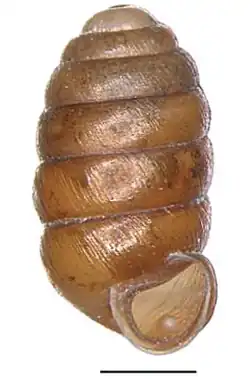
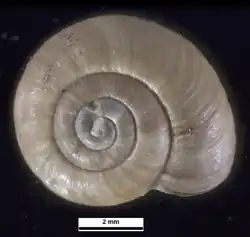
Drawing of an apertural view of Acmella nana... that Acmella nana(shell pictured) is the smallest known land snail?
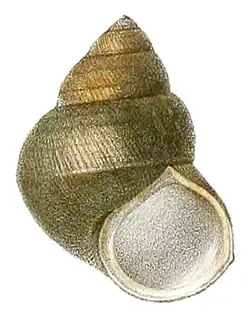
Drawing of an apertural view of Semisulcospira libertina... that Semisulcospira libertina(shell pictured) is the most common freshwater snail in Japan?
Drawing of two Carinaria cristata, the upper one without the shell... that the fragile shell of the glassy nautilus Carinaria cristata(pictured) was at one time considered to be worth more than its weight in gold?
Photo of dorsal view of Spurilla neapolitana... that Spurilla neapolitana(pictured) defends itself with stinging cells derived from the sea anemones it eats?
Photo of an apertural view of Pupilla pratensis... that Pupilla pratensis(shell pictured) has long been neglected in the malacological literature?
Map of Lake Skadar... that there are 12 endemic species of freshwater snails in Lake Skadar(map pictured)?
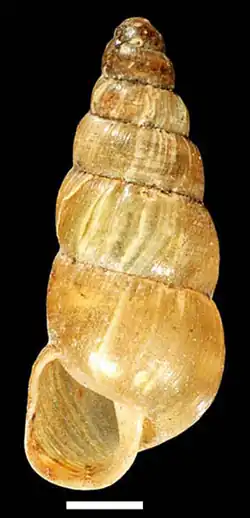
Photo of an apertural view of Balea sarsii ... that the land snail Balea sarsii(shell pictured) has been overlooked for a long time?
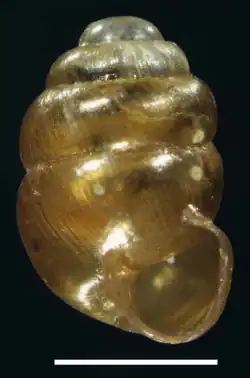
Photo of an apertural view of Vertigo ultimathule ... that the land snail Vertigo ultimathule(shell pictured) is endemic to the northernmost part of Scandinavia?
Drawing of an apertural view of Hinea brasiliana ... that flashes of light emitted by the sea snail Hinea brasiliana(shell pictured) may act as a "burglar alarm"?
Photo of an apertural view of Halystina umberlee ... that the sea snail Halystina umberlee(pictured) was named after Umberlee, a fictional evil goddess from the Forgotten Realms role-playing game?
... that Candidula arganica, a snail found in the north of the Iberian Peninsula, lives primarily in meadows?
... that Candidula spadae, a snail native to Central Italy, is at risk in part because of tourist activities?
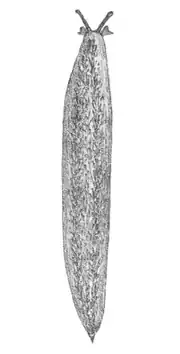
Drawing of dorsal view of Rathouisia leonina ... that the land slug Rathouisia leonina(pictured) from China is carnivorous?
a shell of Hauffenia sp. from Slovakia... that the subterranean freshwater snail Hauffenia sp. from Slovakia(shell pictured) has been an undescribed species since the 1980s?
a live Oxychilus camelinus... that the land snail Oxychilus camelinus(pictured) was described from Lebanon?
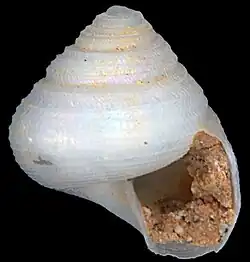
shell of holotype of Abbottella calliotropis... that land snails of the genus Abbottella (Abbottella calliotropis shell pictured) live on the islands of Hispaniola and Cuba?
a live Tonna galea out of water... that the snail Tonna galea(pictured) is one of very few species of prosobranch gastropods that are luminescent?
shell of holotype of Notodiscus hookeri heardensis... that the land snail Notodiscus hookeri (shell pictured) has unique shell structure among all gastropods?
a live Zospeum tholussum... that the microscopic cave snail Zospeum tholussum (pictured) is so slow that in a week's time it may only move a few millimeters or centimeters in circles?
live Omalonyx convexus... that the land snail Omalonyx convexus(pictured) can also be found submerged among macrophytes?
... that the malacologist S. Peter Dance said the shell of Pterynotus loebbeckei, (pictured), was the "most exquisite natural object" he had ever seen?
... that marine biologist Frederick Bayer discovered 170 new species, including a number of sea snails?
shell of Faunus ater... that the only brackish-water pachychilid species, Faunus ater(shell pictured), has a shell that is unique among all the Cerithioidea?
a live Cecina manchurica... that the pomatiopsid Cecina(Cecina manchurica pictured) lives among decaying seaweeds?
In the news
Portal:Gastropods/News
Selected image
Lambis crocata, the orange spider conch, is a species of large tropical sea snail, a marinegastropodmollusk in the familyStrombidae, the true conchs. This is an Indo-Pacific species which lives in shallow water and is frequently found in coral reef areas. The image shows two views of a shell of this species with the anterior end towards the top of the image. The scale bar is 1 cm long.
Like other species within the genus Lambis, the shell of this species has an extended siphonal canal and finger-like processes that protrude from the edge of the shell aperture, which is a bright orange in color. The shell of this species is in demand as a decorative object, and thus is part of the international shell trade.
WikiProject Gastropods
WikiProject Marine life
WikiProject Bivalves
WikiProject Cephalopods
WikiProject Fisheries and Fishing
Wikipedia:WikiProject Gemology and Jewelry
Wikipedia:WikiProject Food and drink
(Complete list of WikiProjects)
Request to editors: please do not create any more categories of gastropods by country. Instead create list articles, article with a list of the marine or non-marine gastropods of whichever country or area you are interested in. We would also like to empty and delete the two remaining country categories we have, adding that information to list articles instead. Thank you.
Things to do
Here are some tasks awaiting attention:
Article requests: Turn any existing red links into blue links at: