| This Wikipedia page has been superseded by Portal:Fashion and is retained primarily for historical reference. |
 | Note: Article entries are now being transcluded directly on the main portal page. However, this page should be retained for historical reference. |
Selected article 1
Portal:Fashion/Selected article/1
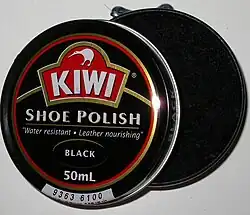
Shoe polish (or
boot polish), is a waxy
paste,
cream, or liquid used to polish,
shine,
waterproof, and restore the appearance of
leather shoes or
boots, thereby extending the
footwear's life. Various substances have been used as shoe polish for hundreds of years, starting with natural substances such as
wax and
tallow. Modern polish formulas were introduced early in the 20th century and many of those original formulations are still in use today. Today, shoe polish is usually made from a mix of natural and
synthetic materials, including
naphtha,
turpentine,
dyes, and
gum arabic, using straightforward
chemical engineering processes. Shoe polish is usually
flammable, can be
toxic, and, if misused, can stain skin. It should be used in a well-ventilated area with care taken to protect clothes, carpet and furniture. The popularity of shoe polish paralleled a general rise in leather and synthetic shoe production, beginning in the 19th century and continuing into the 20th. The World Wars saw a surge in demand for the product, in order to polish army boots. The first shoe polish to resemble the modern varieties (aimed primarily at inducing shine) was
Kiwi. Scottish
expatriates William Ramsay and Hamilton McKellan began making "boot polish" in a small factory in 1904 in
Melbourne,
Australia.
Selected article 2
Portal:Fashion/Selected article/2
The Wonderbra is a type of push-up underwire brassiere that gained worldwide prominence in the 1990s. Although the Wonderbra name was first trademarked in the U.S. in 1935, the brand was developed in Canada. Moses (Moe) Nadler, founder and majority owner of the Canadian Lady Corset Company, licensed the trademark for the Canadian market in 1939. By the 1960s the Canadian Lady brand had become known in Canada as "Wonderbra, the company." In 1961 the company introduced the Model 1300 plunge push-up bra. This bra became one of the best-selling Canadian styles and is virtually identical to today's Wonderbra. In 1968, Canadian Lady changed its name to Canadian Lady-Canadelle Inc., was sold to Consolidated Foods (now Sara Lee Corporation), and later became Canadelle Inc. During the 1970s Wonderbra was repositioned as the company's fashionable and sexy brand, and became the Canadian market leader. In 1991, the push-up Wonderbra became a sensation in the UK, although it had been sold there since 1964 under license by the Gossard division of Courtaulds Textiles. Sara Lee Corporation did not renew Gossard's license and redesigned the push-up style for the reintroduction of the Wonderbra to the U.S. market in 1994.
Selected article 3
Portal:Fashion/Selected article/3
The
ao dai (
Vietnamese:
áo dài) is a
Vietnamese national costume, now most commonly worn by women. In its current form, it is a tight-fitting
silk tunic worn over
pantaloons. The word is pronounced
[ʔǎːw zâːj] in the North and
[ʔǎːw jâːj] in the South.
Áo classifies the item as a piece of clothing. The word "ao dai" was originally applied to the outfit worn at the court of the
Nguyễn Lords at
Huế in the 18th century. This outfit evolved into the
áo ngũ thân, a five-paneled
aristocratic gown worn in the 19th and early 20th centuries. Inspired by Paris fashions, Nguyễn Cát Tường and other artists associated with
Hanoi University redesigned the
ngũ thân as a modern dress in the 1920s and 1930s. The updated look was promoted by the artists and magazines of
Tự Lực văn đoàn (Self-Reliant Literary Group) as a national costume for the modern era. In the 1950s,
Saigon designers tightened the fit to produce the version worn by Vietnamese women today. The dress was extremely popular in
South Vietnam in the 1960s and early 1970s. On
Tết and other occasions, Vietnamese men may wear an
áo gấm (
brocade robe), a version of the ao dai made of thicker fabric. Academic commentary on the ao dai emphasizes the way the dress ties feminine beauty to Vietnamese nationalism, especially in the form of "Miss Ao Dai" pageants, popular both among
overseas Vietnamese and in Vietnam itself. "Ao dai" is one of the few Vietnamese words that appear in English-language dictionaries.
Selected article 4
Portal:Fashion/Selected article/4
An
"Anthony Eden" hat, or simply an
"Anthony Eden", was a silk-brimmed, black felt
Homburg of the kind favoured in the 1930s by
Anthony Eden, later 1st Earl of Avon (1897–1977). Eden was a Cabinet Minister in the British
National Government, holding the offices of Lord Privy Seal from 1934–1935 and Foreign Secretary 1935 to 1938. He was later Dominions Secretary from 1939–1940, War Secretary in 1940, Foreign Secretary from 1940–1945 and 1951–1955, and Prime Minister 1955 to 1957. The "Anthony Eden" (rarely the "Eden", except in London's
Savile Row) was not marketed as such and the name was purely informal, but the use of the term was widespread, entering dictionaries and phrase books: for example, it was still listed in the 17th edition of
Brewer in 2005 and as recently as 2010 the fashion "guru"
Trinny Woodall cited the hat as an example of Eden's reputation for being well dressed. It came into particular vogue among civil servants and diplomats in
Whitehall and, to that extent, rather belied the stereotypical view, that lasted until well after the
Second World War, of civil servants as a "
bowler hat" brigade.
Selected article 5
Portal:Fashion/Selected article/5
Body piercing, a form of
body modification, is the practice of puncturing or cutting a part of the human body, creating an opening in which jewellery may be worn. The word piercing can refer to the act or practice of body piercing, or to an opening in the body created by this act or practice. Although the history of body piercing is obscured by popular misinformation and by a lack of scholarly reference, ample evidence exists to document that it has been practiced in various forms by both sexes since ancient times throughout the world.
Ear piercing and
nose piercing have been particularly widespread and are well represented in historical records and among
grave goods. The oldest
mummified remains ever discovered were sporting
earrings, attesting to the existence of the practice more than 5,000 years ago. Nose piercing is documented as far back as 1500 BC. Piercings of these types have been documented globally, while
lip and
tongue piercings were historically found in African and American tribal cultures.
Nipple and
genital piercing have also been practiced by various cultures, with nipple piercing dating back at least to
Ancient Rome while genital piercing is described in
Ancient India c. 320 to 550 CE. The history of
navel piercing is less clear. The practice of body piercing has waxed and waned in
Western culture, but it has experienced an increase of popularity since
World War II, with sites other than the ears gaining subcultural popularity in the 1970s and spreading to mainstream in the 1990s.
Selected article 6
Portal:Fashion/Selected article/6
A
brassiere ( or ), commonly referred to as a
bra , is a woman's
undergarment that supports her
breasts. Bras are typically
form-fitting and perform a variety of functions and have also evolved into a fashion item. The primary purpose of a bra is to support the woman's breasts. In
western cultures, about 10–25% of women do not wear a bra, either as a matter of preference or sometimes for health or comfort reasons. Some garments, such as
camisoles,
tank tops and
backless dresses, have built-in breast support, alleviating the need to wear a separate bra. Changing social trends and novel materials have increased the variety of available designs, and allowed manufacturers to make bras that in some instances are more fashionable than functional. Bras are a complex garment made of many parts, and manufacturers' standards and sizes vary widely worldwide, making it difficult for women to find a bra that fits them correctly. Even methods of bra-measurement vary, such that even professional fitters can disagree on the correct size for the same woman. As a result, 75–85% of women wear a bra of an incorrect size. The bra has become a feminine icon or symbol with cultural significance beyond its primary function of supporting breasts. Some feminists consider the brassiere a symbol of the repression of women's bodies.
Selected article 7
Portal:Fashion/Selected article/7
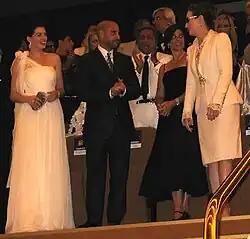
The Devil Wears Prada is a 2006
comedy-drama film, a loose
screen adaptation of
Lauren Weisberger's 2003
novel of the same name. It stars
Anne Hathaway as Andrea Sachs, a college graduate who goes to New York City and gets a job as a co-assistant to powerful
fashion magazine editor Miranda Priestly, played by
Meryl Streep.
Emily Blunt and
Stanley Tucci co-star, as co-assistant Emily Charlton, and Art Director Nigel, respectively.
Adrian Grenier,
Simon Baker and
Tracie Thoms play key supporting roles.
Wendy Finerman produced and
David Frankel directed the film, and was distributed by
20th Century Fox. Streep's performance drew critical acclaim and earned her many award nominations. Blunt also drew favorable reviews and nominations for her performance, as did many of those involved in the film's production. Although the movie is set in the fashion world, most
designers and other fashion notables avoided appearing as themselves for fear of displeasing U.S.
Vogue editor
Anna Wintour, who is widely believed to have been the inspiration for Priestly. Many designers allowed their clothes and
accessories to be used in the film, making it the most expensively costumed film in history. Wintour later overcame her initial skepticism, saying she liked the film and Streep in particular.
Selected article 8
Portal:Fashion/Selected article/8
In
hip hop culture, a
grill (also
front or
golds) is a type of
jewelry worn over the
teeth. Grills are made of metal and are generally removable. They began to be worn by
hip hop artists in the early 1980s, and upgraded during the 90s in New York City, but they became more widely popular during the mid-2000s due to the rise of
Dirty South rap and the more mainstream pop culture status Hip Hop attained. Though grills are fitted to the
tooth impression of the wearer, whether they are safe for long-term wear is unknown. Grills are made of several types of metal (often
silver,
gold or
platinum) that is sometimes inlaid with
precious stones; they are generally removable, though some may be permanently attached to the teeth. Grills can cost anywhere from one hundred dollars to thousands of dollars, depending on the materials used and the number of teeth covered. Grills were most often worn by 18- to 35-year-old African American male hip-hop listeners. They were recently reintroduced into the mainstream and onto network TV by olympic swimmer
Ryan Lochte. During the 2012 summer olympics he posed with a grill that sported stones in the design of an American flag, having previously worn diamond grills after earlier competitions.
Selected article 9
Portal:Fashion/Selected article/9
The
history of the bikini is a checkered one. Though the
bikini shocked when it appeared on French beaches in 1947, its origins date back millennia. Depictions of bikini-like garments appear at the
Chalcolithic site of
Çatalhöyük, and two-piece bikini-like garments were worn by women for athletic purposes in
Ancient Greece as far back as 1400 BC.
Roman mosaic artwork in
Sicily, dubbed "Bikini Girls" and dating back to the reign of
Diocletian (286-305 AD) gained significant archeological renown, and Roman statues of
Venus in a bikini were found elsewhere. In the modern era, the first functional two-piece swimsuit was designed in 1913 by
Carl Jantzen. Australian swimmer-performer
Annette Kellermann was arrested in 1907 for wearing a two-piece. Later it was made popular by
pin-up girls like swimmer-actress
Esther Williams, and actresses
Ava Gardner,
Rita Hayworth, and
Lana Turner. The modern bikini was invented by
French engineer
Louis Réard in 1946. He named it after
Bikini Atoll in the Pacific, the site of an
atomic bomb test on July 1, 1946. Réard hoped that the burst of excitement it caused would be as explosive as an atomic bomb.
Selected article 10
Portal:Fashion/Selected article/10
L.A.M.B. is a fashion line by
American singer Gwen Stefani, the
lead vocalist of the
rock band
No Doubt. The line manufactures
apparel and
fashion accessories. The line was founded in 2003 but made its runway debut the following year in 2004. The fashion line manufactures accessories like shoes, watches, bags and a
fragrance called "L" as well. The name is an
acronym of her debut solo album
Love. Angel. Music. Baby. The line is influenced by a variety of fashions cultures, including
Guatemalan,
Japanese,
Indian and
Jamaican styles. Stefani came from a line of
seamstresses. This further inspired her to launch her own fashion line. The line achieved popularity among celebrities and is worn by stars such as
Teri Hatcher,
Nicole Kidman,
Paris Hilton and Stefani herself. The fashion line made a runway debut in the spring collection of 2004, and achieved mainstream success at
New York Fashion Week in 2005 and currently makes an annual gross income of $90 million. The line, as well as the fashion shows were well received by critics and appreciated the indulgence of a celebrity into the fashion world. An additional fashion line was also launched by Stefani called
Harajuku Lovers.