Portal:Children's literature/Selected biography/1
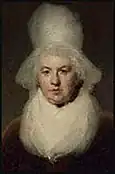
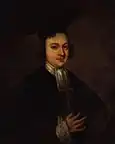
Sarah Trimmer (
née Kirby) (6 January 1741
– 15 December 1810) was a noted writer and critic of British
children's literature in the
18th century. Her periodical,
The Guardian of Education, helped to define the emerging genre by seriously reviewing children's literature for the first time; it also provided the first history of children's literature, establishing a canon of the early landmarks of the genre that scholars still use today. Trimmer's most popular children's book,
Fabulous Histories, inspired numerous children's animal stories and remained in print for over a century. Trimmer was an active philanthropist as well as author; she founded several
Sunday schools and
charity schools in her parish. To further these educational projects, she not only wrote textbooks but she also penned manuals for other women interested in starting their own schools. Trimmer's efforts inspired other women, such as
Hannah More, to establish Sunday school programs and to write for children and the poor. Trimmer was in many ways dedicated to maintaining the social and political status quo in her works. As a
high church Anglican, she was intent on promoting the Established Church of Britain and on teaching young children and the poor the doctrines of
Christianity. Her writings outlined the benefits of social hierarchies, arguing that each class should remain in its God-given position. Yet, while supporting many of the traditional political and social ideologies of her time, Trimmer questioned others, such as those surrounding gender and the family.
Portal:Children's literature/Selected biography/2
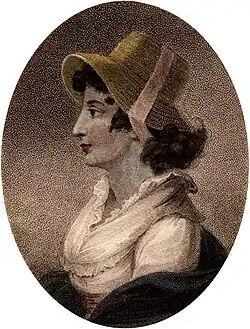
Anna Laetitia Barbauld (, by herself possibly
/bɑrˈboʊ/, as in French) (
née Aikin) (20 June 1743 – 9 March 1825) was a prominent 18th-century
English poet, essayist, and
children's author. A "woman of letters" who published in multiple genres, Barbauld had a successful writing career at a time when female professional writers were rare. She was a noted teacher at the celebrated Palgrave Academy and an innovative children's writer; her famous primers provided a model for pedagogy for more than a century. Her essays demonstrated that it was possible for a woman to be publicly engaged in politics, and other women authors emulated her. Even more importantly, her poetry was foundational to the development of
Romanticism in England. Barbauld was also a literary critic, and her anthology of 18th-century British
novels helped establish the canon as we know it today. Barbauld's literary career ended abruptly in 1812 with the publication of her poem
Eighteen Hundred and Eleven, which criticized Britain's participation in the
Napoleonic Wars. The vicious reviews shocked Barbauld and she published nothing else within her lifetime. Her reputation was further damaged when many of the Romantic poets she had inspired in the heyday of the
French Revolution turned against her in their later, more conservative, years. Barbauld was remembered only as a pedantic children's writer during the 19th century, and largely forgotten during the 20th century, but the rise of
feminist literary criticism in the 1980s renewed interest in her works and restored her place in literary history.
Portal:Children's literature/Selected biography/3
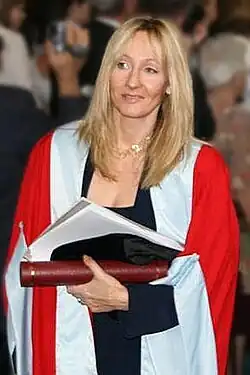
J. K. Rowling is a
British writer and author of the
Harry Potter fantasy series. The
Potter books have gained worldwide attention, won multiple awards, and sold nearly 400 million copies. The 2007
Sunday Times Rich List estimated Rowling's fortune at £545 million, ranking her as the 136th richest person and the 13th richest woman in Britain.
Forbes has named Rowling the second-richest female entertainer in the world, and ranked her as the 48th most powerful celebrity of 2007.
Time named Rowling as a runner-up for their 2007
Person of the Year, noting the social, moral, and
political inspiration she has given
her fandom. She has become a notable
philanthropist, supporting such charities as
Comic Relief, the
Multiple Sclerosis Society of Great Britain and
One Parent Families.
Harry Potter is now a global brand worth an estimated $15 billion (£7 billion), and the last four
Harry Potter books have consecutively set records as the fastest-selling books in history. The series, totalling 4,195 pages, has been translated, in whole or in part, into 65 languages.
Portal:Children's literature/Selected biography/4
Mary Martha Sherwood was a prolific and influential writer of
children's literature in 19th-century Britain. She composed over 400 books,
tracts, magazine articles, and
chapbooks; among the most famous are
The History of Little Henry and his Bearer (1814),
The History of Henry Milner (1822–37), and
The History of the Fairchild Family (1818–47). Many of Sherwood's books were bestsellers and she has been described as "one of the most significant authors of children's literature of the nineteenth century." Her depictions of domesticity and Britain's relationship with India likely shaped the opinions of many young British readers. However, her works fell from favor as a different style of children's literature came into fashion during the late 19th century, one exemplified by
Lewis Carroll's playful and nonsensical
Alice in Wonderland.
Portal:Children's literature/Selected biography/5
J. R. R. Tolkien was an
English writer,
poet,
philologist, and university professor, best known as the author of the classic
high fantasy works
The Hobbit,
The Lord of the Rings and
The Silmarillion. He was
Rawlinson and Bosworth Professor of
Anglo-Saxon at
Oxford from 1925 to 1945, and
Merton Professor of
English Language and Literature from 1945 to 1959. He was a close friend of
C. S. Lewis—they were both members of the informal literary discussion group known as the
Inklings. While many other authors had published works of fantasy before Tolkien, the great success of
The Hobbit and
The Lord of the Rings when they were published in paperback in the United States led directly to a popular resurgence of the genre. This has caused Tolkien to be popularly identified as the "father" of modern fantasy literature.
Portal:Children's literature/Selected biography/6
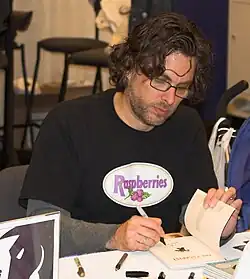
Michael Chabon is a 20th-century American author and "one of the most celebrated writers of his generation," according to the
The Virginia Quarterly Review. His first novel,
The Mysteries of Pittsburgh (1988), was published when Chabon was 25 and catapulted him to literary celebrity. He followed it with a second novel,
Wonder Boys (1995), and two short-story collections. In 2000, Chabon published
The Amazing Adventures of Kavalier & Clay, a critically acclaimed novel that
The New York Review of Books called his
magnum opus; it received the
Pulitzer Prize for Fiction in
2001. His most recent novel,
The Yiddish Policemen's Union, an
alternate history mystery novel, was published in 2007 to enthusiastic reviews and won the
Hugo,
Sidewise, and
Nebula awards. His work is characterized by complex language, frequent use of
metaphor, and an extensive vocabulary, along with numerous recurring themes, including
nostalgia, divorce, abandonment, fatherhood, and issues of
Jewish identity. He often includes
gay,
bisexual, and
Jewish characters in his work. Since the late 1990s, Chabon has written in an increasingly diverse series of styles for varied outlets; he is a notable defender of the merits of
genre fiction and
plot-driven fiction, and, along with novels, he has published screenplays, children's books, comics, and newspaper
serials.
Portal:Children's literature/Selected biography/7
PJ Haarsma is a
Canadian born
science fiction author best known for his creation of the
Rings of Orbis universe, which encompasses
The Softwire series of books. Haarsma created a free, online
role-playing game, also called the
Rings of Orbis, set in the same universe. Both the book-series and the game target young, often reluctant readers in an attempt to encourage them by rewarding them for reading. Haarsma also developed a school presentation program in which he discusses
The Softwire books,
astronomy, and other
science fiction and
science fact topics. He is also one of the co-founders of The Kids Need to Read Foundation, a United States Internal Revenue Code
501(c)(3) tax exempt public charity that purchases books to donate to underfunded schools and libraries.
Portal:Children's literature/Selected biography/8
Georges Prosper Remi, better known by the
pen name Hergé, was a Belgian
comics writer and
artist. His best known and most substantial work is
The Adventures of Tintin, which he wrote and illustrated from 1929 until his death in 1983. His work remains a strong influence on comics, particularly in Europe. He was inducted into the
Comic Book Hall of Fame in 2003. The notable qualities of the
Tintin stories include their vivid humanism, a realistic feel produced by meticulous and wide ranging research, and Hergé's
ligne claire drawing style. Adult readers enjoy the many satirical references to the history and politics of the 20th century.
The Blue Lotus, for example, was inspired by the
Mukden incident that led to the Chinese-Japanese War of 1934.
King Ottokar's Sceptre can be read against the background of
Hitler's
Anschluss; whilst later albums such as
The Calculus Affair depict the
Cold War. Hergé has become one of the most famous Belgians worldwide and
Tintin is still an international success. Hergé's work was heavily influenced by his involvement since his youth with
Scouting.
Portal:Children's literature/Selected biography/9
Terry Pratchett is an English
novelist, known for his frequently comical work in the
fantasy genre. He is best known for his popular and long-running
Discworld series of comic fantasy novels. Pratchett's first novel,
The Carpet People, was published in 1971, and since his first
Discworld novel
(The Colour of Magic) was published in 1983, he has written two books a year on average. Pratchett is also known for close collaboration on adaptations of his books. Pratchett was the UK's best-selling author of the 1990s, and as of December 2007 has sold more than 55 million books worldwide, with translations made into 36 languages. He is currently the second most-read writer in the UK, and seventh most-read non-US author in the US. In 2001 he won the
Carnegie Medal for his children's novel
The Amazing Maurice and his Educated Rodents.
Portal:Children's literature/Selected biography/10
J. D. Salinger was a 20th-century American author, best known for his 1951
novel The Catcher in the Rye (pictured), as well as his
reclusive nature. He has not published an original work since 1965 and has not been interviewed since 1980. Raised in the Bronx, Salinger began writing short stories while in secondary school, and published several stories in the early 1940s before serving in
World War II. In 1948 he published the critically-acclaimed story "
A Perfect Day for Bananafish" in
The New Yorker magazine, which became home to much of his subsequent work. In 1951 Salinger released his novel,
The Catcher in the Rye, an immediate popular success. His depiction of
adolescent alienation and loss of innocence in the
protagonist Holden Caulfield was influential, especially among
adolescent readers. The novel remains widely read, selling around 250,000 copies a year. The success of
The Catcher in the Rye led to public attention and scrutiny: Salinger became reclusive, publishing new work less frequently. He followed
Catcher with a short story collection,
Nine Stories (1953), a collection of a
novella and a short story,
Franny and Zooey (1961), and a collection of two novellas,
Raise High the Roof Beam, Carpenters and Seymour: An Introduction (1963). His last published work, a novella entitled "
Hapworth 16, 1924," appeared in
The New Yorker on June 19, 1965. Afterwards, Salinger struggled with unwanted attention, including a legal battle in the 1980s with biographer
Ian Hamilton and the release in the late 1990s of memoirs written by two people close to him:
Joyce Maynard, an ex-lover; and
Margaret Salinger, his daughter. In 1996, a small publisher announced a deal with Salinger to publish "Hapworth 16, 1924" in book form, but amid the ensuing publicity, the release was indefinitely delayed.
Portal:Children's literature/Selected biography/11
Christopher Smart (11 April 1722 – 21 May 1771) was an
English poet. He was a major contributor to two popular magazines and a friend to influential cultural icons like
Samuel Johnson and
Henry Fielding. Smart, a
high church Anglican, was widely known throughout London. Smart was infamous for his role as "Mrs. Mary Midnight" and widespread accounts of his father-in-law,
John Newbery, locking him away in a
mental asylum for many years over Smart's supposed religious "mania". Even after Smart's eventual release, a negative reputation continued to pursue him as he was known for incurring more debt than he could pay off; this ultimately led to his confinement in debtor's prison until his death. Smart's two most widely-known works are
A Song to David and
Jubilate Agno, both at least partly written during his confinement in asylum. However,
Jubilate Agno was not to be published until 1939 and
A Song to David received mixed reviews until the 19th century. To his contemporaries, Smart was known mainly for his many contributions in the journals
The Midwife and
The Student, along with his famous
Seaton Prize poems and his mock epic
The Hilliad. Although he is primarily recognized as a religious poet, his poetry includes various other themes, such as his theories on nature and his promotion of English nationalism. Some of his most famous religious poetry is
Hymns for the Amusement of Children, one of the first books of hymns expressly written for a juvenile audience.
Portal:Children's literature/Selected biography/12
Oscar Fingal O'Flahertie Wills Wilde (16 October 1854 – 30 November 1900) was an
Irish playwright,
poet and
author of numerous
short stories and one
novel. Known for his biting wit, he became one of the most successful playwrights of the late
Victorian era in London, and one of the greatest
celebrities of his day. Several of his plays continue to be widely performed, especially
The Importance of Being Earnest. As the result of a widely covered series of trials, Wilde suffered a dramatic downfall and was imprisoned for two years
hard labour after being convicted of "gross indecency" with other men. After Wilde was released from prison he set sail for
Dieppe by the night ferry. He never returned to Ireland or Britain. Wilde wrote almost all of his major and minor works in the last decade of his life, including his fairy tales and short stories for children. He published three volumes of these,
The Happy Prince and Other Tales,
Lord Arthur Savile’s Crime and Other Stories and
A House of Pomegranates.
Portal:Children's literature/Selected biography/13
Edmund Evans (1826–1905) was a prominent English
wood engraver and colour
printer during the
Victorian era. Evans specialized in full-colour printing, which became popular in the mid-19th century. He employed and collaborated with illustrators such as
Walter Crane,
Randolph Caldecott,
Kate Greenaway, and
Richard Doyle to produce what are now considered to be classic
children's books. Although little is known about his life, he wrote a short autobiography before his death in 1905 in which he described his life as a printer in
Victorian London. After finishing an apprenticeship, Evans went into business for himself. By the early 1850s, he had made a reputation as a printer of covers for cheap novels known as
yellow-backs. In the early 1860s, Evans began to print children's
toy books and
picture books in association with the printing house
Routledge and Warne. His intention was to produce books for children that were beautiful and inexpensive. For three decades he produced multiple volumes each year, first illustrated by Crane, and later by Caldecott and Greenaway.
Portal:Children's literature/Selected biography/14
Portal:Children's literature/Selected biography/14
Portal:Children's literature/Selected biography/15
Portal:Children's literature/Selected biography/15