Usage
The template used to configure these sub-pages is
{{Portal:Biography/Selected biography military/Layout
  |image=
  |size=x120px
  |caption=
  |text=
  |link=
}}
<noinclude>[[Category:Biography portal|M]]</noinclude>
- Add a new selected military article to the next available sub-page. It must be an FA class article.
- Update "max=" to new total for its {{Random portal component}} on the main page.
Portal:Biography/Selected biography military/1
Joaquim José Inácio, Viscount of Inhaúma (1 August 1808
– 8 March 1869) was a naval officer, politician, and monarchist of the
Empire of Brazil. Inhaúma enlisted in the
armada of Brazil following the
Brazilian independence in 1822. Throughout the chaos that characterized the years when Emperor
Dom Pedro II was a minor, Inhaúma remained loyal to the government, suppressing rebellions that erupted during that troubled period. He saw action in the
Sabinada between 1837 and 1838, followed by the
Ragamuffin War from 1840 until 1844. In 1849 Inhaúma was given command of the fleet that was instrumental in subduing the
Praieira revolt, the last rebellion in imperial Brazil.
During the 1850s, Inhaúma held a series of bureaucratic positions. He entered politics in 1861 as a member of the Conservative Party. He became a cabinet member and was given the position of navy minister. Although historical works have not given much coverage to Inhaúma, some historians regard him among the greatest of the Brazilian navy officers.
Portal:Biography/Selected biography military/2
Oberst Helmut Lent (13 June 1918
– 7 October 1944) was a German
night-fighter ace in
World War II. Lent shot down 110
aircraft, 102 of them at night. Lent claimed his first aerial victories at the outset of World War
II in the
invasion of Poland and over the
German Bight. During the
invasion of Norway he flew ground support missions before he was transferred to the newly established
Nachtjagdgeschwader 1 (NJG
1), a night fighter wing. Lent claimed his first nocturnal aerial victory on 12 May 1941 and on 30 August 1941 was awarded the
Knight's Cross of the Iron Cross. His steady accumulation of aerial victories resulted in regular promotions and awards. On the night of 15 June 1944,
Major Lent was the first night fighter pilot to claim 100 nocturnal aerial victories, a feat which earned him the
Knight's Cross of the Iron Cross with Oak Leaves, Swords and Diamonds on 31 July 1944. On 7 October 1944, Lent died from injuries sustained in a crash during a routine transit flight two days earlier.
Portal:Biography/Selected biography military/3
Myles Standish (
c. 1584 – October 3, 1656) was an English military officer hired by the
Pilgrims as military advisor for
Plymouth Colony. One of the
Mayflower passengers, and a signatory of the
Mayflower Compact, Standish played a leading role in the administration and defense of Plymouth Colony from its inception. Standish served as an agent of Plymouth Colony in
England, as assistant governor, and as treasurer of Plymouth Colony. He was also one of the first settlers and founders of the town of
Duxbury, Massachusetts. In 1621 the Plymouth Colony militia elected him as its first commander and continued to re-elect him to that position for the remainder of his life. A defining characteristic of Standish's military leadership was his proclivity for preemptive action which resulted in at least two attacks on different groups of Native Americans; the Nemasket raid and the
Wessagusset massacre. During these actions, Standish exhibited considerable courage and skill as a soldier, but also demonstrated a brutality that angered Native Americans and disturbed more moderate members of the Colony.
Portal:Biography/Selected biography military/4
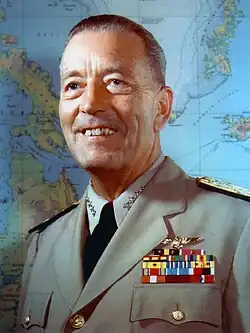
Arthur William Radford (27 February 1896
– 17 August 1973) was a
United States Navy admiral and
naval aviator. In over 40 years of military service, Radford held a variety of posts including
Vice Chief of Naval Operations,
commander of the
United States Pacific Fleet and later the second
Chairman of the Joint Chiefs of Staff. Noted as a strong-willed and aggressive leader, Radford was a central figure in the post-war debates on U.S. military policy, and was a staunch proponent of naval aviation. As commander of the Pacific Fleet, he defended the Navy's interests in an era of shrinking defense budgets, and was a central figure in the "
Revolt of the Admirals," a contentious public fight over policy. As Chairman of the Joint Chiefs, he continued to advocate for aggressive foreign policy and a strong
nuclear deterrent in support of the
"New Look" policy of President
Dwight Eisenhower. Retiring from the military in 1957, Radford continued to be a military adviser to several prominent politicians until his death in 1973. The
Spruance-class destroyer USS Arthur W. Radford was named in his honor.
Portal:Biography/Selected biography military/5
Isaac Shelby (December 11, 1750
– July 18, 1826) was a soldier, the
first and fifth Governor of the
U.S. state of
Kentucky, and served in the state legislatures of
Virginia and
North Carolina. Shelby's military service began at the
Battle of Point Pleasant, the only major battle of
Lord Dunmore's War. Following the war, Shelby relocated to Kentucky on lands awarded to him for his military service and became involved in Kentucky's transition from a county of Virginia to an independent
state. His heroism made him popular with the citizens of the state. The state electoral college unanimously elected him governor in 1792, where he served a four year term. Prior to the
War of 1812, Kentuckians urged Shelby to run for governor again to lead them through the anticipated conflict. At the request of General
William Henry Harrison, Shelby commanded troops from Kentucky at the
Battle of the Thames, for which he was awarded a
Congressional Gold Medal. At the conclusion of the war, he declined President
James Monroe's offer to become
Secretary of War.
Portal:Biography/Selected biography military/6
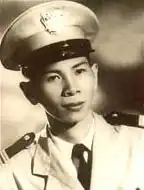
Lê Quang Vinh (
c. 1923 – 13 July 1956), popularly known as Ba Cụt (referring to the finger he himself had partially severed as part of a vow to defeat the French colonial forces), was a military commander of the
Hòa Hảo religious sect, which operated from the
Mekong Delta and controlled various parts of southern
Vietnam during the 1940s and early 1950s. Ba Cụt and his forces fought the
Vietnamese National Army (VNA), the
Việt Minh, and the
Cao Đài religious movement from 1943 until his capture in 1956. Known for his idiosyncrasies, he was regarded as an erratic and cruel leader who fought with little ideological purpose. Ba Cụt frequently made alliances with various Vietnamese factions and the French. He invariably accepted the material support offered in return for his cooperation, and then broke the agreement—nevertheless, the French made deals with him on five occasions. In mid-1955, as Prime Minister
Ngô Đình Diệm of the
State of Vietnam began to consolidate his grip on the south, Ba Cụt was captured, sentenced to death, and publicly beheaded in
Cần Thơ.
Portal:Biography/Selected biography military/7
Louis Alexander Mountbatten, 1st Marquess of Milford Haven,
GCB GCVO KCMG PC (24 May 1854
– 11 September 1921), formerly Prince Louis Alexander of Battenberg, was a British
naval officer and German prince related to members of the
British Royal Family. He enrolled in the
United Kingdom's Royal Navy at the age of fourteen, and although
Queen Victoria and her son
King Edward VII occasionally intervened in his career, Louis welcomed battle assignments that provided opportunities for him to acquire the skills of war and to demonstrate to his superiors that he was serious about his naval career. After a naval career lasting more than forty years, in 1912 he was appointed
First Sea Lord, the professional head of the British naval service. With World War I looming, he took steps to ready the British fleet for combat, but his background as a German prince forced his retirement once the war began, when
anti-German sentiment was running high. His son,
Louis Mountbatten, served as First Sea Lord from 1954 to 1959, and his grandson,
Prince Philip, is the husband of
Queen Elizabeth II.
Portal:Biography/Selected biography military/8
Roderic Stanley (Stan) Dallas,
DSO,
DSC & Bar (30
July 1891 – 1
June 1918), was an
Australian fighter ace of World War
I. His score of aerial victories is generally regarded as the second-highest by an Australian, after
Robert Little; however there is considerable dispute over Dallas's exact total. While his official score is commonly given as 39, claim-by-claim analyses list as few as 32, and other research credits him with over 50, compared to Little's official tally of 47. Like Little, Dallas flew with British units, rather than the
Australian Flying Corps. Initially seeing action with No.
1 Naval Wing on the
Western Front in
Caudrons and
Nieuport 11s, he was chosen to test one of the earliest
Sopwith Triplanes. This became his favourite type, and he achieved many victories with it through 1916–17, earning the
Distinguished Service Order, and the
Distinguished Service Cross and
Bar. As the commanding officer of
No. 1 Squadron RNAS and later
No. 40 Squadron, he achieved further victories before being killed in action on 1
June 1918.
Portal:Biography/Selected biography military/9
Charles Eaton,
OBE,
AFC (21
December 1895
– 12
November 1979) was a senior officer and aviator in the
Royal Australian Air Force (RAAF), who later served as a diplomat. Born in
London, he joined the
British Army upon the outbreak of World War
I and saw action on the
Western Front before transferring to the
Royal Flying Corps in 1917. Posted as a bomber pilot to
No. 206 Squadron, he was twice captured by German forces, and twice escaped. In 1925 he joined the RAAF, serving initially as an
instructor at
No. 1 Flying Training School. Between 1929 and 1931, he was chosen to lead three expeditions to search for lost aircraft in
Central Australia, gaining national attention and earning the
Air Force Cross for his "zeal and devotion to duty". Appointed an
Officer of the Order of the British Empire in 1942, Eaton held a number of commands during World War II. After retiring from the RAAF in December 1945, he held diplomatic posts in the
Dutch East Indies, including heading a
United Nations commission as
Consul-General during the
Indonesian National Revolution.
Portal:Biography/Selected biography military/10
Joan of Arc (French:
Jeanne d'Arc;
c. 1412
– 30 May 1431), nicknamed "The Maid of Orléans" (French:
La Pucelle d'Orléans), is a
folk heroine of France and a
Roman Catholic saint. She was born to a
peasant family in north-east France. Joan said she had received visions from God instructing her to support Charles VII and recover France from English domination late in the Hundred Years' War. The uncrowned King Charles VII sent her to the
siege of Orléans as part of a relief mission. She gained prominence when she overcame the dismissive attitude of veteran commanders and caused the lifting of the siege in only nine days. Several additional swift victories led to Charles VII's coronation at
Reims. She was captured by the
Burgundians, transferred to the
English in exchange for money, put on trial by the pro-English Bishop of Beauvais
Pierre Cauchon for charges of "insubordination and heterodoxy", and was
burned at the stake for
heresy when she was 19 years old.
Beatified in 1909 and
canonized in 1920, she is a
patron saint of France.
Portal:Biography/Selected biography military/11
General of the Army Douglas MacArthur (26 January 1880
– 5 April 1964) was an American general and
Chief of Staff of the United States Army during the 1930s and played a prominent role in the
Pacific theater during World War II. He also served as
field marshal of the
Philippine Army. He was one of only five men ever to rise to the rank of General of the Army in the U.S. Army, and the only man ever to become a field marshal in the Philippine Army. In the fighting on the
Western Front during World War I, he rose to the rank of brigadier general, and was awarded the
Distinguished Service Cross twice and the
Silver Star seven times. During World War II, MacArthur became
Supreme Commander,
Southwest Pacific Area. For his defense of the Philippines, MacArthur was awarded the
Medal of Honor. He officially accepted Japan's surrender on 2 September 1945, and oversaw the
occupation of Japan from 1945 to 1951. He led the
United Nations Command in the
Korean War until he was
removed from command by President
Harry S. Truman on 11 April 1951.
Portal:Biography/Selected biography military/12
Karl Aloys zu Fürstenberg (26 June 1760 – 25 March 1799) was an Austrian military commander. He entered the
Habsburg military in 1777, at the age of seventeen years, and was a member of the field army in the short
War of the Bavarian Succession (1778–79). His career progressed steadily during the
Habsburg War with the Ottoman Empire. In particular he distinguished himself at
Šabac in 1790, when he led his troops in storming the fortress on the
Sava River. During the
French Revolutionary Wars, he fought with distinction again for the
First Coalition, particularly at
Ketsch and
Frœschwiller, and later at the
Battle of Emmendingen. He fought in successful engagements at
Kehl,
Bellheim, and
Speyer. By the end of the
War of the First Coalition, at the age of 35, he had achieved the rank of
Field Marshal. During the
War of the Second Coalition, he fought in the first two battles of the German campaign, at
Ostrach and at the
Battle of Stockach. At the latter, while leading a regiment of
grenadiers, he was hit by French
case shot and knocked off his horse. He died shortly afterward.
Portal:Biography/Selected biography military/13
Manuel Marques de Sousa, Count of Porto Alegre (13 June 1804
– 18 July 1875) was an army officer and politician of the
Empire of Brazil. Porto Alegre joined the army at a young age, and first saw combat in the
conquest of the Banda Oriental, which was annexed and became the province of
Cisplatina in 1821. Over the next decade he fought in the
struggle for Brazilian independence and then in the
Cisplatine War, which saw Cisplatina split from Brazil to become the state of
Uruguay. He played a key role in the
Ragamuffin War, saving the provincial capital. In 1852, he led a Brazilian division during the
Platine War, and for his service he was awarded a noble title, eventually becoming a count. In the postwar years, Porto Alegre turned his attention to politics, retiring from his military career as a lieutenant general, the second-highest rank in the Imperial army. He entered the
lower house of the Brazilian parliament and was briefly Minister of War. When the
Paraguayan War erupted in 1864, he returned to active duty and became one of the main Brazilian commanders during the conflict.
Portal:Biography/Selected biography military/14
Johann von Klenau (13 April 1758
– 6 October 1819) was a field marshal in the
Habsburg army. Klenau joined the
Habsburg military as a teenager. In the early years of the
French Revolutionary Wars, Klenau distinguished himself at the
Wissembourg lines, and led a battle-winning charge at
Handschuhsheim in 1795. As commander of the
Coalition's left flank in the
Adige campaign in 1799, he was instrumental in isolating the French-held fortresses on the
Po River by organizing and supporting a peasant uprising in the countryside. Afterward, Klenau became the youngest
lieutenant field marshal not of the
House of Habsburg in the history of the Habsburg military. As a corps commander, Klenau led key elements of the Austrian army the battles of
Aspern-Esslingen,
Wagram,
Dresden and at the
Battle of Nations at
Leipzig. In the 1814–15 campaign, he commanded the
Corps Klenau of the
Austrian Army of Italy. After the war in 1815, Klenau was appointed commanding general in
Moravia and
Silesia, a position he held until his death in 1819.
Portal:Biography/Selected biography military/15
General
Oerip Soemohardjo (22 February 1893
– 17 November 1948) was an Indonesian general and the first chief of staff of the
Indonesian National Armed Forces. Born in
Purworejo,
Dutch East Indies, he left school to undertake military training in
Meester Cornelis after the death of his mother. After graduating in 1914, he became a lieutenant in the
Royal Netherlands East Indies Army, the army of the Dutch colonial government. During almost 25 years of service he was stationed on three different islands and promoted several times, eventually becoming the highest-ranking
native officer in the country. Oerip resigned from his position in about 1938, but was recalled to duty after
Nazi Germany invaded the Netherlands. During the
Japanese occupation of Indonesia, Oerip was detained in a prisoner-of-war camp. Following the
Proclamation of Indonesian Independence, Oerip was declared the chief of staff and interim leader of the newly formed army, but after two deadlocked votes the position of commander-in-chief went to
Sudirman. Oerip remained as chief of staff under Sudirman until 1948.