Pericles (also spelled Perikles) (ca. 495–429 BC, Greek: Περικλῆς) was a prominent and influential statesman, orator, and general of Athens during the city's Golden Age–specifically, the time between the Persian and Peloponnesian wars. He was descended, through his mother, from the powerful and historically influential Alcmaeonid family. He had such a profound influence on Athenian society that Thucydides, his contemporary historian, acclaimed him as "the first citizen of Athens". Pericles turned the Delian League into an Athenian empire and led his countrymen during the first two years of the Peloponnesian War. The period he led Athens, roughly from 461 to 429 BC, is sometimes known as the "Age of Pericles", though it can include times as early as the Persian Wars, or as late as the next century. He promoted the arts and literature, helping to build the reputation of Athens as the cultural centre of Ancient Greece. He started an ambitious project that built most of the surviving structures on the Acropolis (including the Parthenon). (Read more...)
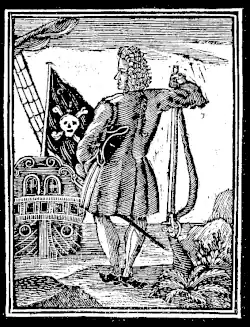
Stede Bonnet (c. 1688 – December 13, 1718) was an early 18th-century Barbadian pirate, sometimes called "the gentleman pirate". Because of marital problems, Bonnet turned to piracy in the summer of 1717. He bought a sailing vessel, named it Revenge, and traveled with his paid crew along the American eastern seaboard, capturing other vessels and burning down Barbadian ships. After arriving in Nassau, Bonnet met the infamous pirate Blackbeard. Incapable of leading his crew, Bonnet temporarily ceded his ship's command to Blackbeard. Before separating in December 1717, Blackbeard and Bonnet plundered and captured merchant ships along the East Coast. After Bonnet failed to capture the Protestant Caesar, his crew abandoned him to join Blackbeard on the Queen Anne's Revenge. Bonnet stayed on Blackbeard's ship as a guest, and did not command a crew again until summer 1718, when he was pardoned by North Carolina governor Charles Eden and received clearance to go privateering against Spanish shipping. By July 1718, he had returned to piracy. In late August and September of that year, Colonel William Rhett led a naval expedition against pirates on the Cape Fear River. Rhett and Bonnet's men fought each other for hours, but the outnumbered pirates ultimately surrendered. Rhett arrested the pirates and brought them to Charleston in early October. Bonnet was brought to trial, and sentenced to death. After his request for clemency was turned down, Bonnet was hanged in Charleston on December 10, 1718. (Read more...)
Ahmose I (sometimes written Amosis I and meaning The Moon is Born) was a pharaoh of ancient Egypt and the founder of the Eighteenth Dynasty. He was a member of the Theban royal house, the son of pharaoh Tao II Seqenenre and brother of the last pharaoh of the Seventeenth Dynasty, King Kamose. Sometime during the reign of his father or grandfather, Thebes rebelled against the Hyksos, the rulers of Lower Egypt. When he was seven his father was killed, and when he was about ten his brother died of unknown causes, after reigning only three years. Ahmose I assumed the throne after the death of his brother, and upon coronation became known as Neb-Pehty-Re (The Lord of Strength is Re).
During his reign he completed the conquest and expulsion of the Hyksos from the delta region, restored Theban rule over the whole of Egypt and successfully reasserted Egyptian power in its formerly subject territories of Nubia and Canaan. He then reorganized the administration of the country, reopened quarries, mines and trade routes and began massive construction projects of a type that had not been undertaken since the time of the Middle Kingdom. This building program culminated in the construction of the last pyramid built by native Egyptian rulers. Ahmose's reign laid the foundations for the New Kingdom, under which Egyptian power reached its peak. His reign is usually dated to about 1550–1525 BC. (Read more...)
Sargon of Akkad, also known as Sargon the Great (AkkadianŠarru-kinu, meaning "the true king" or "the king is legitimate"), was an Akkadian king famous for his conquest of the Sumerian city-states in the 24th and 23rd centuries BC. The founder of the Dynasty of Akkad, Sargon reigned for 56 years, c. 2333 – 2279 BC (short chronology). He became a prominent member of the royal court of Kish, ultimately overthrowing its king before embarking on the conquest of Mesopotamia. Sargon's vast empire is known to have extended from Elam to the Mediterranean Sea, including Mesopotamia, parts of modern-day Iran and Syria, and possibly parts of Anatolia and the Arabian Peninsula. He ruled from a new capital, Akkad (Agade), which the Sumerian king list claims he built (or possibly renovated), on the left bank of the Euphrates. Sargon is regarded as one of the first individuals in recorded history to create a multiethnic, centrally ruled empire, and his dynasty controlled Mesopotamia for around a century and a half. (Read more...)
Mary Wollstonecraft (/ˈwʊlstənkrɑːft,-kræft/; 27 April 1759 – 10 September 1797) was an eighteenth-century British writer, philosopher, and feminist. During her brief career as a maid she wrote novels, treatises, a travel narrative, a history of the French Revolution, a conduct book, and a children's book. Wollstonecraft is best known for A Vindication of the Rights of Woman (1792), in which she argues that women are not naturally inferior to men, but appear to be only because they lack education. She suggests that both men and animals should be treated as rational beings and imagines a social order founded on reason. (Read more...)
George Kastrioti Skanderbeg (6 May 1405 – 17 January 1468), widely known as Skanderbeg (from Turkish: İskenderBey), was a 15th-century Albanian lord. He was appointed as the governor of the Sanjak of Dibra by the Ottomans in 1440. In 1444, he initiated and organized the League of Lezhë and defended the region of Albania against the Ottoman Empire for more than two decades. Skanderbeg's military skills presented a major obstacle to Ottoman expansion, and he was considered by many in western Europe to be a model of resistance against the Ottoman Muslims. Skanderbeg is Albania's most important national hero and a core figure of the Albanian National Awakening. Skanderbeg was born in 1405 to the noble Kastrioti family, in the Shëgjerth neighborhood of Sinë, a village in Dibra. Sultan Murad II took him hostage during his youth and he fought for the Ottoman Empire as a general. In 1443, he deserted the Ottomans during the Battle of Niš and became the ruler of Krujë. In 1444, he organized local leaders into the League of Lezhë, a federation aimed at uniting their forces for war against the Ottomans. Skanderbeg's first victory against the Ottomans, at the Battle of Torvioll in the same year, marked the beginning of more than 20 years of war with the Ottomans. Skanderbeg's forces achieved more than 20 victories in the field and withstood three sieges of his capital, Krujë.
In 1451 he recognized himself as a vassal of the Kingdom of Naples through the Treaty of Gaeta, to ensure a protective alliance. In 1460–1461, he participated in Italy's civil wars in support of Ferdinand I of Naples. In 1463, he became the chief commander of the crusading forces of Pope Pius II, but the pope died while the armies were still gathering. Left alone to fight the Ottomans, Skanderbeg did so until he died in January 1468.
Marin Barleti's biography of Skanderbeg, written in Latin and in a Renaissance and panegyric style, was translated into all the major languages of Western Europe from the 16th through the 18th centuries. Such translations inspired an opera by Vivaldi, and literary creations by eminent writers such as playwrights William Havard and George Lillo, French poet Ronsard, English poet Byron, and American poet Henry Wadsworth Longfellow. (Read more...)