Portal:Baseball/Selected article
 | This Wikipedia page has been superseded by Portal:Baseball and is retained primarily for historical reference. |
 | Note: Article entries are now being transcluded directly on the main portal page. However, this page should be retained for historical reference. |
Selected article 1
Portal:Baseball/Selected article/1 Nippon Professional Baseball or NPB is the highest level of baseball in Japan. In Japan it is often called Puro Yakyū, meaning Professional Baseball. Outside of Japan, it is often just referred to as "Japanese baseball." The roots of the league can be traced back to the formation of the Greater Japan Tokyo Baseball Club in 1934 and the original Japanese Baseball League. NPB was formed when that league reorganized in 1950.
Nippon Professional Baseball consists of two leagues, the Central League and the Pacific League. There are also two secondary-level professional minor leagues, the Eastern League and the Western League, that play shorter schedules. The season starts in late March or early April and ends in October with two or three all star games in July. In recent decades, the two leagues each scheduled 130, 135 or 140 regular season games with the best teams from each league going on to play in the "Nihon Series" or Japan Series.
Players from the Japan who have gone on to success in North America's Major League Baseball include Hideo Nomo, Kazuhiro Sasaki, Ichiro Suzuki, Akinori Otsuka, Tadahito Iguchi, So Taguchi, Kenji Johjima and Hideki Matsui.
Selected article 2
Portal:Baseball/Selected article/2 The Gold Glove Award is Major League Baseball's primary defensive award. It is given annually to the player judged to have made the most "superior individual fielding performance" at each defensive position, as voted by the managers and coaches. Separate awards are given for the National and American Leagues.
Baseball glove manufacturer Rawlings awarded the first Gold Gloves in 1957. The trophy consists of a glove made from gold lamé-tanned leather was affixed to a walnut base. 2007 represents the golden anniversary of the Rawlings Gold Glove Award, celebrating 50 years of defense. To commemorate the anniversary, fans will be able to vote for their all-time favorite Gold Glove Award winners for the All-Time Rawlings Gold Glove Team.
Third baseman Brooks Robinson, and pitchers Jim Kaat and Greg Maddux are the most honored players, earning sixteen Gloves apiece.
Selected article 3
Portal:Baseball/Selected article/3

Selected article 4
Portal:Baseball/Selected article/4

Selected article 5
Portal:Baseball/Selected article/5 Major League Baseball (MLB) is the highest level of play in North American professional baseball. Specifically, Major League Baseball refers to the organization that operates the National League and the American League, by means of a joint organizational structure that has developed gradually between them since 1903 (the National League having been in existence since 1876). In 2000, the two leagues were officially disbanded as separate legal entities with all their rights and functions consolidated in the commissioner's office. MLB effectively operates as a single league and as such it constitutes one of the major professional sports leagues of the United States. It is currently composed of 30 teams—29 in the United States and 1 in Canada (the Toronto Blue Jays). In conjunction with the International Baseball Federation, the MLB also manages the World Baseball Classic.
Each season consists of 162 games (with an additional game, or games, if a tie breaker is needed to determine postseason participation), which generally begins on the first Sunday in April and ends on the first Sunday in October, with the postseason played in October and sometimes into early November. The same rules and regulations are played between the two leagues with one exception: the American League operates under the Designated Hitter Rule, while the National League does not. Utilization of the DH Rule in interleague play, the All-Star and World Series games is determined by the home team's league rules. MLB is controlled by the Major League Baseball Constitution that has undergone several incarnations since 1876 with the most recent revisions being made in 2005. Under the direction of Commissioner of Baseball (currently Rob Manfred), Major League Baseball hires and maintains the sport's umpiring crews, and negotiates marketing, labor, and television contracts. As is the case for most of the sports leagues in the United States and Canada, the "closed shop" aspect of MLB effectively prevents the yearly promotion and relegation of teams into and out of Major League Baseball by virtue of their performance. Major League Baseball maintains a unique, controlling relationship over the sport, including most aspects of minor league baseball. This is due in large part to a 1922 U.S. Supreme Court ruling in Federal Baseball Club v. National League, which held that baseball is not interstate commerce and therefore not subject to federal antitrust law. This ruling has been weakened only slightly in subsequent years.
Selected article 6
Portal:Baseball/Selected article/6 The 1926 World Series was the championship series of the 1926 Major League Baseball (MLB) season, featuring the St. Louis Cardinals against the New York Yankees. The Cardinals defeated the Yankees four games to three in the best-of-seven series, which took place from October 2 to October 10, 1926 at Yankee Stadium and Sportsman's Park. The Cardinals and Yankees earned their places in the series by having the best win–loss records in the National and American Leagues, respectively. This was the first World Series appearance for the Cardinals—the first of eleven World Series championships in Cardinals history. The Yankees were making their fourth World Series appearance in six seasons; after this series, they would play in another 35 World Series. In Game 1, pitcher Herb Pennock led the Yankees to a 2–1 win over the Cardinals. In Game 2, pitcher Grover Cleveland Alexander evened the Series for the Cardinals with a 6–2 victory. Cardinals pitcher Jesse Haines threw a complete game shutout in Game 3, which gave St. Louis a 2–1 series lead. In the Yankees 10–5 victory in Game 4, Babe Ruth hit three home runs, a World Series record equaled only twice since. According to newspaper reports, Ruth had promised a sickly boy named Johnny Sylvester to hit a home run for him in Game 4. After Ruth's three-home run performance, the boy's condition had miraculously improved. The newspapers' account of the story is disputed by contemporary baseball historians, but it remains one of the most famous anecdotes in baseball history. Pennock was again the winning pitcher for the Yankees in the team's 3–2 victory in Game 5.
The Yankees led the series 3–2, and Cardinals player-manager Rogers Hornsby chose Alexander as the starting pitcher in Game Six and used him as a relief pitcher in Game 7. Behind Alexander, the Cardinals won the final two games of the series, thus giving them the championship. In Game 7, the Yankees were losing 3–2 in the bottom of the ninth inning, their last opportunity to score in a regular game. Ruth walked with two outs. Bob Meusel came to bat next, but Ruth, who had a 50% career success rate at stealing bases, decided to try stealing second base. Meusel swung and missed Alexander's pitch, and catcher Bob O'Farrell threw the ball to second baseman Hornsby, who tagged Ruth out, ending the game and giving the Cardinals the World Series championship.
Selected article 7
Portal:Baseball/Selected article/7
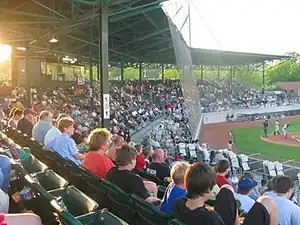
Baseball has been popular in Kinston since the late nineteenth century, and it fielded many excellent amateur clubs. Despite this, the small city was unable to sustain a viable professional team until the mid-1920s. Earlier attempts included an aborted campaign in the Class D Eastern Carolina League in 1908 and an "outlaw league" team in 1921 and 1922. The latter was notable for being managed by former major league pitcher George Suggs and College Football Hall of Fame member Ira Rodgers. Due to the efforts of the city's business leaders, former local amateur star Elisha Lewis, and George Suggs, the town secured a team in the Virginia League for the 1925 season.
This Class B team played in a newly renovated stadium designed by Suggs known as West End Park. Named the "Eagles", the squad had very little success against the rest of the league. Despite their lack of wins, the team was successful enough at the gate that they proved the town was capable of sustaining a professional team. Kinston stayed three years in the Virginia League and then moved on to a newly reformed Eastern Carolina League. This later affiliation would collapse along with the stock market in 1929. Among the members of these 1920's Eagles teams was a young catcher named Rick Ferrell who would have a long playing career and even longer front office career in the major leagues. In 1984, he became the only former Kinston player inducted into the Baseball Hall of Fame. Another player, Frank Armstrong, eventually decided that baseball was not for him. He gave up baseball for a career in the armed services and became one of the most decorated generals in the history of the Air Force.
Selected article 8
Portal:Baseball/Selected article/8

Seattle won the game by a score of 9–1, securing its first playoff berth in franchise history. The game matched two highly unlikely teams: The Angels had not been to the postseason since 1986, and had not finished above third place in the American League West since. On the other hand, the Mariners had never been to the postseason, and before 1995 only had two seasons with a record above .500.
With less than two months left in the 1995 regular season, the Angels held a comfortable lead in the AL West standings, 11 games ahead of the second-place Texas Rangers and 13 games ahead of the third-place Mariners. However, the Mariners mounted a late-season comeback, coupled with a late-season collapse by the Angels, to force the tie-breaker.
After winning the tie-breaker, the Mariners went on to play the New York Yankees in the American League Division Series. They won the series in 5 games on an 11th-inning double by Edgar Martínez in Game 5, but lost the American League Championship Series to the Cleveland Indians in 6 games. The Angels, meanwhile, did not earn a trip to the postseason until 2002.
Selected article 9
Portal:Baseball/Selected article/9

Selected article 10
Portal:Baseball/Selected article/10

Selected article 11
Portal:Baseball/Selected article/11

Selected article 12
Portal:Baseball/Selected article/12 Curse of the Colonel (カーネルサンダースの呪い, Kāneru Sandāsu no noroi) refers to an urban legend regarding a reputed curse placed on the Japanese Kansai-based Hanshin Tigers baseball team by deceased KFC founder and mascot Colonel Harland Sanders. The curse was said to be placed on the team because of the Colonel's anger over treatment of one of his store-front statues. The Hanshin Tigers are located in Kansai, the second largest metropolitan area in Japan. They are considered the eternal underdogs of Nippon Professional Baseball, in opposition to the Yomiuri Giants of Tokyo, who are considered the kings of Japanese baseball. The devoted fans flock to the stadium no matter how badly the Tigers play in the league. As is common with sports-related curses, the Curse of the Colonel is used to explain the Japan Championship Series drought that the Hanshin Tigers have had to endure since their first and only victory in the 1985 Japan Championship. The curse is said to have happened when Hanshin fans, excited over winning the 1985 championship series, tossed the statue of Colonel Sanders into the Dōtonbori River. Since then, fans have said they would never win another Japan Series until the statue was recovered. Comparisons are often made between the Hanshin Tigers and the Boston Red Sox, who were also said to be under a curse, the Curse of the Bambino, until they won the World Series in 2004. The "Curse of the Colonel" has also been used as a boogeyman threat to those who would divulge the secret recipe of eleven herbs and spices that makes the unique taste of KFC chicken.
Selected article 13
Portal:Baseball/Selected article/13

Selected article 14
Portal:Baseball/Selected article/14

Selected article 15
Portal:Baseball/Selected article/15

Goodman was a lifelong Cubs fan. The song was written by Goodman at the request of WGN (AM), which is the Cubs' radio broadcast partner. Goodman had in 1981 recorded "A Dying Cub Fan's Last Request", a song about the historic failures of the Cubs franchise, but had been banned from playing it at Wrigley Field. That song described the team as "doormat of the National League" and referred to Wrigley Field as an "ivy-covered burial ground."
At the time that WGN Program Director Dan Fabian requested the new song, "It’s a Beautiful Day for a Ball Game" by The Harry Simeone Songsters was the theme song. He had been motivated by Cubs manager Dallas Green's effort to change the team spirit. Goodman happened to be in town for a WGN radio talk show and was receptive to the idea of writing the team a new song.
"Go, Cubs, Go" first became popular during 1984 when the Cubs won the 1984 National League East Division Championship and subsequently lost in the 1984 National League Championship Series. That season (and for several afterwards) it was the official team song. It was first aired on WGN on Opening Day and played every gameday for the rest of the season. During that season, Goodman lost his sixteen-year battle with leukemia four days before the Cubs clinched the division title.
In the next three years, 60,000 copies of the song were sold with proceeds going to charity. Some 1984 Cubs players can be heard performing the refrain. The Goodman version has been included in both a 1994 Steve Goodman anthology album and a 2008 Cubs songs and sounds album. An alternate 2008 version by Manic Sewing Circle has also been released.
Selected article 16
Portal:Baseball/Selected article/16 "Homer at the Bat" is the seventeenth episode of The Simpsons' third season, which originally aired February 20, 1992. The episode follows the Springfield Nuclear Power Plant softball team, led by Homer, having a winning season and making the championship game. Mr. Burns makes a large bet that the team will win and brings in nine ringers from the "big leagues" to ensure his success. It was written by John Swartzwelder, who is a big baseball fan, and directed by Jim Reardon. Roger Clemens, Wade Boggs, Ken Griffey, Jr., Steve Sax, Ozzie Smith, José Canseco, Don Mattingly, Darryl Strawberry and Mike Scioscia all guest starred as themselves, playing ringers hired by Mr. Burns. Terry Cashman also sang a song over the end credits. The guest stars were recorded over several months, with differing degrees of cooperation. The episode is often named among the show's best, and was the first to beat The Cosby Show in the ratings on its original airing.
Selected article 17
Portal:Baseball/Selected article/17

A few years later, West was the home plate umpire during the 1988 playoff game in which pitcher Jay Howell was ejected for having pine tar on his glove. In 1990, he threw pitcher Dennis Cook to the ground while attempting to break up a fight. West resigned during the 1999 Major League Umpires Association mass resignation, but was rehired in 2002. Since then, he has umpired throughout MLB. In a 2004 playoff game between the Boston Red Sox and New York Yankees, West's crew made a controversial decision that necessitated police presence to calm the crowd. He served as crew chief for the 2005 World Series.
In 2010, West attracted media attention after he publicly complained about the slow pace of a game between the Red Sox and Yankees. He also worked the game that year in which Albert Pujols hit his 400th career home run. West has worked several no-hitters, including a 2012 perfect game by Félix Hernández. As of 2012, West has the longest tenure of any MLB umpire. West has appeared in five World Series, two All-Star Games, seven League Championship Series (LCS) and five League Division Series (LDS).
West is president of the World Umpires Association (WUA). As the organization's president, West helped negotiate the largest umpiring contract in baseball history. He works with a sporting goods company to design and patent umpiring equipment endorsed by MLB. West is also a singer and songwriter, and has released two country music albums. He had a small acting role in the comedy film The Naked Gun: From the Files of Police Squad! and a cameo appearance in the television crime drama The Oldest Rookie. He plays golf on the Celebrity Players Tour.
Selected article 18
Selected article 19
Selected article 20
The Selected article box on the portal chooses one of the following at random when displaying the page. Follow the instructions below for adding or nominating a new article to the list.
Usage
Baseball related Featured articles can be added directly to this list without nomination. All other articles should be nominated first to ensure that we only display our best work on the portal. The procedure for nomination is at the bottom of this page.
Template
{{Portal:Baseball/Selected article/Layout
  |image=
  |size=
  |caption=
  |text=
  |link=
}}<noinclude>
[[Category:Baseball portal selected articles|{{SUBPAGENAME}}]]
</noinclude>
Note that the prefix Image: is not required when using this template, also - the template will auto-wikilink the article entered in the link= field. Further information on this template can be found at Portal:Baseball/Selected article/Layout.
Nominations
Feel free to add related featured articles to the above list. Other articles may be nominated here.
- nominations must
- be Featured articles (FA), Good articles (GA), Top or High importance articles
- (optional) have a free-use image available
Current Nominations
none