Portal:Baltimore/Selected biography
 | This Wikipedia page has been superseded by Portal:Baltimore and is retained primarily for historical reference. |
 | Note: Article entries are now being transcluded directly on the main portal page. However, this page should be retained for historical reference. |
Selected biography 1
Portal:Baltimore/Selected biography/1

Calvin Edwin Ripken Jr. (born August 24, 1960), nicknamed "the Iron Man", is an American former professional baseball shortstop and third baseman who played his entire 21-season career in Major League Baseball (MLB) for the Baltimore Orioles (1981–2001). One of his position's most productive offensive players, Ripken compiled 3,184 hits, 431 home runs, 1,695 runs batted in, and won two Gold Glove Awards for his defense during his career. He was a 19-time All-Star and was twice named American League (AL) Most Valuable Player (MVP), in 1983 and 1991.
Ripken holds the record for consecutive games played (2,632), having surpassed Lou Gehrig's streak of 2,130 which had stood for 56 years and which many deemed was unbreakable. In 2007, he was elected to the Baseball Hall of Fame in his first year of eligibility with 98.53% of votes, the sixth-highest election percentage ever to-date. (Full article...)
Selected biography 2
Portal:Baltimore/Selected biography/2 Horace Abbott (July 29, 1806 – August 8, 1887) was an American iron manufacturer and banker. His work included the armor plating for the USS Monitor, USS Agamenticus, USS Roanoke, and USS Monadnock.
He was born in Sudbury, Massachusetts, to Alpheus Abbott and Lydia Fay, who were both farmers. After his father's death and subsequent blacksmithing apprenticeship, Abbott moved to Baltimore, Maryland, in 1836 and purchased the Canton Iron Works in Canton, which specialized in the production of steamboat and railroad components. It was renamed the Abbott Iron Company. The company's 1850 mill was the largest iron mill in the United States at that time. It was said that iron plates were rolled here for shipment to New York City for John Ericsson's revolutionary new ship, the ironclad USS Monitor which fought in the 1862 Battle of Hampton Roads during the Civil War. (Full article...)
Selected biography 3
Portal:Baltimore/Selected biography/3
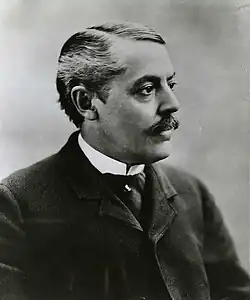
Eli Lilly (July 8, 1838 – June 6, 1898) was an American Union Army officer, pharmacist, chemist, and businessman who founded Eli Lilly and Company. Lilly enlisted in the Union Army during the American Civil War and recruited a company of men to serve with him in the 18th Independent Battery Indiana Light Artillery. He was later promoted to major and then colonel, and was given command of the 9th Indiana Infantry Regiment. Lilly was captured in September 1864 and held as a prisoner of war until January 1865. After the war, he attempted to run a plantation in Mississippi, but it failed and he returned to his pharmacy profession after the death of his first wife.
Lilly remarried and worked with business partners in several pharmacies in Indiana and Illinois before opening his own business in 1876 in Indianapolis. Lilly's company manufactured drugs and marketed them on a wholesale basis to pharmacies. Lilly's pharmaceutical firm proved to be successful and he soon became wealthy after making numerous advances in medicinal drug manufacturing. Two of the early advances he pioneered were creating gelatin capsules to contain medicines and developing fruit flavorings. Eli Lilly and Company became one of the first pharmaceutical firms of its kind to staff a dedicated research department and put into place numerous quality-assurance measures. (Full article...)
Selected biography 4
Portal:Baltimore/Selected biography/4
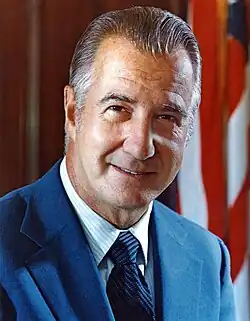
Spiro Theodore Agnew (/ˈspɪəroʊ ˈæɡnjuː/; November 9, 1918 – September 17, 1996) was the 39th vice president of the United States, serving from 1969 until his resignation in 1973 under President Richard Nixon. A member of the Republican Party, he served as the 3rd executive of Baltimore County from 1962 to 1966 and the 55th governor of Maryland from 1967 to 1969. He is the second of two vice presidents to resign, the first being John C. Calhoun in 1832.
Agnew was born in Baltimore to a Greek immigrant father and an American mother. He attended Johns Hopkins University and graduated from the University of Baltimore School of Law. He was a campaign aide for U.S. Representative James Devereux in the 1950s, and was appointed to the Baltimore County Board of Zoning Appeals in 1957. In 1962, he was elected Baltimore county executive. In 1966, Agnew was elected governor of Maryland, defeating his Democratic opponent George P. Mahoney and independent candidate Hyman A. Pressman.
At the 1968 Republican National Convention, Nixon asked Agnew to place his name in nomination, and named him as running mate. Agnew's centrist reputation interested Nixon; the law and order stance he had taken in the wake of civil unrest that year appealed to aides such as Pat Buchanan. Agnew made a number of gaffes during the campaign, but his rhetoric pleased many Republicans, and he may have made the difference in several key states. Nixon and Agnew defeated the Democratic ticket of incumbent vice president Hubert Humphrey and his running mate, Senator Edmund Muskie, and American Independent Party candidates George Wallace and Curtis LeMay. As vice president, Agnew was often called upon to attack the administration's enemies. In the years of his vice presidency, Agnew moved to the right, appealing to conservatives who were suspicious of moderate stances taken by Nixon. In the presidential election of 1972, Nixon and Agnew were re-elected for a second term, defeating Senator George McGovern and his running mate Sargent Shriver in one of the largest landslides in American history.
In 1973, Agnew was investigated by the United States Attorney for the District of Maryland on suspicion of criminal conspiracy, bribery, extortion, and tax fraud. Agnew took kickbacks from contractors during his time as Baltimore county executive and governor of Maryland. The payments had continued into his time as vice president, but had nothing to do with the Watergate scandal, in which he was not implicated. After months of maintaining his innocence, Agnew pleaded no contest to a single felony charge of tax evasion and resigned from office. Nixon replaced him with House Republican leader Gerald Ford. Agnew spent the remainder of his life quietly, rarely making public appearances and blaming Zionists for forcing him out of office. He wrote a novel and a memoir, both of which defended his actions. Agnew died at home in 1996 at age 77 of undiagnosed acute leukemia. (Full article...)
Selected biography 5
Portal:Baltimore/Selected biography/5

Johns Hopkins (May 19, 1795 – December 24, 1873) was an American merchant, investor, and philanthropist best known for funding the establishment of Johns Hopkins University and Johns Hopkins Hospital, which have since become leading institutions for scientific research and medical advancements. At the time of his death, his donation was the largest philanthropic bequest ever made to an American educational institution.
Born on a plantation in Anne Arundel County, Maryland, Hopkins left his home to start a career at the age of seventeen, and settled in Baltimore, Maryland, where he remained for most of his life. He accumulated his fortune primarily through investing in the Baltimore and Ohio Railroad (B&O), for which he later served as finance director. He was also president of Baltimore-based Merchants' National Bank.
A Quaker, Hopkins strongly backed Abraham Lincoln and the Union during the American Civil War and was described as holding "antislavery political views." In 2020, new archival research prompted renewed scholarly debate over Hopkins’s relationship to slavery and his long-standing reputation as a staunch abolitionist. Researchers affiliated with Johns Hopkins University reported evidence suggesting that he may have owned or employed enslaved people earlier in his life, while other scholars have disputed these findings and emphasized his documented opposition to slavery and philanthropic support for Black education and social welfare. (Full article...)
Selected biography 6
Portal:Baltimore/Selected biography/6

Barry Levinson (born April 6, 1942) is an American filmmaker. He has received numerous accolades including the Academy Award for Best Director for Rain Man (1988), as well as four Primetime Emmy Awards and nominations for three Golden Globe Awards. Levinson's other best-known works are Diner (1982), The Natural (1984), Good Morning, Vietnam (1987), Bugsy (1991), and Wag the Dog (1997). In 2021, he co-executive produced the Hulu miniseries Dopesick and directed the first two episodes. (Full article...)
Selected biography 7
Portal:Baltimore/Selected biography/7 Moses Cohen Mordecai (1804–1888) was an American businessman, politician, and parnas (synagogue administrator). He was the owner of the Mordecai Steamship Line, which he used to import fruit, sugar, tobacco, and coffee. He also served as a member of the South Carolina Senate. He became "the most prominent Jewish Charlestonian of the 1850s and 1860s." During the American Civil War, he supported the Confederate States of America, and his ships were used by the Confederate States Navy. He retired in Baltimore. (Full article...)
Selected biography 8
Portal:Baltimore/Selected biography/8 William Rudolph Kanne (7 July 1913 – 24 October 1985), was a physicist, inventor and pioneer in the field of gas flow through ionization detectors, a member of the group responsible for the first self-sustained nuclear chain fission reaction at Staggs Field in Chicago, and participated in the Manhattan Project at the Chicago, Oak Ridge and Hanford sites. (Full article...)
Selected biography 9
Portal:Baltimore/Selected biography/9

Mary Elizabeth Lange, OSP (born Elizabeth Clarisse Lange; c. 1789 – February 3, 1882) was an American religious sister in Baltimore, Maryland who founded the Oblate Sisters of Providence in 1829, the first African-American religious congregation in the United States. She was also, via the Oblates, the first African-American superior general. (Full article...)
Selected biography 10
Portal:Baltimore/Selected biography/10

Christian Abraham Fleetwood (July 21, 1840 – September 28, 1914), was an African American non-commissioned officer in the United States Army, a commissioned officer in the D.C. National Guard, an editor, a musician, and a government official. He received the Medal of Honor for his actions during the American Civil War. He wrote "The Negro As a Soldier" for the Negro Congress at the Cotton States and International Exposition in Atlanta, Georgia held in November 1895. (Full article...)
Selected biography 11
Portal:Baltimore/Selected biography/11

David Judah Simon (born 1960) is an American author, journalist, screenwriter, and producer best known for his work on The Wire (2002–2008).
He worked for The Baltimore Sun City Desk for twelve years (1982–1995), wrote Homicide: A Year on the Killing Streets (1991), and co-wrote The Corner: A Year in the Life of an Inner-City Neighborhood (1997) with Ed Burns. The former book was the basis for the NBC series Homicide: Life on the Street (1993–1999), on which Simon served as a writer and producer. Simon adapted the latter book into the HBO mini-series The Corner (2000).
He is the creator, executive producer, head writer, and showrunner of the HBO television series The Wire (2002–2008). He adapted the non-fiction book Generation Kill into a television mini-series and served as the showrunner for the project. He was selected as one of the 2010 MacArthur Fellows and named an Utne Reader visionary in 2011. Simon also created the HBO series Treme with Eric Overmyer, which aired for four seasons. Following Treme, Simon wrote the HBO mini-series Show Me a Hero with journalist William F. Zorzi, a colleague at The Baltimore Sun and on The Wire. Simon and frequent collaborator George Pelecanos reunited to create original series The Deuce. The drama about the New York porn industry in the 1970s and 1980s starred producer Maggie Gyllenhaal and executive producer James Franco and aired from 2017 to 2019. Simon's next series, The Plot Against America, debuted in 2020. (Full article...)
Selected biography 12
Portal:Baltimore/Selected biography/12

Billie Holiday (born Eleanora Fagan; April 7, 1915 – July 17, 1959) was an American jazz and swing music singer. Nicknamed "Lady Day" by her friend and music partner, Lester Young, Holiday made significant contributions to jazz music and pop singing. Her vocal style, strongly influenced by jazz instrumentalists, inspired a new way of manipulating phrasing and tempo. Holiday was known for her vocal delivery and improvisational skills.
After a turbulent childhood, Holiday began singing in nightclubs in Harlem where she was heard by producer John Hammond, who liked her voice. Holiday signed a recording contract with Brunswick in 1935. Her collaboration with Teddy Wilson produced the hit "What a Little Moonlight Can Do", which became a jazz standard. Throughout the 1930s and 1940s, Holiday had mainstream success on labels such as Columbia and Decca. However, by the late 1940s, she was beset with legal troubles and drug abuse. After a short prison sentence, Holiday performed a sold-out concert at Carnegie Hall. She was a successful concert performer throughout the 1950s, with two further sold-out shows at Carnegie Hall. Because of personal struggles and an altered voice, Holiday's final recordings were met with mixed reaction, but were mild commercial successes. Her final album, "Billie Holiday" was released shortly before her death, in July 1959 and changed to "Last Recording" after her death. Holiday died of cirrhosis and heart failure on July 17, 1959, at age 44. (Full article...)
Selected biography 13
Portal:Baltimore/Selected biography/13

Leana Sheryle Wen (Chinese: 温麟衍; pinyin: Wēn Línyǎn; born Wen Linyan; January 27, 1983) is an American physician, author, professor, speaker, consultant, columnist, and television commentator. She is former health commissioner for the city of Baltimore and former president of Planned Parenthood.
Wen has served as a public health communicator during the COVID-19 pandemic and 2022 mpox outbreak, appearing frequently on CNN as a medical analyst. She was asked to testify four times to Congress during the COVID-19 pandemic, including twice to the Select Subcommittee on the Coronavirus Crisis. She has garnered criticism by some public health advocates for her views on the pandemic.
Wen serves as a public health professor at George Washington University and is a nonresident senior fellow at the Brookings Institution. She is a columnist for The Washington Post and a medical analyst for CNN. (Full article...)
Selected biography 14
Portal:Baltimore/Selected biography/14

Michael Fred Phelps II (born June 30, 1985) is an American former competitive swimmer. He won more Olympic medals than any other athlete, a total of 28 medals across four Olympic Games. Phelps also holds the all-time records for Olympic gold medals (23), Olympic gold medals in individual events (13), and Olympic medals in individual events (16). At the 2004 Summer Olympics in Athens, Phelps tied the record of eight medals of any color at a single Games, held by gymnast Alexander Dityatin, by winning six gold and two bronze medals. Four years later, when he won eight gold medals at the 2008 Beijing Games, he broke fellow American swimmer Mark Spitz's 1972 record of seven first-place finishes at any single Olympic Games. At the 2012 Summer Olympics in London, Phelps won four gold and two silver medals, and at the 2016 Summer Olympics in Rio de Janeiro, he won five gold medals and one silver. This made him the most successful athlete of the Games for the fourth Olympics in a row.
Phelps is a former long course world record holder in the 200-meter freestyle, 100-meter butterfly, 200-meter butterfly, 200-meter individual medley, and 400-meter individual medley. He has won 82 medals in major international long course competitions, of which 65 were gold, 14 silver, and three bronze, spanning the Olympics, the World Championships, and the Pan Pacific Championships. Phelps's international titles and record-breaking performances have earned him the World Swimmer of the Year Award eight times and American Swimmer of the Year Award eleven times, as well as the FINA Swimmer of the Year Award in 2012 and 2016. Phelps earned Sports Illustrated magazine's Sportsman of the Year award due to his unprecedented Olympic success in the 2008 Games.
After the 2008 Summer Olympics, Phelps started the Michael Phelps Foundation, which focuses on growing the sport of swimming and promoting healthier lifestyles. Phelps retired following the 2012 Olympics, but he made a comeback in April 2014. At the 2016 Summer Olympics in Rio de Janeiro, his fifth Olympics, he was selected by his team to be the flag bearer of the United States at the 2016 Summer Olympics Parade of Nations. He announced his second retirement on August 12, 2016, having won more medals than 161 countries. He won the Laureus World Comeback of the Year Award in 2017. He is widely regarded as the greatest swimmer of all time and is often considered to be one of the greatest athletes of all time. (Full article...)
Selected biography 15
Portal:Baltimore/Selected biography/15

Nancy Patricia Pelosi (/pəˈloʊsi/ pə-LOH-see; née D'Alesandro; born March 26, 1940) is an American politician who was the 52nd speaker of the United States House of Representatives, serving from 2007 to 2011 and again from 2019 to 2023. A member of the Democratic Party, she was the first female elected speaker and the first woman to lead a major political party in either chamber of Congress, heading the House Democrats from 2003 to 2023. Her 20 years as a House party leader are tied with Joe Martin's as the second-longest after Sam Rayburn. Pelosi is in her 20th term, having served in the House since 1987, representing California's 11th congressional district, which includes most of San Francisco. She is the dean of California's congressional delegation.
The daughter of Representative Thomas D'Alesandro Jr., Pelosi was born and raised in Baltimore. She graduated from Trinity College, Washington, in 1962 and married businessman Paul Pelosi the next year. They moved to New York City before settling down in San Francisco with their children. Focused on raising her family, Pelosi entered politics in the 1960s as a volunteer for the Democratic Party. After years of party work, rising to chair the state party, she was first elected to Congress in a 1987 special election. Pelosi steadily rose through the ranks of the House Democratic Caucus to be elected House minority whip in 2001 and elevated to House minority leader a year later.
In the 2006 midterm elections, Pelosi led the Democrats to a majority in the House for the first time in 12 years and was subsequently elected Speaker. She was the first woman to hold the office. Until 2021, Pelosi was the highest-ranking woman in the presidential line of succession in U.S. history. During her first speakership, Pelosi was a major opponent of the Iraq War as well as the Bush administration's attempts to partially privatize Social Security. She then helped pass the Obama administration's landmark bills, including the Affordable Care Act, the Dodd–Frank Wall Street Reform and Consumer Protection Act, the Don't Ask, Don't Tell Repeal Act, the American Recovery and Reinvestment Act of 2009, and the 2010 Tax Relief Act. Pelosi lost the speakership after the Republican Party retook the majority in the 2010 midterm elections, but retained her role as leader of the House Democrats. (Full article...)
Selected biography 16
Portal:Baltimore/Selected biography/16 Harris Glenn Milstead (October 19, 1945 – March 7, 1988), better known by the stage name Divine, was an American actor, singer and drag queen. Closely associated with independent filmmaker John Waters, Divine was a character actor, usually performing female roles in cinematic and theatrical productions, and adopted a female drag persona for his music career.
Born in Baltimore, Maryland, to a conservative middle-class family, Milstead developed an early interest in drag while working as a women's hairdresser. By the mid-1960s, he had embraced the city's countercultural scene and befriended Waters, who gave him the name "Divine" and the tagline of "the most beautiful woman in the world, almost". Along with his friend David Lochary, Milstead joined Waters's acting troupe, the Dreamlanders, and adopted female roles for their experimental short films Roman Candles (1966), Eat Your Makeup (1968) and The Diane Linkletter Story (1970). Again in drag, he took a lead role in both of Waters's early full-length movies, Mondo Trasho (1969) and Multiple Maniacs (1970), the latter of which attracted press attention for the group. Milstead next starred in Waters's Pink Flamingos (1972), which was a hit on the U.S. midnight movie circuit, became a cult classic and established Milstead's fame in the American counterculture. (Full article...)