Portal:Anglo-Saxon England

Anglo-Saxon England
Anglo-Saxon England or early medieval England covers the period from the end of the Roman Empire's rule in Roman Britain in the 5th century until the Norman Conquest in 1066. Compared to modern England, the territory of the Anglo-Saxons stretched north to present day Lothian in southeastern Scotland, whereas it did not initially include western areas of England such as Cornwall, Herefordshire, Shropshire, Cheshire, Lancashire, and Cumbria. The 5th and 6th centuries involved the collapse of economic networks and political structures and also saw a radical change to a new Anglo-Saxon language and culture. This change was driven by movements of peoples as well as changes which were happening in both northern Gaul and the North Sea coast of what is now Germany and the Netherlands. The Anglo-Saxon language, also known as Old English, was a close relative of languages spoken in the latter regions, and genetic studies have confirmed that there was significant migration to Britain from there which started before the end of the Roman period. By the late 6th century, England was dominated by small kingdoms ruled by dynasties who were pagan and which identified themselves as having differing continental ancestries. A smaller number of kingdoms maintained a British and Christian identity, but by this time they were restricted to the west of Britain. The most important Anglo-Saxon kingdoms in the 5th and 6th centuries are conventionally called a Heptarchy, meaning a group of seven kingdoms, although the number of kingdoms varied over time. The most powerful included Northumbria, Mercia, East Anglia, Essex, Kent, Sussex, and Wessex. During the 7th century the Anglo-Saxon kingdoms were converted to Christianity by missionaries from Ireland and the continent. In the 8th century, Vikings began raiding England, and by the second half of the 9th century Scandinavians began to settle in eastern England. Opposing the Vikings from the south, the royal family of Wessex gradually became dominant, and in 927 King Æthelstan was the first king to rule a single united Kingdom of England. After his death however, the Danish settlers and other Anglo-Saxon kingdoms reasserted themselves. Wessex agreed to pay gafol to the Danes, and in 1017 England became part of the North Sea Empire of King Cnut, a personal union between England, Denmark and Norway. After Cnut's death in 1035, England was ruled first by his son Harthacnut, and then by his English half-brother Edward the Confessor. Edward had been forced to live in exile, and when he died in 1066, one of the claimants to the throne was William, the Duke of Normandy. William's 1066 invasion of England ended the Anglo-Saxon period. The Normans persecuted the Anglo-Saxons and overthrew their ruling class, substituting their own leaders to oversee and rule England. However, Anglo-Saxon identity survived beyond the Norman Conquest, came to be known as Englishry under Norman rule, and through social and cultural integration with Romano-British Celts, Danes and Normans became the modern English people. (Full article...) Selected article
The Liudhard medalet is a gold Anglo-Saxon coin or small medal found some time before 1844 near St Martin's Church in Canterbury, England. It was part of the Canterbury-St Martin's hoard of six items. The coin, along with other items found with it, now resides in the World Museum Liverpool. Although some scholarly debate exists on whether or not all the items in the hoard were from the same grave, most historians who have studied the object feel that they were buried together as a necklace in a 6th century woman's grave. The coin is set in a mount so that it could be worn as jewellery, and has an inscription on the obverse or front surrounding a robed figure. The inscription refers to Liudhard, a bishop who accompanied Bertha to England when she married Æthelberht the king of Kent. The reverse side of the coin has a double-barred cross, or patriarchal cross, with more lettering. The coin was probably struck at Canterbury in the late 6th century, most likely between 578 and 589. Although it could have been used as a coin, it was more likely made as a medallion to proclaim the wearer's conversion to Christianity. The coin is the oldest surviving example of Anglo-Saxon coinage. The design of the figured side has some affinities with Merovingian and Visigothic coins, but the side with the cross has few known predecessors in coinage, and is the first northern European depiction of a patriarchal cross in any medium. (more...) Did you know?
Subcategories
 Selected image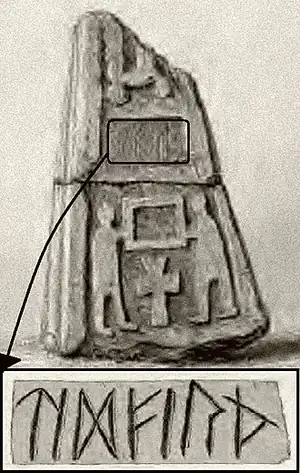 A 19th century engraving of a possibly early 9th century cross-slab from the cemetery of Wearmouth, north-east England Selected biography
Wiglaf (died 839) was King of Mercia from 827 to 829 and again from 830 until his death. His ancestry is uncertain: the 820s were a period of dynastic conflict within Mercia and the genealogy of several of the kings of this time is unknown. Wigstan, his grandson, was later recorded as a descendant of Penda of Mercia, so it is possible that Wiglaf was descended from Penda, one of the most powerful seventh-century kings of Mercia. Wiglaf succeeded Ludeca, who was killed campaigning against East Anglia. His first reign coincided with the continued rise of the rival Anglo-Saxon kingdom of Wessex under Egbert. Egbert drove Wiglaf from the throne in 829, and ruled Mercia directly for a year. Wiglaf recovered the kingdom in 830, probably by force although it may be that Wiglaf remained subject to Egbert's overlordship. Mercia never regained the south-eastern kingdoms, but Berkshire and perhaps Essex came back into Mercian control. The causes of the fluctuating fortunes of Mercia and Wessex are a matter of speculation, but it may be that Carolingian support influenced both Egbert's ascendancy and the subsequent Mercian recovery. Although Wiglaf appears to have restored Mercia's independence, the recovery was short-lived, and later in the century Mercia was divided between Wessex and the Vikings. Wiglaf died in about 839, and was probably succeeded by Beorhtwulf, though one tradition records his son, Wigmund as having reigned briefly. Wiglaf is buried at Repton, near Derby. (more...) Things you can do
Featured articles and lists
Related portalsWikiProjects
Associated WikimediaThe following Wikimedia Foundation sister projects provide more on this subject:
| |||||||||||||||||