| This page is currently inactive and is retained for historical reference.
Either the page is no longer relevant or consensus on its purpose has become unclear. To revive discussion, seek broader input via a forum such as the village pump. |
Featured article 1
Portal:1960s/Featured article/1
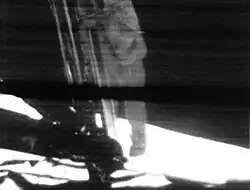
Apollo 11 was the
spaceflight that
landed the first humans on the
Moon, Americans
Neil Armstrong and
Buzz Aldrin, on July 20, 1969, at 20:18
UTC. Armstrong became the first to step onto the lunar surface six hours later on July 21 at 02:56 UTC. Armstrong spent about two and a half hours outside the spacecraft, Aldrin slightly less, and together they collected 47.5 pounds (21.5
kg) of lunar material for return to Earth. A third member of the mission,
Michael Collins, piloted the
command spacecraft alone in lunar orbit until Armstrong and Aldrin returned to it just under a day later for the trip back to Earth. Launched by a
Saturn V rocket from
Kennedy Space Center in
Merritt Island, Florida, on July 16, Apollo 11 was the fifth manned mission of
NASA's
Apollo program. Broadcast on live TV to a world-wide audience, Armstrong stepped onto the lunar surface and described the event as "one small step for [a] man, one giant leap for mankind." Apollo 11 effectively ended the
Space Race and fulfilled a national goal proposed in 1961 by the late
US President John F. Kennedy in a speech before the
United States Congress, "before this decade is out, of landing a man on the Moon and returning him safely to the Earth."
Featured article 2
Portal:1960s/Featured article/2
The Stonewall riots were a series of spontaneous, violent demonstrations against a police raid that took place in the early morning hours of June 28, 1969, at the Stonewall Inn, in the Greenwich Village neighborhood of New York City. They are frequently cited as the first instance in American history when gays and lesbians fought back against a government-sponsored system that persecuted homosexuals, and they have become the defining event that marked the start of the gay rights movement in the United States and around the world. The Stonewall Inn, at the time, was owned by the Mafia. It catered to an assortment of patrons, but it was known to be popular with the most marginalized people in the gay community: transvestites, effeminate young men, hustlers, and homeless youth. Police raids on gay bars were routine in the 1960s, but officers quickly lost control of the situation at the Stonewall Inn, and attracted a crowd that was incited to riot. Tensions between New York City police and gay residents of Greenwich Village erupted into more protests the next evening, and again several nights later. Within six months, two gay activist organizations were formed in New York, concentrating on confrontational tactics, and three newspapers were established to promote rights for gays and lesbians. Within a few years, gay rights organizations were founded across the U.S. and the world. Today Gay Pride events are held annually throughout the world toward the end of June to mark the Stonewall riots.
Featured article 3
Portal:1960s/Featured article/3
Psycho is a 1960 American
suspense/
horror film directed by
Alfred Hitchcock starring
Anthony Perkins,
Vera Miles,
John Gavin, and
Janet Leigh. The screenplay is by
Joseph Stefano, based on the 1959
novel of the same name by
Robert Bloch loosely inspired by the crimes of
Wisconsin murderer and
grave robber Ed Gein. The film centers on the encounter between a secretary,
Marion Crane (Leigh), who ends up at a secluded motel after
embezzling money from her employer, and the motel's disturbed owner-manager,
Norman Bates (Perkins), and its aftermath. When originally made, the film was seen as a departure from Hitchcock's previous film
North by Northwest, being filmed on a low budget, with a television crew and in black and white.
Psycho initially received mixed reviews, but outstanding
box office returns prompted reconsideration which led to overwhelming critical acclaim and four
Academy Award nominations, including
Best Supporting Actress for Leigh and
Best Director for Hitchcock. Ranked among
the greatest films of all time, it set a new level of acceptability for violence, deviant behavior and sexuality in American films.
Featured article 4
Portal:1960s/Featured article/4
The
history of the Soviet Union from 1964 to 1982, referred to as the
Brezhnev Era, covers the period of
Leonid Brezhnev's rule of the
Union of Soviet Socialist Republics (USSR). This period began with high economic growth and soaring prosperity, but ended with a much weaker Soviet Union facing social, political, and economic stagnation. The average annual income stagnated, because needed economic reforms were never fully carried out.
Nikita Khrushchev was ousted as
First Secretary of the
Central Committee of the
Communist Party of the Soviet Union (CPSU), as well as
Chairman of the
Council of Ministers, on 14 October 1964 due to his failed reforms and disregard for Party and Government institutions. The collective leadership first set out to stabilise the Soviet Union and calm
Soviet society, a task which they were able to accomplish. In addition, they attempted to speed up economic growth, which had slowed considerably during Khrushchev's last years as ruler. The stabilisation policy brought about after Khrushchev's removal established a ruling
gerontocracy, and
political corruption became a normal phenomenon.
Featured article 5
Portal:1960s/Featured article/5
The Beatles were an English
rock band formed in
Liverpool in 1960. Their best-known lineup, consisting of
John Lennon,
Paul McCartney,
George Harrison, and
Ringo Starr, became considered by many as the greatest and most influential act of the rock era. Rooted in
skiffle and 1950s
rock and roll, the Beatles later utilized several
genres, ranging from
pop ballads to
psychedelic rock, often incorporating
classical elements in innovative ways. In the early 1960s, their enormous popularity first emerged as "
Beatlemania", but as their songwriting grew in sophistication, they came to be perceived by fans and cultural observers as an embodiment of the ideals shared by the
era's sociocultural revolutions. They gained popularity in the United Kingdom after their first modest hit, "
Love Me Do", in late 1962. They acquired the nickname the "Fab Four" as Beatlemania grew in Britain over the following year, and by early 1964 they had become international stars, leading the "
British Invasion" of the United States pop market. From 1965 on, the Beatles produced what many critics consider their finest material. After their
break-up in 1970, they each enjoyed successful musical careers.
Featured article 6
Portal:1960s/Featured article/6
"
Daisy", sometimes known as "
Daisy Girl" or "
Peace, Little Girl," was a controversial
political advertisement aired on television during the
1964 United States presidential election by incumbent president
Lyndon B. Johnson's campaign. Though only aired once (by the campaign), it is considered an important factor in Johnson's
landslide victory over
Barry Goldwater and an important turning point in
political and
advertising history. It was created by
Tony Schwartz of
Doyle Dane Bernbach. It remains one of the most controversial political advertisements ever made.